


I’m in trouble over Twitter. I responded approvingly to a post (more slapstick than violent, I thought) captioned something like “This is how I deal with a Nazi,” which showed someone wearing swastikas being beaten up.
Now I’m accused by Twitter of “violating our rules against abusive behavior” and the specific detail is Twitter’s “rules around”: and it stops there. I couldn’t get any further explanations. If I’ve been mean, I’d like to know why so I don’t offend again (and it’s not clear to me what the cause of the offense is here).
Here is the actual text of my post: “@conureCC Was this in the US? The Nazis there support Trump. Nice shot from the antifa guy.” I still have my post because it appears in the Twitter message to me. The post I replied to appears to have been deleted, so I can’t verify its content.
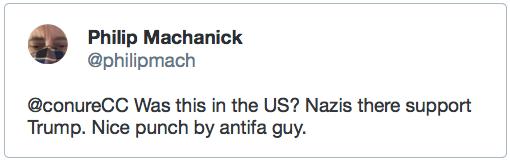
This is interesting because the Donald Trump camp, including Roger Stone, is being welcomed back to Twitter, despite past use of abusive language, including inciting violent insurrection. Trump himself has not used the lifting of his suspension, preferring to stick to his own Truth Social, where he is in charge of what constitutes the truth.
I posted something that could be considered incitement to violence against an anonymous Nazi or Nazis in general, so I am persona non grata, unless I am willing to remove the post myself.
I still don’t know why this is so bad, even if it got to the level of incitement to violence. There are frequent posts about the Russian-Ukrainian war, for example, showing actual violence, and posts from both sides using derogatory language and calling for more death and destruction.
What this overall mix tells me is that far from being a neutral platform that aims to maximize free speech, Elon Musk is pushing it into a safe space for the far right. It’s possible this is all an artifact of their aggressive downsizing and stupid mistakes being made. I have appealed my withdrawal from the platform three times without any clarification of the real reason. I will probably relent and remove it, as there is no evidence that my repeated appeals are being taken seriously.
On the other hand, my rather innocuous blog, Opinions, is blocked on Facebook. If you try to use your “Share to Facebook” link, you get: “Your message could not be sent because it contains content that other people on Facebook have reported as abusive.” If I try to post something like this on Facebook:
My take on whether Ramaphosa was a trap.
https://opinion-nation.blogspot.com/2022/12/was-ramaphosa-set-up
I get:
This URL violates our Community Guidelines on spam:
opinion-nation.blogspot.com
To protect people on Facebook from spam, we don’t allow content that contains such URLs.
I have appealed this many times with no response. What is interesting here is that the reasons for the ban differ. If I try to share from the blog, they tell me that it was reported as abusive. If I try to post to Facebook, it claims that the blog contains spam. These two things are not the same problem.
Spam is unsolicited content, originally email, that advertises a product or service. For a blog to qualify as spam, it must contain irrelevant links or advertisements. Mine contains Google ads, which are a normal occurrence on many sites, ads for my own books, and pointers to other content. None of this would qualify as spam by any reasonable definition.
Is the blog abusive? If you’re a Trump cultist, climate change denier, or hold far-right views, it may seem so. But there is nothing there that cannot appear anywhere else. Well, that was my opinion before I got blocked on Twitter.
The far right (with no hint of irony, given their mindset towards contrary views) strongly advocates “free speech” every time they get shut down. However, opinions from the opposite side are regularly shut down and at least some of this must come from their complaints.
The limits of free speech will always be in dispute, but my experience illustrates that neither Facebook nor Twitter represent ideological consistency. Facebook bans innocuous content because someone has complained and then gets confused about the real reason, indicating sloppy record keeping. Twitter blocks content without a clear reason (at least, that they can provide on appeal).
Are social network providers obligated in any way to their users?
In the US, Section 230 of the Communications Decency Act of 1996 protects service providers from content liability. Section 230(c)(2) specifically protects providers from liability if they moderate content even if they are not required to do so by law.
The main effect of this is to protect service providers; it does not create an obligation to moderate or limit freedom of expression. As soon as the government ventures into the free speech space in the US, the First Amendment would become an issue. A private company is not the government, so it is not regulated by the First Amendment. This is a complex issue and there are no easy solutions.
Social networks are transnational, so US law is not the only factor. In the European Union, the Digital Services Law comes into force in 2024 and regulates what is acceptable speech. With fines of up to 6% of their annual revenue, big players like Twitter, Google and Facebook will be under pressure to comply, which means complying internationally, unless they want a variant of the Great Firewall of China that would segregate the EU from the rest of the world.
The Digital Services Law also requires that decisions be justified, which could help in situations like my run-ins with Facebook and Twitter. None of this is against US law, so the easy option is to comply with the EU and use this as an excuse if someone complains.
If Twitter and Facebook have annoyed me, why am I staying with them? For the same reason that I still sometimes use Microsoft products where there are better alternatives. They are where (almost) everyone else is.
I’m testing a new platform called Post (http://post.news), which is in beta testing and has a limited number of new registrations at this time. It looks good, but there’s a lot more to the old platforms. However, if they bother enough people, other options exist and could take off.
Philip Machanick is an Associate Professor of Computer Science at Rhodes University.


