


Growing up in the shadow of the Federal Law Enforcement Training Center, Joseph Howard dreamed of becoming a special agent. He enlisted in the military after high school, then worked on a contract with the Drug Enforcement Administration and was a police officer in Georgia when he applied for a job with the Border Patrol.
“When I got to the polygraph scene, it blew up in my face,” Howard said. “The first time I took a polygraph, I thought, like any normal person would, any normal American would: Polygraphs are the truth.”
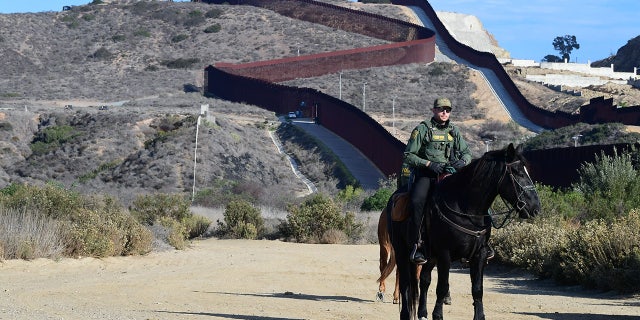
A Border Patrol agent on horseback monitors the area near where the US-Mexico border fence meets the Pacific Ocean on November 7, 2021.
(Frederic J. Brown/AFP via Getty Images)
EXCLUSIVE: AMID BORDER PATROL RECRUITMENT CRISIS, BILL PURPOSES TO DELETE POLYGRAPH REQUIREMENT FOR SOME APPLICANTS
Customs and Border Protection has struggled for years to meet its staffing goals, and the Border Patrol union says the polygraph requirement is eliminating dozens of qualified candidates. Several former CBP applicants, three of whom have other law enforcement experience, shared their experiences with the polygraph with Fox News and said they don’t believe the test should be a deciding factor in employment.
“Do I think the test is reliable? Not at all,” said Howard, who told Fox News that he failed two polygraphs in his quest to join the Secret Service and CBP, but passed one required by the Georgia Bureau of Investigation. “It’s just high-tech voodoo.”
Lie detector tests are generally inadmissible in court cases, and federal law prohibits most private companies from using them to test employees. But taking a polygraph has been mandatory for potential Customs and Border Protection agents over the past decade.
About two-thirds of CBP applicants who took a polygraph failed, The Associated Press reported in 2017. The FBI and Secret Service failure rates were roughly half that, according to the same report.
Neither agency provided Fox News with more recent statistics when asked last month, but the vice president of the National Border Patrol Council said CBP’s failure rate is currently around 50%.
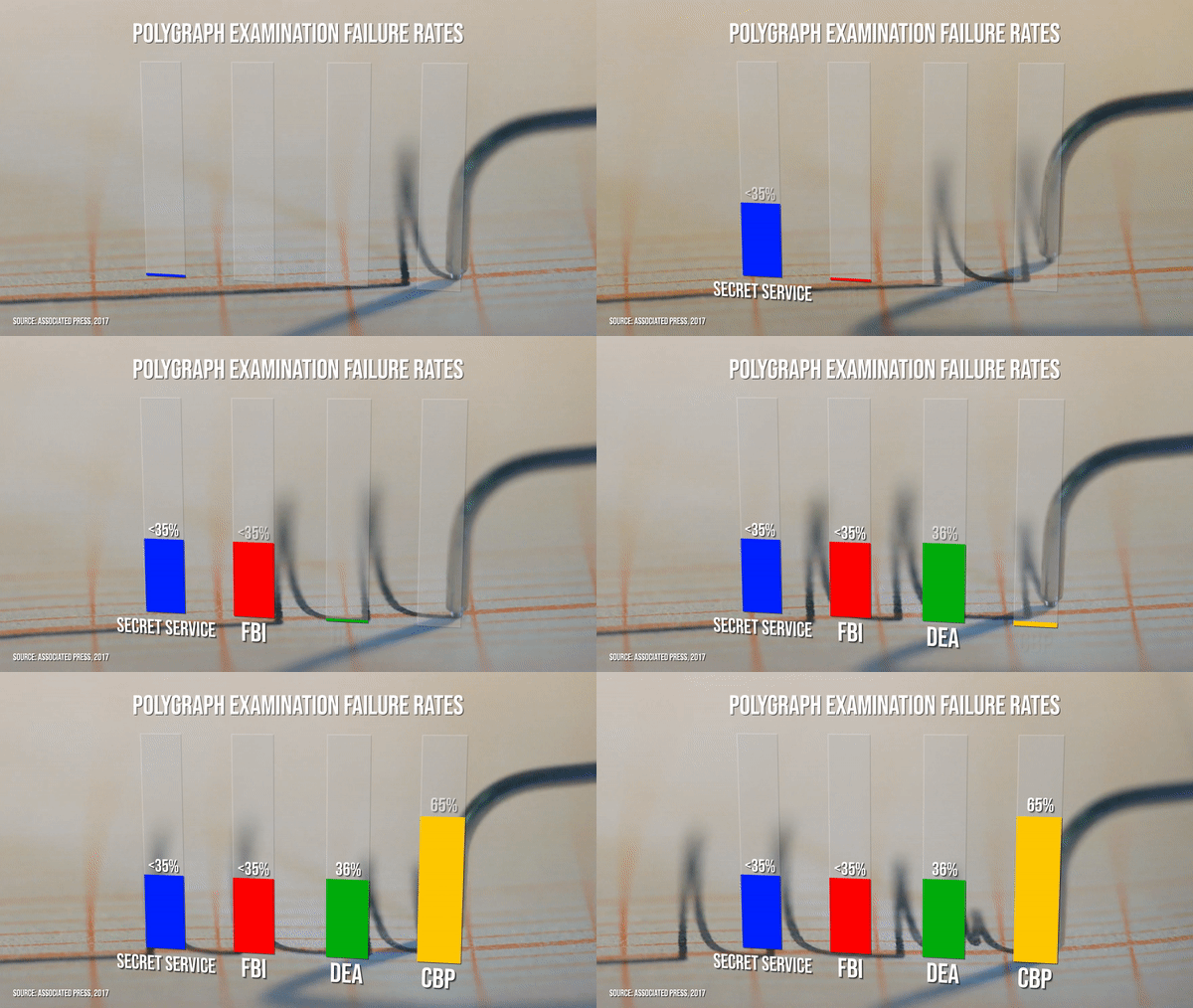
According to a 2017 Associated Press article, 65% of CBP applicants who took a polygraph failed, compared to 36% at the Drug Enforcement Agency and less than 35% at both the US Secret Service. as in the FBI. Neither agency provided updated failure rates when asked by Fox News.
(Ramiro Vargas/Fox News Digital)
‘Look here, mija! What are you thinking?’
A woman who took a polygraph in 2013, shortly after it became mandatory, said her examiner became “aggressive,” accusing her of manipulating her breathing to cheat on the test and asking her if she thought her father, a state trooper retired from Texas, I would be proud. that she was lying.
“That was the worst experience I’ve ever had,” said GA, who wished to be identified only by her initials due to her current job restrictions. “It was just humiliating.”
Throughout the six-hour exam, GA said his examiner seemed “hung up” on the fact that he wasn’t seeing anyone and asked him many pointed questions about whether GA had used drugs, possibly as “sexual favors” for men. .
“Look, mija,” the examiner snapped at one point, surprising GA with his use of the term of endearment in Spanish. “What are you thinking?”
“I remember feeling embarrassed by what I was about to say,” GA said. “But I told him, ‘I’m just praying. I’m trying to get through this process.'”
GA said the examiner responded in a condescending and mocking tone: “Oh, what do you say? ‘My God, help me.'”
At the end of the polygraph, the examiner told him the results were inconclusive, which “meant I pretty much failed,” GA said. He cried on the way home and gave up dreams of joining the police as his father, uncles and brother.
“I couldn’t get over the idea of failing again,” he said. “I couldn’t imagine trying to get in [the Texas Department of Public Safety]where my dad was so outstanding in his department, and then he failed.”
WHY A BORDER PATROL AGENT WHO LEFT THE SERVICE TO TAKE CARE OF HER CHILDREN WAS BLOCKED FROM REHIRING:
WATCH MORE FOX NEWS DIGITAL ORIGINALS HERE
‘You are ready to fail’
KC grew up just four miles from the southern border in Del Rio, Texas, and said she “heard horror stories” about the polygraph before her exam. Other applicants from border cities she knew said the examiners seemed adamant that they were helping Mexican cartels.
“It seems to me that they build on some kind of preconceived notion or try to stereotype you based on your background,” he told Fox News, asking to remain anonymous because he currently works as a police officer in Texas. “You enter the exam and you are ready to fail.”
Now he said he doesn’t understand how the polygraph can completely disqualify Border Patrol applicants.
“It’s disheartening, if anything, to know that Border Patrol needs more bodies and that there’s something that’s unconstitutional in place, preventing people from getting jobs,” he said.
BORDER PROTECTION WARNS TRAVELERS THEY FACE FINES FOR SMUGGLING EGGS INTO US FROM MEXICO AS PRICES SOAR
Wayne Del Grosso, who works at a jail in upstate New York, told Fox News that he submitted to four polygraphs in hopes of joining CBP’s Office of Field Operations, which manages customs enforcement. at hundreds of ports of entry to the United States.
After failing his first polygraph in 2019, he was barred from reapplying for two years. At that point, he tried again, saying a series of inconclusive tests led him to drive to polygraph locations across the state, and even in Connecticut, for three more tests.
“A lot of time and money has gone into even getting to these polygraphs,” Del Grosso said. “It’s just crazy.”

CLICK HERE TO GET THE FOX NEWS APP
The cost of all those polygraphs isn’t limited to applicants: CBP spending on polygraph exams has increased sevenfold since 2014, according to federal contract records.
Del Grosso said he doesn’t think the polygraph should be eliminated entirely, but that it should be used as a starting point for vetting candidates.
“Most people don’t disagree with its use,” he said. “They just don’t agree with the way it’s used and that it’s 100% pass or fail.”
Ramiro Vargas and Matt Leach contributed to the attached video.


