


Almost the first words Robert Devereux says to me are: “I don’t like the word ‘collector’. I don’t like labels. I don’t call myself boss either.”
And yet, he is very much both, regardless of how he describes himself. He has amassed over 1,000 works of art, half of them post-war British, the other 500 or so by artists from Africa or the African diaspora. On October 13, Christie’s will distribute 74 of the African works, with at least 20 per cent of the proceeds going to arts and environmental charities including Gasworks, The Africa Centre, the African Arts Trust (recipient of £3mn from a previous sale from his collection ) and the Lamu Environmental Foundation.
“Philanthropy has always been in my family, and giving back was part of the way I was raised,” he says. “I have a puritanical streak that says that I have been very lucky. All who have been successful have relied on others. You don’t do it on your own.”

‘Head’ (1992) by William Kentridge
We meet in London, where he’s been spending the morning at the William Kentridge show at the Royal Academy. He is direct, kind and close. Tall and lean, dressed casually in jeans and rather trendy sneakers, Devereux looks much younger than his 67 years, with a halo of curly blonde hair and a light beard.
He made his fortune after selling his partnership in the Virgin Group in 1996, where he had headed the entertainment division. “It was a lot of money at the time, but to be honest, now it seems insignificant!” he says. After that, he chaired Soho House for 10 years and started an online search business “long before Google; the idea was right but the execution was totally wrong”, he laughs.
His mid-life crisis in the mid-1990s was “boringly predictable”. She wanted to get away and “had always been fascinated by the great arc of the Indian Ocean from South Africa to the east coast of India. I took my backpack to Heathrow airport and decided to catch the next plane to the area. The first flights were to Durban and Mogadishu. I wasn’t quite sure what the situation was in Mogadishu, so I went to Durban and made my way to Mombasa.
“I fell in love with Africa during that trip. I wanted to invest time and money in the place, and when I go somewhere I always look up the artists and end up buying art.”
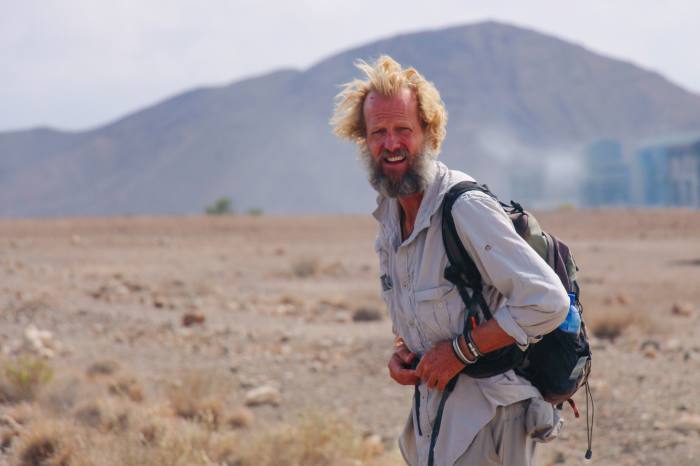
Robert Devereux in his son’s film The Rift’. . .
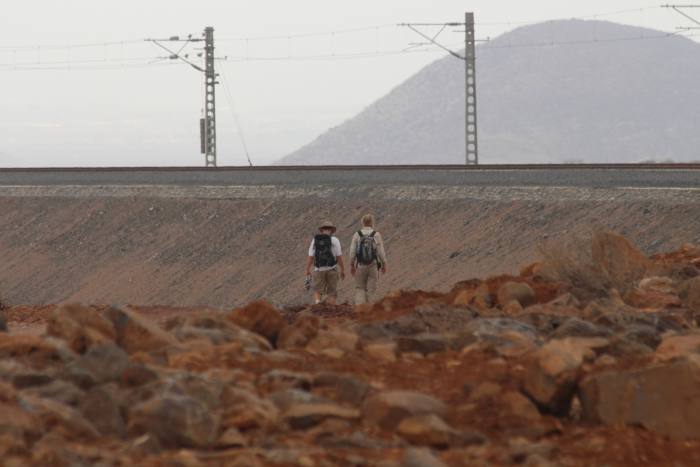
. . . who continues his journey on foot through Africa
I ask him what particularly attracted him to the art of the region. “Part of it was the context, I was there, but I liked the authenticity and the frankness of the art, it was a stark contrast to what was happening in the UK in the 1990s.”
He had already been a collector, since his marriage to British art dealer and businesswoman Vanessa Branson, who had a gallery on Portobello Road in the 1980s. It was then that Devereux bought British art, but also works by South African Kentridge, whom he admires. a lot: “He’s as important an artist as there are,” says Devereux.
His collection is named after the house he bought in 2005 on Lamu Island in northern Kenya, Sina Jina. “I stopped flying five years ago for environmental reasons,” she says. “I’m a bit extreme sometimes. . . He was going to sell the entire collection, since he didn’t see the point if he couldn’t go to Africa. But I realized that I couldn’t bear not to go there, so now I allow myself one trip a year. And I decided to keep part of the collection.”
I’m curious to know more about his extreme, and he thinks for a moment. “Well, I walked 5,600 km across Africa, from Mozambique to Djibouti, along the Rift Valley. I didn’t feel any fear at the time, but in hindsight I was lucky nothing happened.” His son Louis made a documentary, the crack, about the ride, but it became an examination of the breakdown of Devereux’s marriage. “It’s pretty hard for me to watch it,” Devereux says. “But Louis made an honest movie and it’s been pretty cathartic for the family.”

‘Oga 1’ by El Anatsui
While I would have liked to continue with this theme, and he seems willing to do so, I feel that I should return to the subject of his art. How did you choose the works that will be auctioned at Christie’s? “I decided to focus more on East Africa, so I mainly sell works from South and West Africa.” Up for sale are names like El Anatsui (“Oga 1”, est £60,000-£80,000); Ibrahim El-Salahi (“The Tree”, £20,000-£30,000); William Kentridge (“The Head”, between £50,000 and £70,000); and Lynette Yiadom-Boakye (“Erector”, £100,000-£150,000). “I think I was the first person to buy a work by Lynette, while she was doing a residency at Gasworks in 2007,” she says. Part of the proceeds from the sale, which could generate more than £2m, will go to Gasworks. “I need to replenish the war chest, so I can continue to support the organizations I believe in,” says Devereux.
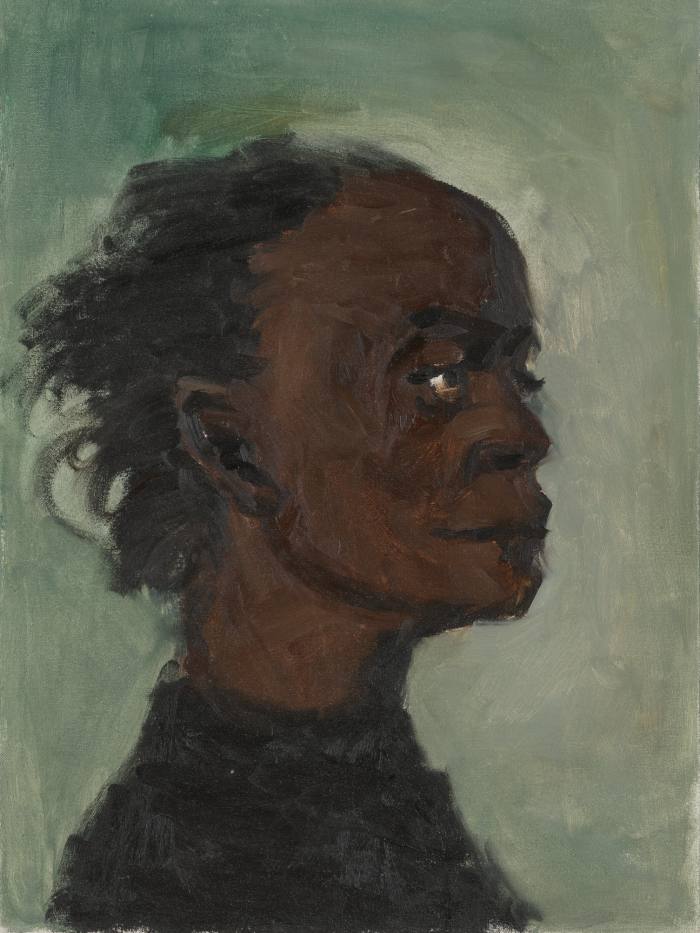
‘Erector’ (2007) by Lynette Yiadom-Boakye

‘The Tree’ (2003) by Ibrahim El-Salahi
I wonder what the future of the rest of the collection will be. To his disappointment, one project went off the rails: building what he calls a shed around Nairobi’s Circle commercial art gallery, in which he has a stake. This would have served as a display space for his collection. “Unfortunately, the land owner has decided to sell the site,” says Devereux. “The idea is to build my shed in another place, until I find a suitable place for the collection. Ultimately, I hope it all goes to one institution, ideally in Nairobi.”

‘Le Chef: Celui Qui A Vendu L’Afrique Aux Colons’ (The Chief Who Sold Africa to the Colonists) (1997) by Samuel Fosso © Christie’s Images
And when leaving, to return to the Kentridge show, he adds: “I am a romantic. I buy art because I love it, but also because the most important thing is to support the artists and the institutions that support them”.
The ‘A Place with No Name: Works from the Sina Jina Collection’ auction will be held at Christie’s London on October 13. christies.com


