


The death of Pope Emeritus Benedict marks a crossing unknown to modern Catholics.
He is the first Pope since the Middle Ages to die after retiring from office.
His death will spark public mourning but not the choice of a successor to which many are accustomed.
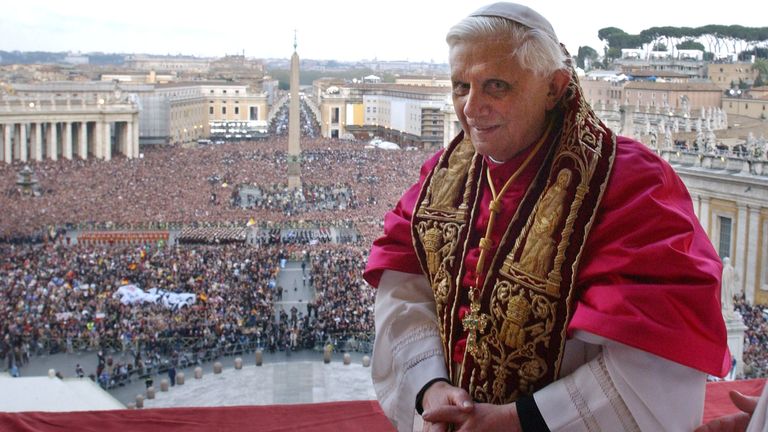
Pope Benedict on a balcony of St. Peter’s Basilica in the Vatican
Pope Franciscoelected in 2013 after the resignation of Benedict XVI, he will continue in his role as leader of the Catholic Church.
As the world remembers the 265th Pope, it will also reflect on his time as one of the most powerful religious leaders on earth.
Clergy members familiar with Benedict say he was known as the intellectual pope.
“Benedict was a shy person. He loved books. He loved his desk, writing, reflecting. His thinking brought beautiful German and then other languages as well. But a lonely person. He even told people: ‘My true friends’ . are the books,'” said Professor Felix Koerner SJ, a theologian at the Humboldt University of Berlin.
In 2005, Cardinal Joseph Ratzinger became Benedict XVI, the first German to be elected pope in a thousand years.

Queen Elizabeth II and Pope Benedict at the Palace of Holyroodhouse in 2010
An uncompromising theological conservative, he was chosen by the cardinals as a “safe pair of hands” and while he was a hero to many traditionalists, his time in office was marked by several scandals.
Son of a policeman, born in 1927, as a child he lived through Nazi rule.
As a teenager, he served in the Hitler Youth during World War II, when membership was compulsory.
Although his family opposed Adolf Hitler’s regime and he did not join the Nazi party, many in the Jewish community were concerned when he was first elected.
On a trip to the Auschwitz death camp, he was confronted with Germany’s dark past.
“This is as important a historic journey as that of his predecessor, Pope John Paul II,” said Rabbi Marvin Hier, founder and dean of the Simon Wiesenthal Center at the time. “For a German pope raised in Nazi Germany and once wearing a Hitler Youth uniform to kneel in prayer at the site of the world’s greatest atrocity and condemn hate is a repudiation of anti-Semitism.”

Pope Benedict with his fellow priests, his brother Georg Ratzinger and his friend Rupert Berger, on the day they were ordained in June 1951
This was not the only flash point.
In 2006, Benedict sparked outrage in the Muslim world when, during a speech in Germany, he quoted a 14th-century emperor as saying that Islam brought evil to the world spread by the sword.
The protest continued as the fury spread.
A nun was shot in Somalia.
He later had to issue an apology, saying he was “deeply sorry” for the reactions his speech had provoked.
In 2009, the rehabilitation of a Holocaust denier outraged Jews, as well as many Catholics.
Later that year, he provoked more anger when he told reporters on his first trip to Africa that condoms exacerbated the problem of AIDS and HIV.
Despite these missteps, among many conservative Catholics, Benedict was popular.
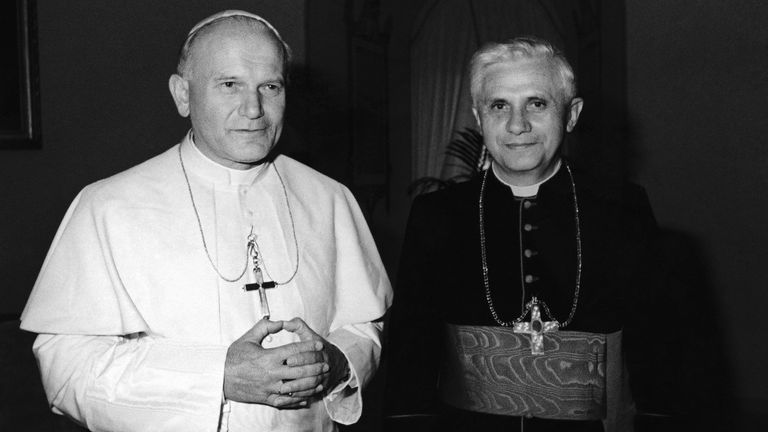
Pope John Paul II (L) , with Pope Benedict -then Cardinal Joseph Ratzinger- in 1979
As a cardinal charged with enforcing doctrinal purity, Benedict was nicknamed “Rottweiler of God” for his uncompromising conservative views.
As Pope, he was respected for his deep faith and his work as a theologian, producing 60 books between 1963 and 2013.
“His strength was clearly how to express the Christian faith in a way understandable to modern human beings. That is your message. That is what leaves us,” said Professor Koerner.
Child abuse scandals marred his time as pope and continued to haunt him until his retirement.
While his supporters pointed out that he removed hundreds of priests from the priesthood for abuse, others felt that he could have done more.
“The number one challenge for Pope Benedict was the abuse crisis, which was gaining speed and spreading throughout the world during his pontificate. And he took several steps to begin to respond to that. But critics of him say he didn’t do it. I didn’t do enough in the time that he was pope,” said Luke Coppen, senior correspondent for Catholic website The Pillar.

The Easter Sunday blessing mass in Saint Peter’s Square in the Vatican in 2012
In 2022, Benedict admitted that mistakes had been made and apologized after an independent report in Germany alleged that he had failed to act on four sexual abuse cases when he was Archbishop of Munich between 1977 and 1982.
His lawyers argued that he was not directly at fault.
In 2012, scandal once again darkened Pope Benedict’s door when it was discovered that his butler was the source of leaked documents alleging corruption and disputes in the Vatican.
“Pope Benedict XVI’s pontificate was undoubtedly marked by vast corruption and dysfunction within the Vatican itself. And he struggled throughout his pontificate to deal with it.
“And a lot of people think that in fact his pontificate was sidetracked because of all the problems in the Vatican that prevented him from concentrating on his key strengths of preaching and teaching,” Coppen said.
No doubt exhausted by the “Vatileaks” scandal and ongoing ill-health, the following year Pope Benedict XVI again stirred controversy, this time becoming the first pope in 600 years to resign.

Pope Francis and Pope Benedict in August 2022
In his final address to the faithful, he recognized the weight of the position and the problems of the Church.
Then, in an extraordinary chapter for the Catholic church, he said goodbye to the cardinals before retiring to a monastery in Vatican City.
“That was a remarkable step he took. And there hasn’t been a pope since the Middle Ages who resigned. So he, as quite a conservative person, was also opening a door to a world today where people don’t need to stay at home”. charge until they die, but where they can realize ‘I’m too weak to lead now so I need to step down’, even as Pope,” Professor Koerner explained.

Pope Benedict will be remembered ‘as a Pope of reflection and thought’
Upon his retirement, Benedict chose to continue wearing white, giving interviews, and not reverting to his old name; decisions that critics claimed threatened unity in the church.
But the personal relationship of the two popes was strong, with Francis referring to his predecessor as a grandfather figure and asking people to pray for his friend as his health deteriorated.
“He is very sick,” Pope Francis told the faithful in December 2022, asking the Lord to comfort him until the end.
Today, Benedict XVI is remembered “as a pope of reflection and thought” as millions of Catholics around the world pray for the man who led their church for nearly a decade.


