


Sao Paulo, Brazil
CNN
—
Pelé, the Brazilian soccer legend who won three World Cups and became the sport’s first global icon, has died at the age of 82.
“Everything we are is thanks to you,” his daughter Kely Nascimento wrote in a post on Instagram, under an image of family members holding hands with Pele. “We love you infinitely. Rest in peace.”
Pelé was admitted to a São Paulo hospital in late November with a respiratory infection and complications related to colon cancer. Last week, the hospital said his health had worsened as his cancer progressed. He died Thursday of multiple organ failure due to the progression of colon cancer, according to a statement from the Albert Einstein Hospital.
For more than 60 years, the name Pelé has been synonymous with soccer. He played in four World Cups and is the only player in history to win three, but his legacy stretched far beyond his trophy and his remarkable scoring record.
“I was born to play soccer, just like Beethoven was born to write music and Michelangelo was born to paint,” Pelé said.
Tributes have been pouring in for the soccer legend. Pele’s first club, Santos FC, responded to the news on Twitter with the words “eternal” shared alongside an image of a crown.
Brazilian soccer player Neymar said that Pele “changed everything.” In a post on Instagram, he wrote: “he Turned football into art, into entertainment. He gave voice to the poor, to the blacks and above all: he gave visibility to Brazil. Soccer and Brazil have elevated their status thanks to the King!” he added he.
Pelé’s life in pictures
Portugal star striker Cristiano Ronaldo sent his condolences to Brazil in a post on Instagram, saying that “a mere ‘goodbye’ to the eternal King Pelé will never be enough to express the pain that currently engulfs the entire world of football.”
Kylian Mbappé of Paris Saint-Germain said of Pelé’s death: “The king of football has left us, but his legacy will never be forgotten.”
Former English footballer Geoff Hurst wrote On twitter of his memories of Pelé, calling the late star “without a doubt the best footballer I ever played against (with Bobby Moore being the best footballer I ever played with). For me, Pelé is still the greatest of all time and I was proud to be on the pitch with him. RIP Pele and thank you.”
Pelé’s wake will take place in Vila Belmiro, the headquarters of Santos FC in the state of São Paulo, a spokesperson told CNN. The time and date of the event has yet to be announced.
Pelé was born Edson Arantes do Nascimento in Três Corações, an inland city approximately 155 miles northwest of Rio de Janeiro, in 1940, before his family moved to the São Paulo city of Bauru.
The genesis of Pelé’s nickname is unclear, even for the footballer. He once wrote in Britain’s Guardian newspaper that it probably started with school classmates making fun of him for trashing another player’s nickname, Bilé. Whatever the origin, the nickname stuck.
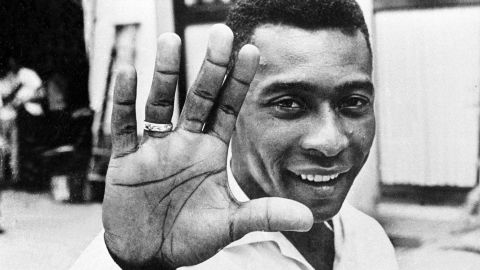
As a boy, his first taste of soccer was playing barefoot with socks and rags rolled up into a ball, a humble beginning that would become a long and fruitful career.
But when he first started playing, his ambitions were modest.
“My dad was a good soccer player, he scored a lot of goals,” Pelé told CNN in 2015. “His name was Dondinho; I wanted to be like him.
“He was famous in Brazil, in Minas Gerais. He was my role model. I always wanted to be like him, but what happened, to this day, only God can explain.”
As a teenager, Pelé left home and began training with Santos, scoring his first goal for the club before his 16th birthday. He would go on to score 619 times in 638 appearances for the club, but it is his exploits in Brazil’s iconic yellow jersey that he is best remembered for.
The world first saw Pelé’s dazzling ability in 1958, when he made his World Cup debut at age 17. He scored Brazil’s only goal in the country’s quarterfinal win against Wales, then scored a hat-trick in the semifinal against France and two in the final against hosts Sweden.
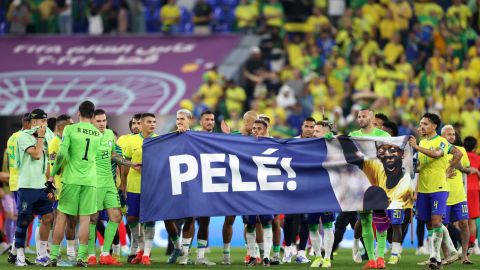
“When Pelé scored the fifth goal in that final, I have to be honest and say that I felt like applauding,” said Swede Sigvard Parling.
For Pelé, the most outstanding memory of the tournament was putting his country on the sporting map.
“When we won the World Cup, everyone knew about Brazil,” he told CNN’s Don Riddell in 2016. “I think this was the most important thing I gave my country because we were so well known after that World Cup.”
Another World Cup victory came in 1962, although injury sidelined Pelé in the latter stages of the tournament. Further injuries hampered his next campaign in 1966 when Brazil crashed out of the competition after the group stage, but redemption came in 1970.
“Pelé said we were going to win, and if Pelé said that, then we were going to win the World Cup,” Brazil co-captain Carlos Alberto said of the tournament.
That team, with players like Jairzinho, Gerson, Tostão, Rivellino and, of course, Pelé, is considered one of the best ever assembled.
In the final, a 4-1 win against Italy, Brazil scored arguably the most famous World Cup goal of all time, a sweeping play that involved nine of the team’s 10 outfield players.
It ended with Pelé teeing off Alberto, who drilled the ball into the back of the net. Brazil’s mantra of jogo bonito (the beautiful game) has never been better encapsulated.
Pelé, who had considered retiring before the 1970 World Cup, scored one own goal in the final and a total of four over the course of the tournament.
“Before the game I told myself that Pele was flesh and blood like the rest of us,” Italian defender Tarcisio Burgnich said after his team’s defeat in the final. “Later, I realized that he had me wrong.”
The tournament capped Pele’s World Cup career, but not his time in the spotlight. In 1975, he signed a $1.67 million a year contract in the United States with the New York Cosmos.
With his larger-than-life personality and extraordinary dribbling skills, a trademark of his game, Pele helped the Cosmos win the North American Soccer League championship in 1977 before officially retiring from soccer.
The league, which attracted more big names like Giorgio Chinaglia and Franz Beckenbauer, would not last and was finally folded in 1984. But around the world, Pele’s influence endured.
He remained in the public eye through endorsement deals and as an outspoken political voice who stood up for the poor in Brazil. He served as a UNICEF Goodwill Ambassador for many years, promoting peace and supporting vulnerable children.
Health problems persisted for much of Pelé’s later life. He moved with the support of a walker – an element that was filmed pushing disdainfully in a documentary released last year – and in September 2021 he underwent surgery to remove a tumor in his right colon.
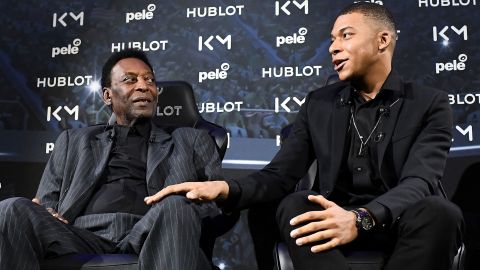
Pelé’s cancer treatment continued for the past year. He was hospitalized in Sao Paulo in November while the 2022 World Cup was being played in Qatar, drawing an outpouring of support from the global soccer community and beyond.
Inevitably, a debate will erupt over whether Pelé is the greatest player of all time, whether it is possible to compare Pelé’s achievements with those of Cristiano Ronaldo or Lionel Messi, who have rewritten the soccer record books in the last 15 years, or Featuring Diego Maradona, the late Argentine star who captivated the soccer world in the 1980s and 1990s.
In 2000, FIFA jointly named Maradona and Pelé the Player of the Century, but to some, the outright winner of the award should have been a no-brainer.
“This debate about the player of the century is absurd,” said Zico, who represented Brazil in the decade after Pelé retired. “There is only one possible answer: Pelé. He is the best player of all time, and with some distance, he might add”.

It is unclear exactly how many goals Pelé scored during his career, and his Guinness World Records tally has come under scrutiny with many scored in unofficial matches.
In March 2021, he congratulated Ronaldo of Portugal for breaking his “record for goals in official matches”: 767.
However, there is little doubt that Pelé was, and always will be, soccer’s first global superstar.
“If I die one day, I’m happy because I tried to do the best I could,” he told The Talks online magazine. “My sport allowed me to do a lot because it is the most important sport in the world.”


