


NASA’s InSight Mars lander, which touched down on the Red Planet more than four years ago, transmitted what could be its last image on Monday.
“My power is really low, so this may be the last image I can send. Don’t worry about me though – my time here has been productive and serene. If I can keep talking to my mission team, I will.” , but I’ll be shutting down here soon,” Insight’s 25 to 30-person team posted on the lander’s Twitter Monday afternoon. “Thank you for staying with me.”
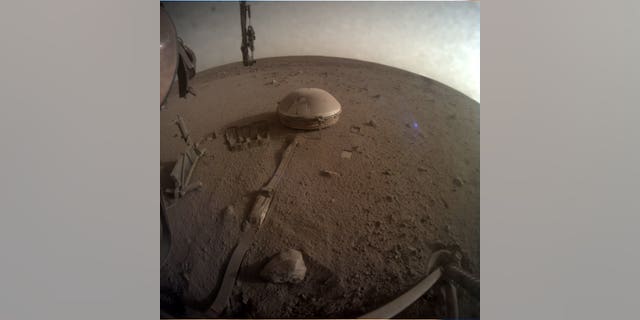
The possible final image from NASA’s InSight Mars lander, which is expected to run out of power later this month.
(NASA InSight Mars landing moon)
NASA will officially end the mission when the lander misses two communication attempts in a row with a spacecraft orbiting the planet.
NASA MARS ROVER DISCOVER STRANGE ROPE-SHAPED OBJECT THAT GOES VIRAL
The InSight operations team began preparing for the end of the lander earlier this year, turning off the devices that require the most power and ensuring data collected over the past four years is preserved.
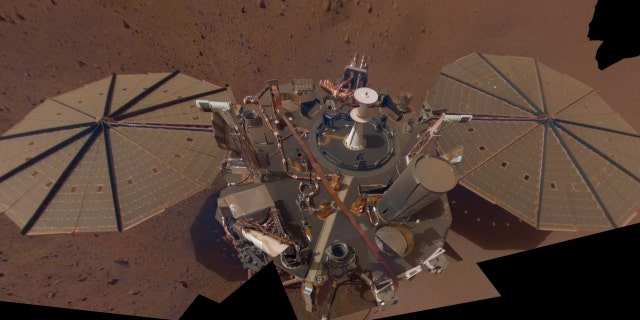
Selfie taken by the Insight lander’s instrument display camera on the lander’s robotic arm on April 11, 2019.
(Credits: NASA/JPL-Caltech)
NASA PUBLISHES JAMES WEBB SPACE TELESCOPE IMAGE OF GHOST GALAXY
Since it touched down in November 2018, the lander has provided information about the liquid core of Mars and the composition of its other inner layers. It has detected more than 1,300 earthquakes on the planet, including a magnitude 5 earthquake in May.
“Ultimately, we can see Mars as a layered planet, with different thicknesses and compositions,” Bruce Banerdt of NASA’s Jet Propulsion Laboratory in southern California said in a statement last month. “We’re starting to puzzle out the details. Now it’s not just this puzzle; it’s actually a living, breathing planet.”

Thick layer of dust on one of the lander’s solar panels.
(NASA/JPL-Caltech)
CLICK HERE TO GET THE FOX NEWS APP
The main mission of the lander was accomplished in its first two years. A pair of 7-foot-wide solar panels initially produced about 5,000 watt-hours each sol, or Martian day, but only produced about 500 watt-hours per sol last month due to a buildup of dust.


