


The United States would face few but significant obstacles if the military were to confront China following an invasion of Taiwan, military experts told Fox News Digital.
“Unfortunately, broadly and broadly speaking, the Chinese have dramatically increased their air, sea, space, cyber and missile capabilities over the past two decades,” said James Anderson, acting assistant secretary of defense for policy under the Trump presidency. .
“In some of the scenarios that could occur, we might well be at a competitive disadvantage initially because they have home court advantage in terms of their ability to quickly mobilize local forces, and that’s really important to the PRC.”
Four-star Air Force General Mike Minihan, head of the Air Mobility Command, wrote in a memo last week that he believes the United States and China “will fight in 2025,” adding: “I hope I’m wrong.” He pointed to upcoming elections in the US and Taiwan, which he believed could provide a diversion and allow China to make a move on the island.
US MISSILE EXPLODES CHINESE SPY BALLOON OVER ATLANTIC OCEAN OFF SOUTH CAROLINA COAST
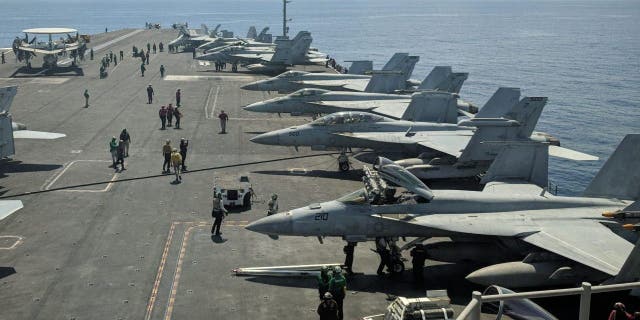
This photo taken on October 16, 2019 shows a US Navy F/A-18 Super Hornets multi-role fighter aircraft and an EA-18G Growler electronic warfare aircraft, second from right, aboard the aircraft carrier USS Ronald Reagan. (CVN-76) as it sails in the South China Sea on its way to Singapore.
(Catherine Lai/AFP via Getty Images)
The general said that “a fortified, ready, integrated and agile joint force maneuver team, ready to fight and win within the first island chain” must be established to prepare for the fight ahead.
And CIA Director William Burns has reported that Chinese President Xi Jinping has ordered his military to be ready for action no later than 2027.
Anderson, along with Heino Klinck, a senior adviser to the National Bureau of Asian Research, stressed that it is difficult to predict how a conflict might play out because “it would depend a lot on the scenario.”
“There are areas where they have dominance, and there are also areas where we have dominance, so it’s not exactly an apples and oranges comparison,” said Klinck, who previously served as deputy assistant secretary of defense for East Asia. , highlighting the “tyranny of distance” as the biggest concern of the US military.
“China certainly has geographical advantages based on the fact that it is only 100 miles from Taiwan, so it is something that requires advanced logistics planning,” he added.
China, in a localized conflict, would have shorter supply lines compared to the US, even with partners and military bases in the region creating a baseline from which to operate. And it could more easily support its naval forces with land-based missile systems.
Anderson also noted that the United States would likely run out of its sophisticated conventional missiles “probably in a matter of days.” US officials announced in October 2022 that they could not maintain the same supply pace for Ukraine’s defense against invasion by Russia due to the risk posed by reduced stockpiles of high-end munitions.
CHINESE SPY BALLOON MAY HAVE PICKED UP ‘INVISIBLE’ INFORMATION, EXPERTS SAY
“In essence, we have exhausted our own ammunition reserves to supply the Ukrainians,” Klinck said. “It has shown the fragility of our defense industrial base. And the fact that we have allegedly withdrawn ammunition from Israel and are planning to withdraw certain types of equipment from South Korea should demonstrate and convey the seriousness of this problem.”
The “tyranny of distance” would cause the biggest problem, Anderson noting that it could take at least two weeks for the US to fully supply both manpower and weapons to the region to sustain any kind of sustained and intensified action against China.
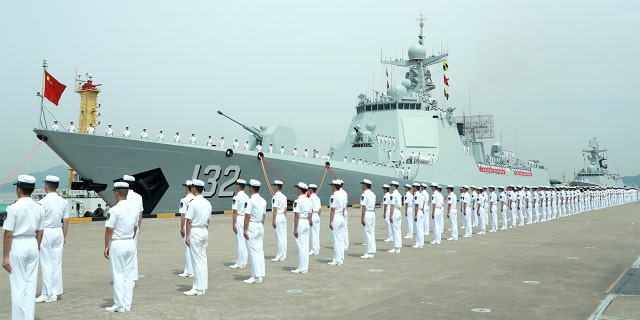
Chinese navy members stand on the deck of the guided-missile destroyer Suzhou (Hull 132) of the escort task force at a military port on May 18, 2022, in Zhoushan, China’s Zhejiang province.
(VCG/VCG via Getty Images)
“There are ways around that,” Anderson stressed. “For example, we can and should do a much better job of storing sufficient amounts of munitions in the region and protecting it, but right now that’s our biggest handicap.”
Anderson noted that despite these shortcomings, the US has a significant and overwhelming advantage over China: the last conflict in which Beijing deployed its forces was the 1979 border war with Vietnam, and it does not have extensive military experience. or actual combat ever since. compared to their American counterparts.
THESE 5 FAILURES OF CHINESE INTELLIGENCE ARE EVEN MORE DANGEROUS THAN THE CHINESE SPY BALLOON
“The fact is that they have no experience in conducting a large amphibious assault on the scale that would be required to take the island of Taiwan,” Anderson added. “Yes, they did attack a number of Taiwan’s outlying islands during multiple crises in the 1950s, but those were very small-scale operations.”
He added that large-scale amphibious operations are “the most difficult combat operations to execute.”
“There are no good parallels and…from our perspective, the fact that the Chinese don’t have a good parallel is good news because it is a competitive disadvantage for them.”
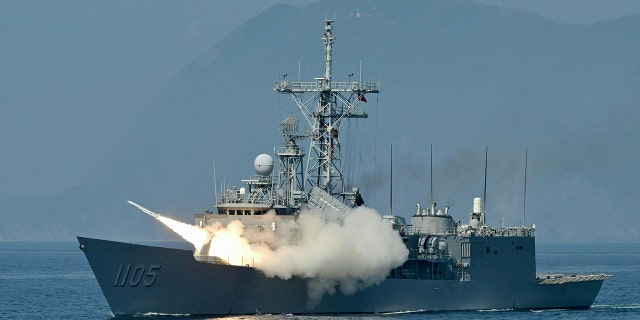
The Taiwanese navy fires a US-made standard missile from a frigate during the annual Han Kuang drill at sea near the Suao naval port in Yilan county on July 26, 2022.
(Sam Yeh/AFP via Getty Images)
Klinck stressed that the lack of parallelism is not necessarily a good thing, simply because the US cannot predict how China will approach the problem.
CLICK HERE TO GET THE FOX NEWS APP
“The fact that they have geography on their side, the fact that the Chinese economy and Chinese companies are also integrated into the Chinese war plans. So, for example, the Chinese have, in fact, exercised with roll-on, roll-off commercial ships with commercial aircraft,” Klinck noted.
“There are a variety of lift assets that the Chinese could bring into play that Western militaries don’t necessarily depend on.”
Fox News Digital’s Caitlin McFall contributed to this report.


