


Maryland is banning the use of TikTok and certain Chinese and Russian-based platforms in the executive branch of the state government, Gov. Larry Hogan said Tuesday, the latest state to address the cybersecurity risks posed by the platforms.
The Republican governor announced an emergency cybersecurity directive to ban use of the platforms, saying they could be involved in cyber espionage, government surveillance and inappropriate collection of sensitive personal information.
“There may be no greater threat to our personal security and our national security than the cyber vulnerabilities that underpin our daily lives,” Hogan said in a statement, adding: “To further protect our systems, we are issuing this emergency directive against foreign”. and organizations that seek to weaken and divide us.”
The Maryland directive comes a week after South Dakota Gov. Kristi Noem, also a Republican, banned state employees and contractors from accessing TikTok on state devices, citing its ties to China. South Carolina Gov. Henry McMaster, also a Republican, asked the state Department of Administration Monday to ban TikTok from all state government devices it runs. Nebraska Governor Pete Ricketts blocked TikTok on state electronic devices in August 2020.
The US military has also banned the app on military devices.
TIKTOK IS CHINA’S ‘DIGITAL FENTANYL’, SAYS FCC COMMISSIONER
“It’s a risk that most governments are beginning to realize is not worth taking,” said Trenchcoat Advisors co-founder Holden Triplett, a former FBI government official who worked in Beijing and in counterintelligence.
While there’s been a lot of debate about whether the Chinese government is actively collecting data from TikTok, Triplett said the app presents a clear vulnerability. Because TikTok’s owner, ByteDance, is a Chinese company, he would have to comply with any potential Chinese security and intelligence requests to hand over data, which could include the location and contacts of employees, he said.
ByteDance moved its headquarters to Singapore in 2020.
TikTok has had trouble detecting ads that contain blatant misinformation about the US election, according to a recent report by the nonprofit organization Global Witness and the Cybersecurity for Democracy team at New York University.
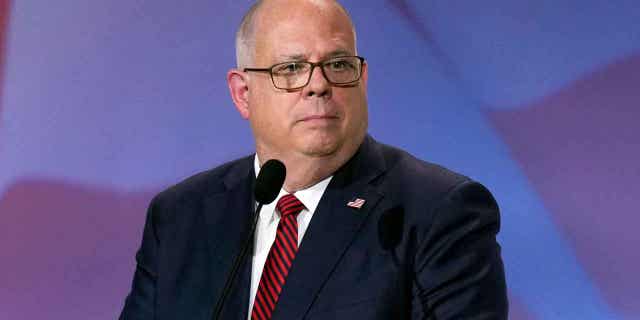
Maryland Governor Larry Hogan speaks at an annual leadership meeting on November 18, 2022 in Las Vegas. Maryland is banning the use of TikTok in the executive branch of the state government, Hogan said on December 6, 2022.
(AP Photo/John Locher, File)
But TikTok spokesman Jamal Brown said concerns about driving bans “are largely fueled by misinformation about our company.”
THE MYSTERY OF THE TIKTOK ALGORITHM: WHAT WE KNOW AND WHAT WE DON’T KNOW ABOUT CHINESE GOVERNMENT CONTROL OF THE APP
“We are always happy to meet with state legislators to discuss our privacy and security practices,” Brown said. “We are disappointed that many state agencies, offices and universities that have been using TikTok to build communities and connect with voters will no longer have access to our platform.”
TikTok COO Vanessa Pappas, based in Los Angeles, said the company protects the data of all American users and that Chinese government officials do not have access to it.
Also Tuesday, Wisconsin’s Republican representatives in Congress called on Democratic Gov. Tony Evers to remove the video platform TikTok from all state government devices, calling it a national security threat.
“Wisconsinites hope their governor is aware of the dangerous national security threats posed by TikTok and protects them from this avenue for CCP intelligence operations,” said US Senator Ron Johnson and US Representatives Mike Gallagher. , Tom Tiffany, Glenn Grothman, Bryan Steil and Scott Fitzgerald said in a letter.
Last month, Gallagher joined US Senator Marco Rubio of Florida to write an opinion piece calling on governments to ban TikTok.
Evers spokesperson Britt Cudaback said the administration takes cybersecurity threats “very seriously” and regularly consults with the US Department of Homeland Security, the FBI and counterintelligence specialists when making decisions about the devices. of the state government.
“We will continue to defer the judgment and advice of law enforcement, cybersecurity, and counterintelligence experts regarding this and other evolving cybersecurity issues,” Cudaback said.
Former President Donald Trump issued blanket orders against Chinese tech companies, but the White House under President Joe Biden replaced them with a narrower focus. US officials and the company are now in talks about a possible deal that would resolve US security concerns.
A researcher at the conservative Heritage Foundation last month asked government officials to ban TikTok from operating entirely in the United States. And last week, FBI Director Chris Wray said China could use the app to collect data about its users that could be used for traditional spying operations.
CLICK HERE TO GET THE FOX NEWS APP
Still, some experts say the threat is overblown. In a Nov. 14 commentary for the Strategic Technologies Program, former diplomat and cybersecurity expert James A. Lewis said TikTok’s national security risk is “easily overstated.”
“Intelligence agencies routinely scrape social media to gather biographical information and you don’t need to own TikTok (or any other social media platform) to do this,” Lewis wrote. “The question is, how much more does China get from having access to TikTok data that isn’t publicly available? There’s probably some benefit, but it’s probably small.”


