


Kosovar Prime Minister Albin Kurti has called on Western powers not to pressure his small Balkan country into agreeing to a contentious partnership of five Serb-majority municipalities that is ratcheting up tensions between Kosovo and Serbia.
Kurti told The Associated Press that the focus should instead be on making Serbia more democratic and ditching what he called Belgrade’s hopes for regional leadership.
Kurti said in the Sunday interview that the Serbian government should recognize Kosovo’s independence to “face the past.” He also stressed that Belgrade should lean more towards the European Union and NATO than towards Russia.
SERBIA DEPLOYS TROOPS FOR ‘COMBAT READINESS’ ON KOSOVO BORDER
The prime minister said that if Belgrade abandons the idea that Kosovo still belongs to Serbia, “they will be much more democratic, European.”
The dispute between Serbia and its former province of Kosovo has remained a source of instability in the Balkans long after the 1998-1999 war, which ended with a NATO intervention that forced Serbia to withdraw from the territory.
Kosovo in 2008 declared its independence from Serbia, which Belgrade has refused to recognize, with the support of Russia and China. The United States and most EU nations have recognized Kosovo.
In recent weeks, US and EU envoys have visited Pristina and Belgrade to encourage them to accept a new proposal to normalize relations and boost their EU membership offers.
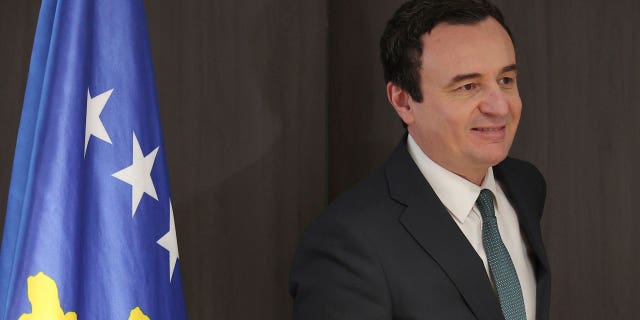
Kosovar Prime Minister Albin Kurti has advised Western powers not to pressure his small Balkan nation to sign a territorial deal with Serbia. (AP Photo/Franc Zhurda)
An EU-mediated Kosovo-Serbia dialogue has been ongoing since 2011, but few of the 33 signed agreements have been implemented.
Kurti said of the negotiations so far that “all the solutions became more and more complicated, less and less implementable, and the public lost interest.” He considered the new proposal “a good framework and platform to move forward… which gives us hope about the prospects for future talks and an agreement.”
Details of the proposal have not yet been made public.
The US ambassador in Pristina, Jeffrey M. Hovenier, told the Associated Press that the proposal “is an intermediate step, which…would regularize relations in a very significant way and would be of enormous benefit to both Kosovo and Serbia.”
“It is in the interest of both countries to be in a different place in their relationship with each other,” he said.
The United States has increased pressure on Pristina to implement a 2013 agreement to establish the Association of Serb-Majority Municipalities in ethnic Serb-dominated north Kosovo, which would coordinate work on education, health care, territorial planning and economic development through local level. In 2015, the Kosovo Constitutional Court declared part of the plan unconstitutional, as it did not include other ethnicities and could involve the use of executive powers.
Kurti says that the establishment of the association is not his priority, and last week he set conditions saying that it can only be formed as part of a general agreement on the normalization of relations, which Serbia has rejected in the past. Kosovo authorities fear it will eventually undermine the country’s statehood with Belgrade’s help.
KOSOVO GIVES TRUMP RELEASE ORDER FOR HIS ROLE IN SECURING THE DEAL WITH SERBIA
Western powers should learn from the example of the Serb-led Bosnian mini-state Republika Srpska, fearing the creation of a mini-state in Kosovo, he said, adding that Belgrade used the creation of the association “as a weapon against our independence.”
“If we introduce in the Western Balkans the idea of an association of municipalities based on ethnicity, it is a recipe for new conflicts,” Kurti said.
Western powers should not put pressure on smaller countries like Kosovo, he said. The problems between Kosovo and Serbia can be small and annoying, but the West needs to pay attention to what has been happening in the region because “any kind of wrong solution in the Balkans can and will be used elsewhere.”
The situation remains tense in northern Kosovo after Western powers helped resolve a tense situation in December when Serbs erected barricades on main roads to protest the arrest of a former Serb police officer.
Lars-Gunnar Wigemark, head of the EU’s rule of law mission in Kosovo, called the incident a “very tense standoff with barricades” and “the most serious crisis facing Kosovo… in the last decade.”
CLICK HERE TO GET THE FOX NEWS APP
Another senior Western diplomat, who spoke on condition of anonymity because of the sensitivity of the issue, said mediators are “working very hard” to avoid anything that could spark protests or violence.


