


When telling the story of the founding of the Congress Youth League (CYL), forerunner of the ANC Youth League, usually only Anton Lembede, AP Mda and a few others are mentioned. The other founding members are rarely mentioned and the omission of their names is a silencing of their intellectual prowess and political contribution to the creation of CYL.
Jordan Khush Ngubane is one such voice that has been silenced. He is sidelined when the CYL story is told. Perhaps his political fluidity and how he left the ANC in the 1950s is why we hear so little about him. Few people equal him as an intellectual and programmatic politician. As a journalist, his record remains unmatched.
Who was Ngubane?
Ngubane was born near Ladysmith, in a small town called Nkwebebe, on November 15, 1917. In 1933, he attended Adams College, matriculating in 1937. While at Adams, he began studying journalism by correspondence and contributed some articles to Iso Lomuzi, a student. magazine.
Due to the link between Adams, the intellectuals of Natal and society in general, his talents caught the attention of Ngazana Luthuli, Albert Luthuli’s uncle and publisher of Ilanga (1915 to 1943), who offered him a job in Ilanga lase Natal. Ilanga had been founded by John Langalibalele Dube in 1903 when African-owned newspapers sprang up in the early 19th century.
Ngubane became famous in Ilanga as Jo the Cow, in Gleanings from Life, a satirical column he wrote between 1938 and 1943. He also wrote a column under the pen name Mkhaba Kawukhethi. Mkhaba was a funny person who presented serious political issues in an accessible and humorous way. It was these columns that drew the attention of many people to the brilliance of the Ngubane. He was an important part of Ilanga and its readers, contributing more than 376 articles.
In 1943 Ngubane left Ilanga to join Bantu World as assistant editor to Richard Victor Selope Thema. Upon his arrival, on March 27, 1943, he was received by the editor RRR Dhlomo. In Bantu World, Ngubane wrote a column similar to Ilanga’s: Izindaba Zokuma Komhlaba (World Affairs) which covered international politics. While there, he rubbed shoulders intellectually with the likes of Dhlomo, Wallet Vilakazi, and Walter and MB Nhlapho.
The founding of the Congressional Youth League in 1944
The founding of the CYL in April 1944 at the Bantu Men’s Social Center was a significant moment for Ngubane. In 1939, he along with Manasseh T Moerane, a member of the ANC and secretary of the Natal Bantu Teachers’ Association, established a short-lived youth organization called the National Union of African Youth. Thus, the founding of CYL five years later was for Ngubane the fulfillment of an idea that he and Moerane had long envisioned.
The CYL commissioned Ngubane, Lembede, its first president, and Mda to write the league’s manifesto. According to Mda, it was Ngubane who wrote it and Lembede only contributed a few words. He had “Ngubane written all over it,” said Mda. Thus, there is no proper history of the ANC youth movement without mentioning the role of the Ngubane, Moerane and the African Youth National Union. And certainly, there is no proper history of the CYL manifesto without its main writer, Ngubane.
Soon after the founding of the CYL, Ngubane left the Bantu world citing their restrictive editorial policy which did not allow words like “suppression” etc. He returned to Durban to become editor (1944 to 1951) of Inkundla ya Bantu (formerly the Territorial Review), published in Verulam.
He had been a contributor to Inkundla since June 1942 under the pseudonyms Khanyisa and Twana. The move to Inkundla was also significant for the CYL. He now had a spokesperson, edited by a founding member and creator of his manifesto. A letter from Mda to Godfrey M Pitje (CYL Fort Hare Leader) shows how the three colluded to have Inkundla as CYL spokesperson.
Mda later suggested that the newspaper was not his mouthpiece, however he encouraged youth league players to subscribe due to it being African owned. Although Mda was telling the truth, he was speaking from a place of bitterness due to his disagreement with Ngubane in 1948.
For Ngubane Inkundla it was an essential part of the CYL. When his life was beginning to fail and he had moved from Durban to live in Rosetta, near Escourt, he offered to give CYL seats on Inkundla’s board of directors to ensure that the editorial policy remained favorable to the activities. of CYL.
Ngubane the politician
On 4 September 1948, at the Bantu Men’s Social Center in Durban, Ngubane was elected president of the CYL’s Natal branch, with Harry Gwala as his vice-president. This election followed several attempts by different committees to establish the CYL. As president of the CYL in Natal, Ngubane was influential in Luthuli’s election in 1951 as president of the ANC in Natal, replacing AWG Champion, who had been in command since 1945.
Ngubane endorsed Luthuli as he stated that he understood what it meant to be a “new African”, something Champion did not. This was important to Ngubane, who had long believed that Luthuli had the potential to become ANC leader. Luthuli and Ngubane had known each other since the Adams days and met frequently at Ilanga’s offices in Durban. Luthuli would sometimes spend a night at the Ngubane house where they would discuss politics.
However, their relationship collapsed in 1955-56 when Ngubane accused Luthuli of being a weak president, used by the communists. Writing in Indian Opinion, for which he worked as an assistant editor (1952-1957), Ngubane accused Luthuli of bringing the congress to Moscow. Basically, he was claiming that Luthuli was being controlled by members of the South African Communist Party. This accusation provoked Luthuli and other ANC leaders, including Mandela and Ruth First, who lashed out at Ngubane. Luthuli’s anger towards Ngubane caused him to never mention Ngubane’s name, even in his autobiography, Let My People Go.
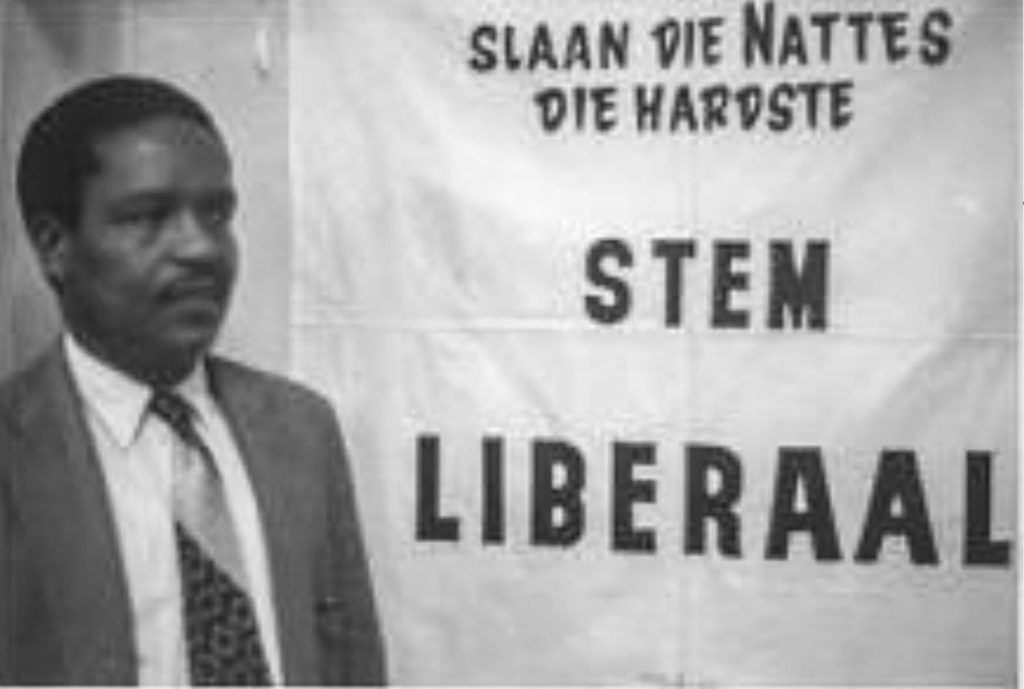
After the Luthuli incident, Ngubane left the ANC to join the South African Liberal Party and became its Vice President. He traveled throughout South Africa preaching the policy of non-racism while campaigning for the party. In 1958, he was part of the South African delegation to the All African Peoples Conference in Ghana, Accra. His appointment as a delegate to this conference was a vote of confidence and recognition of his commitment to the liberation of the African people.
When political organizations were banned in 1960, Ngubane received a letter on August 30 from the Mbata Congress, proposing a meeting of African leaders. Mbata said, “His contribution to the development of the African people and the improvement of his condition is widely known.” A follow-up committee was established from Mbata’s efforts, but Ngubane later resigned citing the influence of the communists.
However, his activities on the committee did not go unpunished by the government. Along with Duma Nokwe, Paul Mosaka, Mbeki, Marks Shope and others, he was charged under the Suppression of Communism Act. Joe Slovo of the South African Communist Party represented them in court. Ngubane was eventually sentenced to 12 months in prison, but appealed the decision and was released pending his appeal.
In 1962, while appealing his sentence, hearing that the police were looking for him, he escaped to Mbabane, Swaziland, now Eswatini, assisted by Lencelort P Msomi, a politician from North Natal. There he published his first book UShaba: The Hurtle to Blood River (1963). Six years later, in 1969, he was offered a Ford Foundation scholarship to attend Howard University in the United States, where he is said to have taught on apartheid in South Africa.
He continued his writing career, working closely with Three Continents Press, a publisher in Washington, to see publication of some of his other work, including An African Explains Apartheid (1964), which was banned by the apartheid government.
While in the US, he became close to Mangosuthu Buthelezi, the leader of the Inkatha Freedom Party, meeting him regularly in Washington. Through Buthelezi’s efforts, Ngubane returned to South Africa to join the Inkatha Freedom Party, but was unable to make any significant impact. He died on September 17, 1985.
A true son of Africa without political borders
Ngubane first saw himself as a liberal and African nationalist, as defined by Mda. His entire life was dedicated to the unity of the African people. He claimed that he was a Seme Man, referring to the principles of Pixley ka Isaka Seme that influenced the founding of the ANC in 1912. He campaigned for a non-racial society based on the ideals of individual freedom. He believed that the race problem in South Africa was a conflict of minds that hindered the advancement of the individual and that this conflict was an Ushaba (proliferation of a problem), which could lead whites and blacks into another Bloody River.
He was the first to make the concept of ubuntu famous in South Africa and theorized about it in one of his writings. Ngubane’s life was remarkable, but he remains on the fringes, his words and activities muted by his political malleability that has been misinterpreted out of context as incoherence.
He was a brilliant intellectual and controversial politician without borders, fluid in his political commitments but firm in the idea of a non-racial society.


