


Police remove personal items from Idaho crime scene
Fox News’ Alexis McAdams reports on Moscow police removing the personal belongings of the four University of Idaho students from the crime scene as families grapple with a lack of responses nearly a month after the murders.
As the investigation into the murders of four University of Idaho students enters its fourth week, law enforcement is likely now trying to identify the killer through investigative genetic genealogy, a novel field that combines state-of-the-art DNA analysis with traditional genealogy research.
Authorities collected 113 pieces of physical evidence at the scene for analysis by Idaho State Police Forensic Services, which have been “working 24/7 in the lab” to try to obtain results as quickly as possible.
Typically, investigators will first compare unknown DNA samples from the crime scene against the FBI’s Combined DNA Index System (CODIS), a database containing genetic samples from known criminals, using traditional STR DNA analysis. .
“It’s pretty quick to compare it to CODIS. If they’d found a match, I think they probably would have arrested him by now, so I think we can assume they’re at least considering using research genetic genealogy,” CeCe Moore, head of genetics. Parabon NanoLabs genealogist, told Fox News Digital.
SCHEDULE OF MURDERS AT THE UNIVERSITY OF IDAHO: WHAT WE KNOW
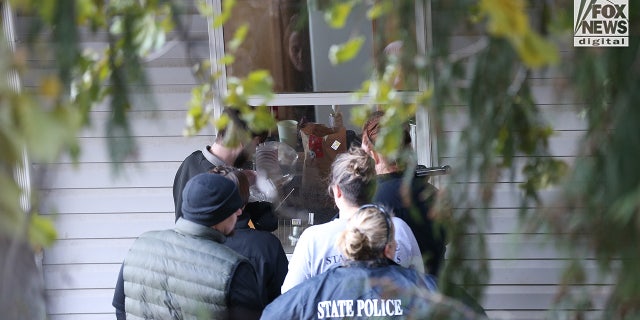
An Idaho State Police forensics team analyzes evidence and searches for clues in Moscow, Idaho on November 21, 2022.
(Derek Shook for Fox News Digital)
“It just depends on how quickly they knew they didn’t have a match in CODIS as to when that would have been done.”
If traditional STR DNA analysis does not find a match in CODIS, then investigators can analyze more than half a million DNA single nucleotide polymorphisms, or SNPs, to identify possible distant relatives of the unknown suspect.
Genetic genealogists can reverse engineer the unknown person’s family tree using traditional genealogy and narrow it down to a possible suspect.
Once law enforcement has identified a suspect using genetic genealogy, they will typically attempt to secretly obtain a fresh DNA sample to confirm a lead.
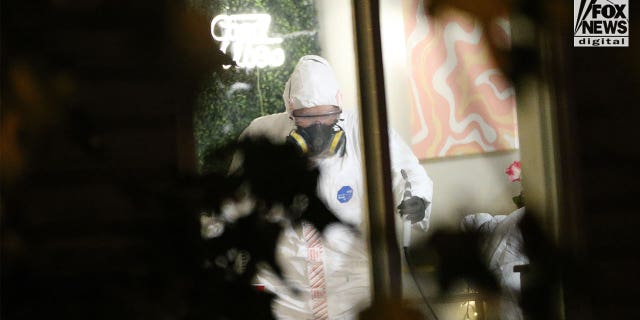
Investigators in hazmat suits examine the scene of a quadruple homicide near the University of Idaho campus.
(Derek Shook for Fox News Digital)
For example, investigators recently took a new look at the unsolved murder case of 19-year-old Lindy Sue Biechler in Pennsylvania in 1975, using genetic genealogy. Male DNA was obtained from Biechler’s underwear, but he received no hit on CODIS for decades.
Moore and his team at Parabon Labs used genetic genealogy to analyze DNA taken from the crime scene and developed 68-year-old David Sinopoli as the suspect. Investigators stealthily obtained fresh DNA from a coffee cup that Sinopoli threw away in February, and it turned out to be a match to DNA taken from the crime scene. Sinopoli was arrested and now faces murder charges.
“They always need that extra step of collecting DNA, and usually it’s going to be surreptitious because they don’t want to alert anybody,” Moore said.

A split photo showing the crime scene and the victims, University of Idaho students Ethan Chapin, 20, and Xana Kernodle, 20, left, and Madison Mogen, 21, and Kaylee Goncalves, 21.
(Derek Shook for Fox News Digital/ Instagram/ @xanakernodle/ @kayleegoncalves)
Dozens of law enforcement officers from the FBI, the Idaho State Police and the Moscow Police Department collected evidence at the off-campus home where Xana Kernodle, 20, Ethan Chapin, 20, Madison Mogen, 21, and Kaylee Goncalves, 21 , were assassinated on November 21. 13
IDAHO MURDERS: ‘RABY,’ ‘RANDOM’ AMONG SIMILARITIES TO INFAMOUS TED BUNDY MURDERS, SAYS FORMER LAWYER
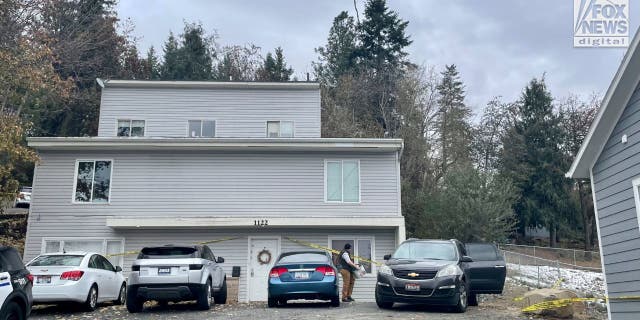
Investigators leaving the house in Moscow, Idaho, on November 22, 2022, where four people were killed on November 13.
(Audrey Conklin/Fox News Digital)
Investigators can obtain DNA samples from strands of hair, skin cells or tissue left under the fingernails of the victims, but it is likely that the suspect’s blood was also at the scene.
“Usually, in the cases that I’ve worked with stabbings, if someone stabs enough times, the knife almost always slips,” said Moore, who has helped solve more than 200 cold cases with Parabon Labs. “Almost the perpetrator’s DNA is always mixed with the victim’s DNA.”
The unsolved murders have stunned the Moscow community. The university estimates that between 25% and 40% of students have not returned to campus since the murders.
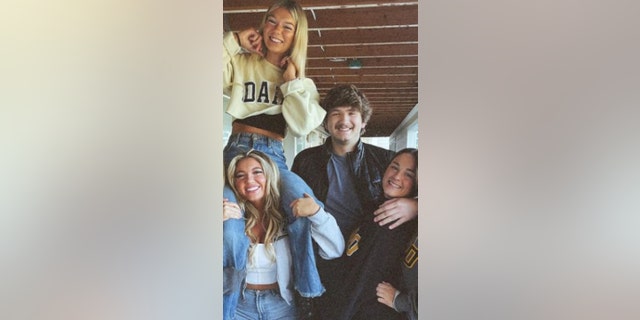
The four victims in the University of Idaho murders on November 13, 2022.
(Instagram/@kayleegoncalves)
CLICK HERE TO GET THE FOX NEWS APP
Moscow Police Chief James Fry vowed Tuesday to solve the murders, saying: “This case is not cooling down.”
“We received clues. We have investigators every day interviewing people. We’re still reviewing evidence, we’re still looking at all aspects of this,” Fry told Fox News. “I said from the beginning that no stone will be left unturned, and I mean it.”


