


My cousin Galaxy’s baby fell out of a two-story window and survived. They called the baby a miracle child like my brother was called a miracle child when he was thrown off a motorcycle just to live.
Some Fulani clans insist that the universe was created from a single drop of milk, from which arose blindness, sleep, pride, worry, and death: all the natural nemeses of men.
Gizo, a tricky spider, employs clever deceptions in search of easy prey or gains. If you hear a noise late one night, like a baby crying outside, no matter how pathetic the crying is, you should ignore it.
There is an uncle that no one in my family visits because his house is at the end of a road full of frogs, and there you can only hear the sound of bodies exploding under the wheels of the cars.
And what if the wind is driven by manipulative spirits from the Sahel, who whisper riches but seek to vex and devour?
These are the stories I heard about my family and native Nigeria during the decades we drifted: unreal, sometimes creepy, always labyrinthine tales that drew me in and repelled me.
I was born in Maiduguri, Nigeria, the birthplace of Boko Haram, the terrorist militia that specializes in kidnapping girls. A mix of three religions, four languages, and thirty-two addresses on three continents made me who I am. For the first decade of my life, I was raised in England until my immediate family moved to the US, our last adopted home. Too many to count: the phone numbers; zip codes; ZIP codes; area codes; ways of thinking and being in Africa, Europe and America.
A mix of three religions, four languages, and thirty-two addresses on three continents made me who I am.
Answering the question “Where are you from?” it has never been easy. My story spans both sides of dueling cultural systems: I have dual citizenship of Nigeria and the United States. I have been told by paternalistic Nigerians that I am not “really Nigerian”; Xenophobic Americans imply that I am not a “real American.”
Restlessness, uprooting In this country, I have lived in Nashville and New Haven; Mystic and Maryland and Manhattan; Koreatown, Los Angeles; Detroit on the riverfront with unobstructed views to Canada; the Brooklyn before the Brooklyn now; Chicago My parents and two brothers eventually put down roots twenty years ago within the large West African community that surrounds the US capital.
But I’m still unchanged. I wander and move for work, school, love. I inherited such an extreme spirit exophoria— that uncontrollable tendency of the eyes to look outward. My ancestors were traders and herders who roamed the Sahara in search of water. My immediate family and I are transcontinental nomads, relentless in our own pursuit of something less material. Only five of us migrated to this part of the world.
We are looking for a real and imaginary country.
Still, the closest thing to “home” I’ve found is the dream lands called California. Five hundred years ago, a famous Spanish fairy tale led the first modern men, in all their madness, to pursue a prophesied utopia. European explorers exploring the American West sought a legendary California: an almost Edenic enclave, where the only metal found was gold. When they arrived at the place they decided should be their promised land, they named it “California,” manifesting an object of exquisite desire in reality. california is way of thinking: the conquistadors wanted something so much that they made it happen. They created their own golden state, their golden beginning.
I could redo it into some form of happy ending.
myths; maps; etymologies; genes: all the ways I’ve tried to tell the story in me. I am a product of the past and of the pilgrimage. I have had to confront many things about my family or about myself that I once considered time-honored truth. work with poetic license; dealing with false information; oblique or direct traffic lies.
When I write, I write the same sentence over and over again in a process of revisionism, each time closer to the truth. Consider this statement: “I was raised as a Christian because my grandfather was the only successful convert to the missionaries who visited his village, buried inside the Islamic stronghold in northern Nigeria. His apostasy in 1955 was not well received. He hid in a tree after turning; his relatives tried to poison him for treason ”.
I wrote that for the first time half a lifetime ago. With each retelling of our family “facts,” the story changes slightly or significantly; perhaps someone misremembered the day or the century. My grandfather was one of the few converts, but he was not the only a. And it wasn’t just him who had to hide in that tree, but both him and my grandmother. They were married; he was thirteen or fourteen years old, much younger than he thought.
Understanding where we are from, who we are, is a task of nuance and discomfort.
“Nigeria” is a fraudulent simulation of the British Empire. His legacy is incongruity; it is arbitrary. If “Nigeria” as a country doesn’t make any sense, then it is never enough for one to simply know, or simply say, that one is Nigerian without further explanation. Understanding where we are from, who we are, is a task of nuance and discomfort. The many influences that inform my ethnicity reflect a millennium of cultural confusion. When I started this project, I was unable to authenticate my mother’s date of birth.
If all this sounds confusing, it is, even for us Nigerians. We come from a nation better perceived in dreamscapes: Nigeria became a myth. A narrative tradition forms the basis of any sense of Nigerian identity. Our nationality is not natural—for what the narratives should make of this nation.
Nigerian stories are built over time, storytellers take elements of the truth and transform them into fables: tales with a moral lesson enlivened by animals and objects, gods and ghosts. In West African fables, humans encounter helpful half-men, meddlesome demons, meddlesome ancestors. In fantastic settings, creatures fight each other as allies or saboteurs. In my father’s tribe, the official storytellers were local celebrities, famous for festivals where they presented songs and stories in rhythm, in dance. The speakers were usually the oldest people, but merit played an important role in their selection, since the stories were a performance art as well as an edification. These elders recognized tribesmen who had done something noteworthy and incorporated their experiences into the tales. When my grandfather suffered a stroke and forgot how to speak three of the four languages he knew, the storytellers spoke of the blessing with a calm mind.
These chroniclers, charged with sharing information about warfare, wrestling contests, and hunting, were in charge of keeping the tribe’s records. Storytellers collaborated with village chiefs to establish, and then perhaps embellish, the important “facts” in the stories they told. Their stories were interpreted in both the tribal dialect and the lingua franca of the area, so that even outsiders could understand. The children learned and repeated the letters, committing them to common memory. A song was composed to insult or challenge another clan. Another song was written to counter a perceived insult; this coming and going went on for generations.
Later in the year, after the crops were stored, the appropriate time came to tell the tale. Under the post-harvest moon, these storytelling sessions were one of the few times everyone left their unattended farms to come together. Moving from one village to another while listening to the stories of the neighboring clans, one could perceive subtle differences in their ideals and ethics.
my directive is digging up—the root of a thing, a name or a narrative.
This communal tradition began to fade soon after the arrival of missionaries and modernity and is no longer seen in my father’s region. Nigeria’s indigenous mythology remains under threat in both the north and the south, condemned by Islamic and Christian authorities alike in favor of their respective gospels. Wherever the Bible became gospel truth, our myth was marked lie.
I turn my hand to a new narrative of my own creation.
This is the great undertaking of pan-African literatures. Africa is not a country: so goes a long-standing joke among its natives. It is, of course, a continent of fifty-four nations, but often undifferentiated or presented as a monolith. Africa is routinely flattened in depictions that are tailored for a Westernized world audience. Homogenization ignores the contours of Africa to produce those facile tropes and stereotypes.
Those fly-studded children asking for charity; distended bellies in hunger; and all time is war time; and everywhere apocalipsis Framed within such fake devices, a story becomes untold.
I am tracing the remote corners of the black diaspora that I inherit and inhabit. I present to you variants of the truth: possible, probable, and implausible versions of the story. Origin stories drawn from everything I’ve been told, that I’ve chased. Many stories settled in Northern Nigeria have only been passed down orally so far, at the time of this writing. my directive is digging up—the root of a thing, a name or a narrative. In my commitment to the past, I move away from nostalgia. I want to get something useful, elemental, out of this whirlwind: in the light of twilight.
what follows is
feeling my way to the bare and buried fact.
__________________________________
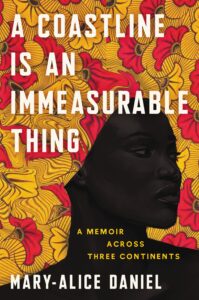
Taken from A coast is an immeasurable thing by Mary-Alice Daniel. Copyright © 2022. Available from Ecco, an imprint of HarperCollins Publishers.


