


The African Continental Free Trade Agreement (AfCFTA) is one of the emblematic projects of Agenda 2063, whose objective is to integrate and transform the continent into the largest single market for goods and services with an estimated value of 3.4 trillion dollars in GDP and 1.3 billion inhabitants. .
Faced with low levels of industrialization in Africa and other structural economic challenges, it remains an open question whether the AfCFTA can deliver on its promise to create a prosperous free trade area.
The main objectives of the AfCFTA agreement include: (i) phasing out trade tariffs; (ii) gradually eliminate non-tariff barriers; (iii) harmonize customs, trade facilitation, and border transit procedures; (iv) promote cooperation on technical barriers to trade (OTC) and sanitary and phytosanitary measures (MSF); (v) develop and promote regional and continental value chains; and (vi) promote socio-economic development, diversification and industrialization throughout Africa.
World Bank trade statistics for 2020 show that intra-African regional trade is among the lowest in the world at 15%, compared to 68% in Europe and 52% in East Asia and the Pacific.
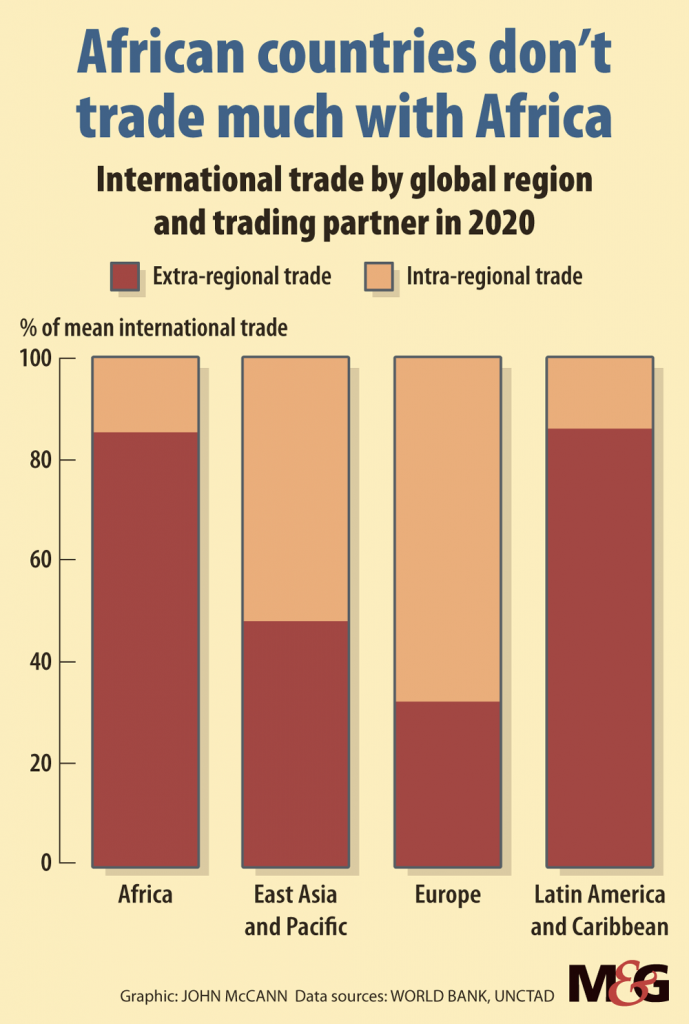
Although minimal, intra-African trade is mostly processed goods and services, with basic goods generally traded outside the region for little or no profit.
The pace and pattern of African industrial development continue to be of concern to development scholars and policy makers. Structural change on the African continent has been unusually slow, unlike the pattern seen in other parts of the world, where structural change is associated with rapid industrialization.
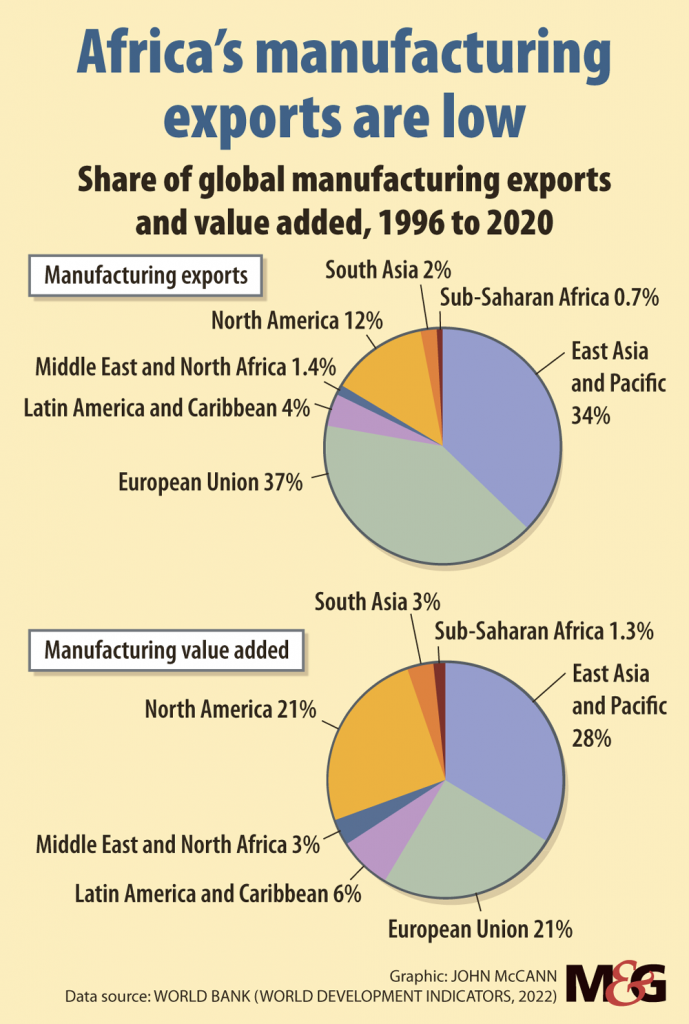
The graph above shows the global distribution of manufacturing exports and value added from 1996 to 2020. Sub-Saharan Africa’s contribution to global manufacturing remains the lowest in the world, averaging less than 1% in exports and more than 1% in added value.
Similarly, the contribution of the Middle East and North Africa to world manufacturing exports and value added shows 1.4 and 3%, respectively. Unlike East Asia and the Pacific, 34% of global manufacturing exports and 28% of global manufacturing value added.
In the context of questioning whether the AfCFTA can deliver on its promise to create a prosperous free trade area, there are three arguments in favor of the proposition that industrialization is a precondition for an effective free trade area in Africa.
commercial specialization
One of the objectives of the AfCFTA is to boost intra-regional trade. But the low levels of intra-African trade reflect the corresponding low levels of specialization of manufacturing exports. In that case, industrialization is a precondition for the success of the AfCFTA. There is a strong global correlation between the specialization of manufacturing exports and intraregional trade. The African and South Asian regions have the lowest shares of global manufacturing exports and the lowest shares of intra-regional trade. Most of the African economies specialized in the export of basic products.
In some African economies, commodity exports reach 90% of total merchandise exports. Given that small manufacturing and industrial production takes place on the continent, it is logical that intra-African trade remains small while showing a higher proportion of extra-regional trade.
Participation in the global value chain
the AfCFTA also aims to stimulate the development of regional value chains as a precursor to Global Value Chain (GVC) participation. But the feasibility of this goal remains to be determined, considering the current state of Africa’s industrial development. Participation in the global or regional value chain depends on the fragmentation of production between different countries with different comparative advantages to achieve profitability.
The data supports the view that some level of industrialization must take place before any value-adding participation in global value chains occurs. Therefore, African economies must prioritize the development of their industrial capacities and the creation of an industrial base to obtain the maximum benefit from a regional free trade area through participation in global value chains.
Industrial policy
Although trade agreements are good for preventing mercantilist policies of impoverishment of others and impoverishment of oneself that undermine the collective good of member countries. They could have unintended, self-limiting consequences if sufficient safeguards are not incorporated into the design and implementation.
For example, free trade agreements may limit the ability of low-income economies to effectively manage their industrial policies to address widespread market failures and other structural economic challenges. Since by entering into free trade agreements, countries relinquish some of their agency to coordinate industrial policy, it falls to the African Union to coordinate a broad-based continental industrial policy that benefits all parties.
With technical support from the United Nations Industrial Development Organization, the African Union should establish a regional industrial cooperation scheme as part of the industrial development arm of the AfCFTA economic cooperation, along the lines of the ASEAN Industrial Cooperation and other initiatives. similar regions.


