


Hawaii’s Mauna Loa volcano erupted for the first time in 38 years over the weekend, drawing some people to the sight and worrying others who had previous experiences with the volcano.
Officials initially feared that lava flowing down the side of the world’s largest volcano was headed south of Kona, but scientists later said the eruption moved into a zone of rifts on the volcano’s northeast flank and that he was not a threat to any community.
There were no evacuation orders from officials, but some people still decided to leave their homes as a precaution, prompting officials to open shelters in the Kona and Kau areas. Few people stayed in the shelters overnight and they closed Tuesday, Hawaii County Mayor Mitch Roth said.
Hawaii Volcano Observatory scientist Ken Hon said Tuesday that lava from the volcano was flowing at less than 1 mph, though it was unclear what the exact sap was. The lava was moving downhill about 6 miles from Saddle Road, which connects the east and west sides of the island, and the flow was expected to slow about 4 miles from the road as it reaches flatter terrain.
HAWAII’S MAUNA LAO: AERIAL VIDEO SHOWS LAVA FLOW FROM SUMMIT AS HISTORIC ERUPTION ATTRACTS TOURISTS
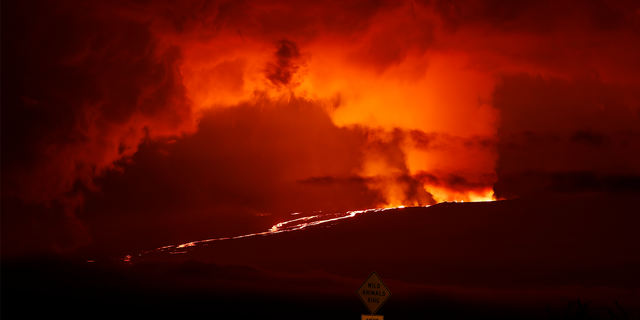
A river of lava flows from Mauna Loa, Monday, Nov. 28, 2022, near Hilo, Hawaii. Mauna Loa, the world’s largest active volcano, erupted Monday for the first time in 38 years.
It was not clear when or if the lava will hit the road. It could reach flatter ground later on Tuesday or Wednesday, Hon said.
“We’re not even sure it’s going to hit the road, but that’s certainly the next step in progress if it continues these trends,” Hon said. He also noted there’s a chance a fissure could open up and drain some of the supply. that feeds the flow.
Residents could smell the thick volcanic gases and sulfur that were in the air Tuesday along Saddle Road. People along the trail saw a large lava flow approaching. A large plume of gas and ash was also seen rising from an open summit vent above the flow after the clouds cleared.
“We are grateful that the lava flow is not impacting residential areas at this time, allowing schools and businesses to remain open,” Hawaii Gov. David Ige, D, said in a statement. “I am issuing this Emergency Proclamation now to allow first responders to respond quickly or limit access, if necessary, as the eruption continues.”
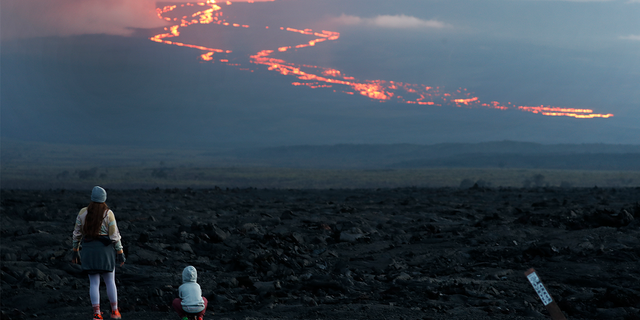
Spectators watch lava flow down a mountain from the eruption of Mauna Loa on Tuesday, November 29, 2022, near Hilo, Hawaii.
HAWAII’S MAUNA LOA, THE WORLD’S LARGEST ACTIVE VOLCANO, BEGINS TO ERUPT FOR THE FIRST TIME IN NEARLY FOUR DECADES
The volcano eruption has drawn visitors to Hawaii Volcanoes National Park, according to park spokeswoman Jessica Ferracane, who said the viewing has been “spectacular,” especially before dawn and at night.
Visitors were able to witness both the glow from Kilauea’s lava lake and the lava from a fissure on Mauna Loa.
“This is a rare time where we have two eruptions simultaneously,” Ferracane said.
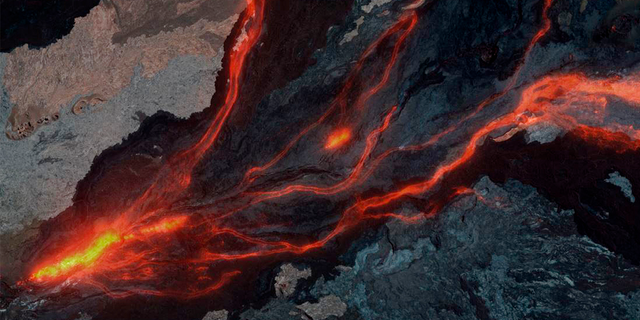
Waves of glowing orange lava and ash erupted from the world’s largest active volcano in its first eruption in 38 years, and authorities told people living on the Big Island of Hawaii to be prepared for the worst-case scenario.
(Maxar Technologies via AP)
CLICK TO GET THE FOX NEWS APP
Meanwhile, people in the northern Hilo neighborhood closest to the Mauna Loa eruption were wary, but not overly scared.
“If you were to look around my property, you would see jutting out lava rock formations,” said Mauna Kea resident Thomas Schneider. “We live on an active volcano, so everywhere there is some kind of lava zone.”
Associated Press contributed to this report.


