


Hawaii’s Mauna Loa is erupting for the first time in nearly 40 years, and according to scientists and officials, it does not appear to pose a threat to nearby communities.
Mauna Loa is the world’s largest and most active volcano, and on Monday it began spewing smoldering ash into the air and orange lava across the grounds of the big island of Hawaii.
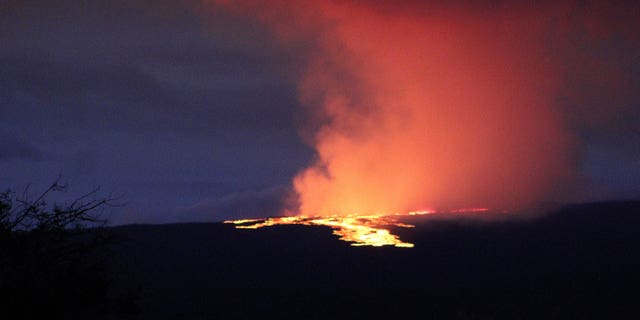
Lava flows from the summit crater of Mauna Loa around 6:35 am on Monday, November 28, 2022, as seen from the Gilbert Kahele Recreation Area in Maunakea, Hawaii. Mauna Loa, the world’s largest active volcano, began spewing ash and debris from its summit, prompting civil defense officials to warn residents Monday to prepare in case the eruption causes lava to flow. flow to the communities.
(Chelsea Jensen/Western Hawaii today)
Lava began pouring out of Moku’āweoweo, the summit caldera of the Mauna Loa volcano, at approximately 11:30 p.m.
HAWAII’S MAUNA LOA, THE WORLD’S LARGEST ACTIVE VOLCANO, BEGINS TO ERUPT FOR THE FIRST TIME IN NEARLY FOUR DECADES
The Hawaii County Civil Defense Agency issued a red alert as soon as the volcano erupted, saying the lava flows were contained within the summit area and did not threaten hillside communities.
Three hours later, the agency notified the public that shelters were opened at the Old Kona Airport in Kailua-Kona and at the Ka’u Gym in Pahala, adding that lava activity remained confined to the summit.
The agency’s latest announcement made Monday was that lava erupted from the summit and was visible in the northeast rift zone, but did not yet pose a threat to any communities.
EARTHQUAKES ROCK HAWAII’S MAUNA LOA VOLCANO DURING RIOTS, CAUSE MINOR DAMAGE
County Civil Defense pulled information from the US Geological Survey, which has been tracking the eruption since it began.
According to the Associated Press, the USGS warned the people of Hawaii that the eruptions were dynamic and that lava flows could change rapidly, warning residents to be prepared for worsening conditions.
Rift zones, like the one where lava appeared to be pouring out of the summit of Mauna Loa, are weakened areas that make it easier for magma to escape.
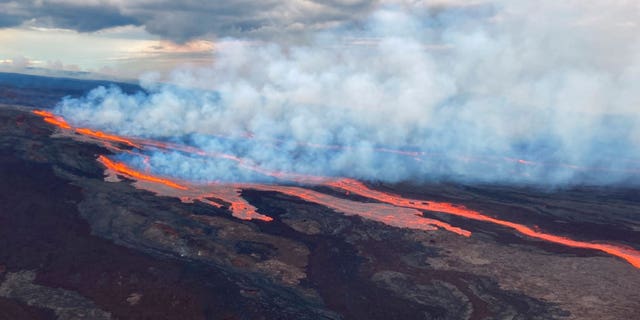
In this aerial photo released by the US Geological Survey, the Mauna Loa volcano is seen erupting from vents in the Northeast Rift Zone on the Big Island of Hawaii on Monday, November 28, 2022. Hawaii’s Mauna Loa, the world’s largest active volcano, began spewing ash and debris from its summit, prompting civil defense officials to warn residents Monday to prepare in case the eruption causes lava flows into the communities.
(US Geological Survey)
Although the rift zone to the northeast does not threaten immediate communities to the south or west, Hilo and other towns could eventually end up in the path of the lava. Of course, it could take weeks or months to reach those areas that are populated, according to the AP.
If the lava moves into a different zone of rifts to the southwest, it would only take hours or days to reach populated communities, the AP said.
THE BIG ISLAND OF HAWAII WARNED OF POSSIBLE ‘LAVA DISASTER’ AS HUGE RUMBA VOLCANO SURGES
Seismic activity around Mauna Loa increased in the days leading up to the eruption.
The county Civil Defense began broadcasting USGS reports of small earthquakes below the volcano in September, and as the days passed, the number of earthquakes increased and tsunami warnings were issued.
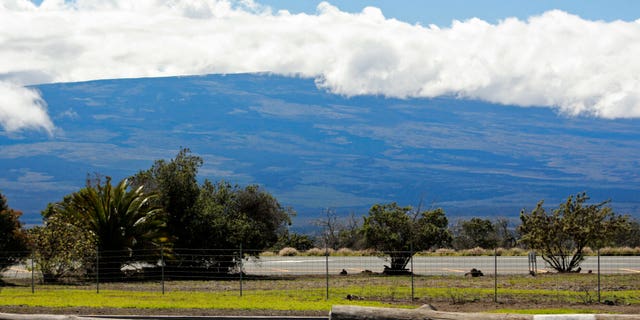
Mauna Loa is seen from the Gilbert Kahele Recreation Area on Saddle Road on the Big Island of Hawaii on October 27, 2022. The ground shakes and swells at Mauna Loa, the world’s largest active volcano, indicating it could enter erupting. Scientists say they don’t expect that to happen right away, but Big Island officials are telling residents to be prepared in case it breaks out anytime soon.
(Megan Mosely)
The agency issued the first yellow alert on October 19 after 18 small earthquakes of less than 3.0 magnitude were detected.
Some days there would be more than 40 earthquakes of magnitude 3.0 or less and the status on each advisory was that Mauna Loa was not erupting and “no sign of imminent eruption” until last night.
CLICK HERE TO GET THE FOX NEWS APP
Mauna Loa is part of a group of five volcanoes that make up the island of Hawaii, located at the southern end of the Hawaiian chain.
The volcano has a maximum altitude of 13,670 feet above sea level, and when it erupted in 1950, it took less than three hours for lava from the mountain to travel 15 miles to the ocean.
Its last eruption was in 1984, when it spewed out lava for 20 days. Sunday night’s eruption interrupted the volcano’s longest period of calm in recorded history.


