


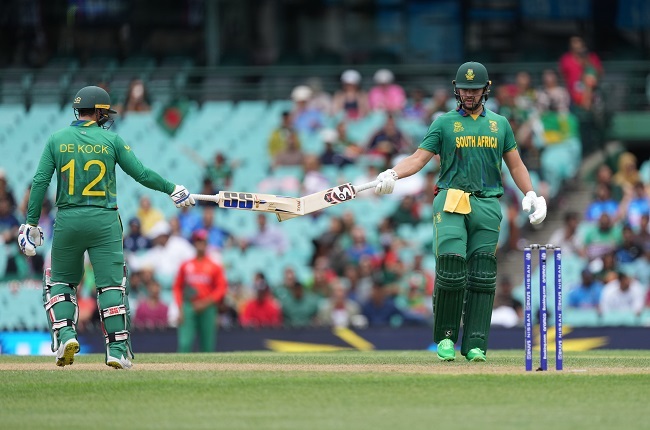
Quinton deKock and Rilee Rossouw. (Photo by Isuru Sameera Peiris/Gallo Images)
- Local cricket is likely to see an increasing number of domestic players opting for hybrid employment or even sacrificing international cricket for the riches of T20 leagues.
- In its latest Global Employment Report, FICA notes that 82% of players surveyed now combine a domestic contract with at least one gig in the T20 league, and 40% are full free agents.
- South Africa is barely affected, with 12 of the 16 Proteas-contracted players currently involved in hybrid employment arrangements.
South African cricket and its supporters, particularly purists, should prepare for more Quinton de Kocks and Rilee Rossouws on the national circuit than Dean Elgars.
That’s one of the key takeaways from the Federation of International Cricketers Associations (FICA) latest Global Employment Report for Men 2022, the survey that provides a fascinating and even mystifying snapshot of the state of the game from the players’ perspective.
No less than 40% of the world’s top T20 players are now full-fledged “mercenaries”, free agents not tied to any sort of national or domestic contract.
Additionally, 42% of players currently adopt a hybrid model for their employment, combining a national or domestic contract with at least one gig in one of the leading overseas T20 leagues.
This is particularly relevant to South Africa, where just four of the 16 players signed by Proteas (Elgar, Temba Bavuma, Keegan Petersen and Andile Phehlukwayo) do not have a T20 allowance on their radar to supplement their income.
On a broader level, it means that 82% of players around the world are not satisfied with just settling for a national contract.
“While historically the employment pathway for professional players was vertical, working upwards in their own country towards international honours/core contracts, increasingly, the employment pathway has expanded horizontally, with the opportunity to ply their trade by playing in multiple national leagues as a foreign player, either in addition to, or instead of his home contract,” FICA noted.
“This reporting period has seen the continuation of the trend of premature ‘brain drain’ to domestic leagues, which is driven by push and pull factors.”
De Kock has already stopped playing Test cricket and only plays for South Africa in the limited overs formats, while Proteas made their first foray into free agent selection by including Rilee Rossouw in their T20 squad mid-year for the last tilt failed. in the ICC T20 World Cup.
The example of 19-year-old Dewald Brevis, who certainly started playing a bit of domestic cricket for the Titans, also illustrates that local players in future might not even use domestic structures to claim an international selection.
However, the biggest factor for some leading players to reduce their international commitments and favor T20 leagues is the crowded playing schedule.
“We have recently seen the launch of the men’s and women’s Future Tours (FTP) program for the next four years, including an increase in the overall volume of ICC events and bilateral international cricket. There are a number of notable positives to both FTPs. the organization said.
“However, FICA remains concerned about the sustainability of filling the calendar with cricket, with no clearly delineated or agreed global windows recognizing how each of the game’s three main global arenas interact with each other (ICC Events/Bilateral International Cricket/Domestic Leagues ), and there is no real framework for how countries can program.”
Ironically, Cricket South Africa (CSA) has significantly reduced its traditional summer window for international cricket at the local level due to the recently established SA20 tournament, a last-ditch attempt to bolster its ailing finances, which requires a consistent time slot into the future. .
That said, the new league is likely to have a significant impact on pay levels for local cricket, which is currently significantly below the world average.
“The competition, which features six teams, all owned by existing IPL franchises, has raised R2.5bn and could be a financial game changer for cricket in South Africa,” FICA noted.


