


Melting mountain glaciers pose a growing flood risk to some 15 million people worldwide, researchers said in a report released Tuesday, with communities in Asia facing the greatest danger.
Runoff from melting glaciers often collects in shallow lakes, held back by rocks and debris. The risk arises when a lake bursts its banks, breaking through its natural barrier and sending a torrent of water into mountain valleys.
Scientists have assessed for the first time how many people around the world are at risk from these floods and found that more than half of the vulnerable populations live in India, Pakistan, China and Peru.
CALIFORNIA’S SIERRA NEVADA IS HIT BY WEEKEND WINDY STORM
The danger is greater, they report in a study published in the journal Nature Communications, when a large number of people live near a lake.
“Our work is not just about the size or number of glacial lakes; no disaster is natural; it is the presence of people, especially vulnerable people, in the landscape that causes a disaster,” said Stuart Dunning, a physical geographer at the University of Great Britain. Newcastle University, and co-author of the study.
Flash floods from glacial lakes are projected to worsen in warmer weather.
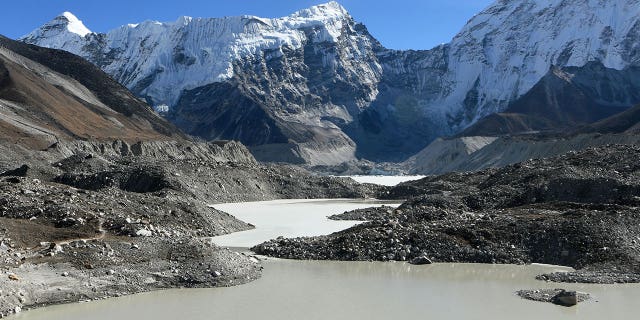
The glacial Lake Imja, a harbinger of catastrophic flooding, is seen in the Nepal Himalayas on November 22, 2018. (PRAKASH MATHEMA/AFP via Getty Images)
Collectively, the world’s glaciers lost about 332 gigatons of ice per year between 2006 and 2016. Since 1990, the number and volume of glacial lakes worldwide have each increased by about 50%.
In the high mountains of Asia, some 9 million people live near more than 2,000 glacial lakes. In 2021, more than 100 people died in India in a flash flood in the northern mountains.
THE SOUTHWEST WAITS TO SEE STORMS TO BRING MORE SNOW AND RAIN
heating up the himalayas
Compared to mountain glaciers in the Alps and North America, the frozen places of Asia are not as well monitored; most lack long-term observations of how they have changed over time.
The best-studied glacier in the Himalayas is northern India’s Chhota Shigri, which has 20 years of mass balance measurements: the difference between the amount of ice a glacier gains and loses in a year.
In 2022, India suffered from scorching temperatures, and near the end of the year, scientists headed to the Himalayas to measure the mass of Chhota Shigri.
CLICK HERE TO GET THE FOX NEWS APP
Their findings, shared with Reuters, revealed that the best-studied Himalayan glacier had experienced its worst year on record; Chhota Shigri lost three times as much mass in 2022 compared to its annual average from 2002 to 2022.
“The impacts are already visible as the glacier thins and retreats,” said Farooq Azam, a glaciologist at the Indian Institute of Technology in Indore who monitors Chhota Shigri. This will have an “impact on the availability of water downstream in the near future,” he said.
Satellite observations also show that the Himalayan glaciers are in a general state of decline.
“The ice is really melting significantly over the last few decades, the mass loss is accelerating,” said Tobias Bolch, a glaciologist at the Graz University of Technology in Austria.
From 1990 to 2015, glacier coverage in the Himalayas dropped by about 11%, according to a July 2022 study.
During the same time period, Himalayan glacial lakes increased by about 9% in number and 14% in area. More than 200 lakes now pose a very high danger to Himalayan communities, according to 2022 research.


