


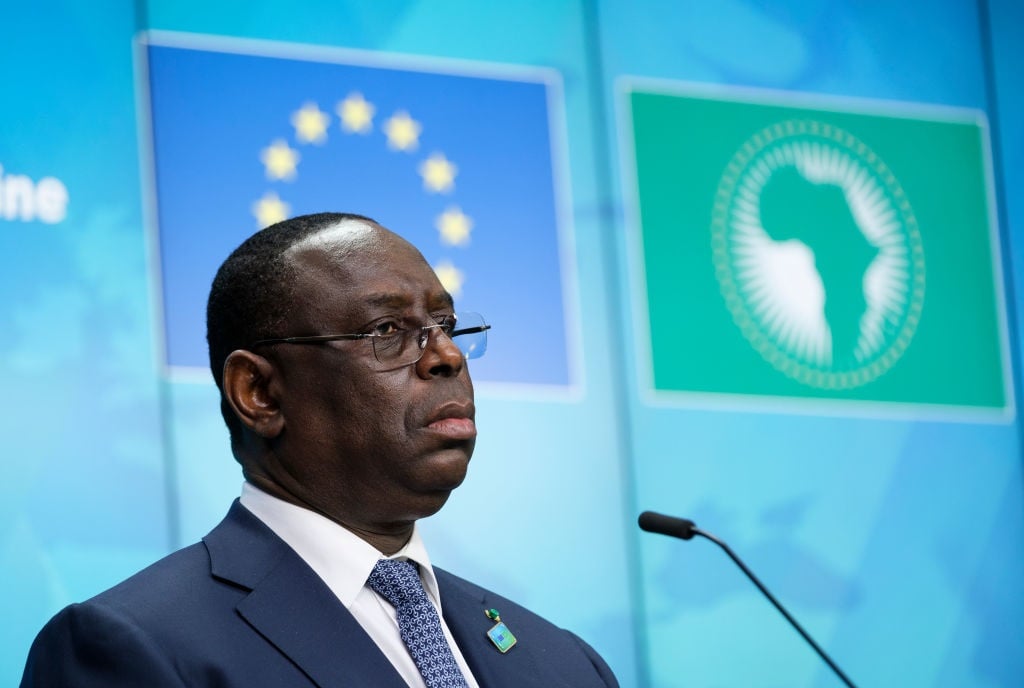
President of Senegal and of the AU, Macky Sall.
Thierry Monasse/Getty Images
- Senegal will host the Dakar 2 – Feed Africa Summit, which will bring together private companies, politicians and technocrats in agribusiness and finance.
- Summit attendees will seek to accelerate Africa’s food security ambitions and the achievement of zero hunger by 2030.
- Africa’s food and agriculture sector is projected to triple to US$1 trillion by 2030.
The Dakar 2 – Feed Africa Summit, co-sponsored by the African Development Bank (AFDB), will be the last major continental gathering of outgoing African Union (AU) President Macky Sall.
Sall, who is also president of Senegal, will hand over the AU presidency in Ethiopia next month to President Azali Assoumani of Comoros.
The summit will begin on Friday in Dakar, the Senegalese capital, and will bring together at least 20 African heads of state, as well as private sector financiers, agricultural technocrats and aid agencies.
International sponsors of the summit include the Islamic Development Bank, the Food and Agriculture Organization of the United Nations, the International Fund for Agricultural Development, the Bill & Melinda Gates Foundation, the Alliance for a Green Revolution in Africa and various bilateral partners. .
Stakeholders at the three-day summit will seek to “accelerate Africa’s food security ambitions and the achievement of zero hunger by 2030,” the AFDB said in a statement.
READ | Russian oil price cap could save African countries billions, says Yellen
At the World Economic Forum last week, a report released by the African Continental Free Trade Area (AFCFTA) identified agriculture as one of four industries poised for rapid growth in Africa.
The AFDB said the Feed Africa summit would work on “reshaping the business of food and agriculture in Africa.”
The summit is important for Africa which, according to World Bank records, is home to 30% of the world’s food insecure people, estimated at 850 million people.
The AFDB said the removal of trade barriers in the agricultural industry, a move advocated by the AFCFTA, would boost Africa’s trade and food security three-fold by 2030.
The AFDB said:
With the removal of barriers to agricultural development with the help of new investment, it is estimated that Africa’s agricultural production could increase from $280 billion per year to $1 trillion by 2030.
By the end of the summit, the private sector is expected to commit to developing critical value chains in food production, value addition and distribution.
News24 Africa Desk is supported by the Hanns Seidel Foundation. The stories produced through the Africa Desk and the opinions and statements that may be contained in this document do not reflect those of the Hanns Seidel Foundation.


