


Senior US military and national security officials confirmed Wednesday that the Chinese spy balloon shot down off the coast of South Carolina over the weekend was linked to a major surveillance program run by China’s military.
The program has been largely carried out in the Chinese province of Hainan Island, off the southeast coast in the South China Sea, by the People’s Liberation Army (PLA). It is known to operate in regional neighbors such as Japan, Taiwan, Vietnam, the Philippines and India, The Washington Post first reported.
But these surveillance balloons, used to collect military intelligence from nations that are of strategic interest to Beijing, have sprung up over the US before, too.
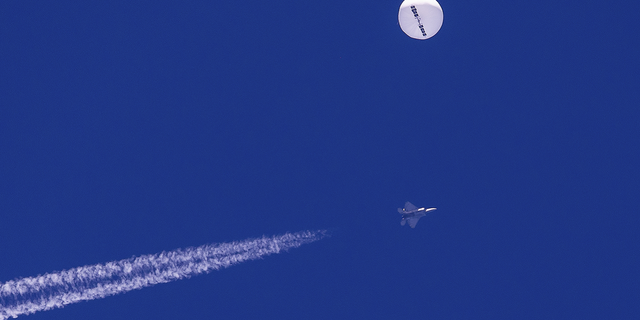
A large balloon drifts over the Atlantic Ocean, off the coast of South Carolina, with a fighter jet and its contrail seen below it on Saturday. (Chad Fish via AP)
CHINA FILES A ‘PROTEST IN STERN’ OVER THE DOWNING OF A SPY AIRCRAFT, CALLS US ‘IRRESPONSIBLE’
Another Chinese spy balloon was discovered four months ago after it crashed in the Pacific Ocean near Hawaii, Fox News confirmed earlier this week. Three more Chinese surveillance balloons were found to have flown over Texas, Florida and Guam during the Trump administration.
Press Secretary, Department of Defense Brig. General Patrick Ryder told reporters Wednesday that the United States had been tracking China’s surveillance practices before the last balloon arrived in the United States last week.
“We are now learning more about the scale of this Chinese balloon surveillance program, which US intelligence and the Pentagon have been watching for several years,” he said. “Our awareness and understanding of this ability has increased.”
It is not clear how long Beijing has been operating the spy program that relies on antiquated balloon technology along with modern surveillance techniques. Spy balloons have been seen on five continents since 2018.
“When you look at the scope of this program, which operates on at least five continents in regions like Latin America, South America, Southeast Asia, East Asia and Europe, again, it shows why, for the Department of Defense, China It’s still the pace challenge and something we’ll continue to focus on,” added Ryder.
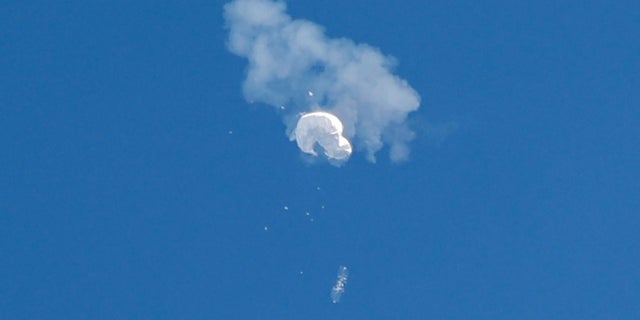
The suspected Chinese spy balloon drifts into the ocean after being shot down off the coast of Surfside Beach, South Carolina, on Saturday. (REUTERS/Randall Hill)
Most of the PLA’s surveillance program is carried out through the use of satellites, but Beijing also apparently sensed an opportunity for additional intelligence gathering.
CHINA REFUSED CALL WITH PENTAGON AFTER F-22 DOWNED ON SPY FLIGHT
The balloons travel through the upper atmosphere, hovering between 60,000 and 80,000 feet above Earth, above where commercial airliners travel.
White House press secretary Karine Jean-Pierre told reporters Wednesday that “these balloons are part of a PRC [People’s Republic of China] fleet of balloons developed to conduct surveillance operations” and said they have “violated the sovereignty” of various nations.
China has sought to cancel the surveillance balloon that floated across the US for seven days before being shot down when a weather balloon veered off course.
But US defense officials have dismissed these claims.
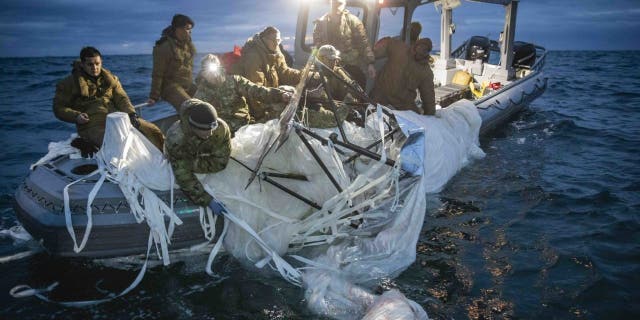
US forces transport debris from China’s surveillance balloon to a boat off the coast of South Carolina. (US Fleet Forces)
National Security Council strategic communications coordinator John Kirby said Monday that the United States “took steps to mitigate any gathering capabilities that the balloon might have over our sensitive military sites.”
He also told reporters that the US decision not to shoot down the balloon until it was safely over the Atlantic “provided us with an excellent opportunity to gain a better understanding to study the capabilities of this balloon.”
CLICK HERE TO GET THE FOX NEWS APP
Under Secretary of State Wendy Sherman briefed nearly 150 diplomats from 40 embassies around the world on Monday about China’s spy program.
The United States has also begun sharing specific details about its findings with allies such as Japan, whose military has been a direct target of Beijing’s efforts.


