


The birth of Stanley Francis Rother was normal in every way, apart from the weather. The Catholic farmer was born during a dust storm in Oklahoma.
But in life, and in death, he was extraordinary.
The 46-year-old priest, shot to death in Guatemala in 1981, became the first person born in the United States to be declared a martyr by the Catholic Church.
Now, a $50 million shrine built to honor the slain missionary, killed by three masked assassins who entered his rectory during Guatemala’s civil war, is expected to draw thousands of pilgrims to his home state.
“People from all over the world can come and find out more about him and really ask for his intercession,” said María Ruiz Scaperlanda, author of “The Pastor Who Didn’t Run,” a 2015 biography of Rother.
A dedication Mass scheduled for Friday will mark the official opening of the Blessed Stanley Rother Shrine in Oklahoma City. The Spanish Colonial-style structure incorporates a 2,000-seat sanctuary, as well as a visitor center, gift shop, museum, and a smaller chapel that will serve as Rother’s final resting place.
CANADIAN PASTOR REPEATEDLY INCARCERATED OVER COVID PROTOCOLS TO FACE DOOM JUDGMENT: ‘CRAZY STUFF’
The shrine grounds will also feature a recreation of Tepeyac Hill, the Mexico City site where Catholics believe the Virgin Mary appeared to an indigenous Mexican man named Juan Diego in 1531. An artist created painted bronze statues of Our Lady of Guadalupe and St. Juan Diego, each weighing thousands of pounds, for the Oklahoma site.
Catholic donors funded the shrine, which was built debt-free, Oklahoma City Archbishop Paul S. Coakley said.
“I think there are a lot of different things that will draw people to campus, whether it’s honoring Maria, Juan Diego or Blessed Stanley Rother,” Coakley said. “We hope it will be an opportunity for people to experience faith and grow in their relationship with the Lord.”
The Oklahoma complex joins nearly 120 national and diocesan Catholic shrines in 27 states and the District of Columbia, according to the National Association of Shrine and Pilgrimage Apostolate.
Before becoming CEO of Rother Shrine in 2020, Leif Arvidson oversaw Our Lady of Guadalupe Shrine in La Crosse, Wisconsin for a decade. About 75,000 pilgrims visited each year, Arvidson said.
He declined to estimate how many visitors Rother’s sanctuary might attract.
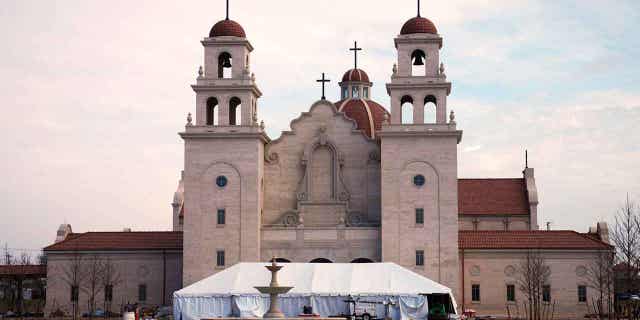
Construction of the Blessed Stanley Rother Shrine will take place on February 2, 2023 in Oklahoma City. (AP Photo/Sue Ogrocki)
“We’re still kind of a minority here,” Arvidson said of Oklahoma’s Catholic population.
Evangelical Protestants make up the majority of adults in the Bible Belt state at 47%, according to the Pew Research Center. Mainline Protestants follow with 18%. Catholics are next with 8%.
“I think it will be really special not only for Catholics but also for Oklahomans and just people who will recognize the beauty of the virtues that he exhibited: service, humility and dedication to God’s call in the life of a person,” Arvidson said.
Zac Craig, president of the Oklahoma City Convention and Visitors Bureau and a Southern Baptist, echoed Arvidson’s assessment.
CATHOLIC BISHOP SENTENCED TO DECADES IN PRISON FOR TREASON AFTER REFUSING EXILE FROM US: ‘Rampant Hate’
“It really adds to the cultural mix of the various attractions that we have…I think it’s going to be appealing to everyone,” Craig said, citing the city’s new Museum of the First Americans, as well as the national memorial for the bombing. of 1995 against a federal building. office building.
Rother’s story begins with his birth in 1935 in Okarche, a small town about 40 miles northwest of Oklahoma City.
While serving as an altar boy at his hometown’s Holy Trinity Catholic Church, Rother seemed destined for life on the farm. He studied vocational agriculture in high school, while his brother Tom took a course in Latin, a language long associated with Catholicism.
Family members couldn’t help but laugh when Stan, not Tom, later became a clergyman. But the road to the priesthood turned out to be a struggle. He dropped out of his first seminary but eventually graduated from another before his ordination in 1963.
He served in various parishes in Oklahoma before volunteering for mission work in Santiago Atitlán, Guatemala, in 1968.
During his 13 years in the Central American nation, the priest who once struggled with Latin learned Spanish and the Tzʼutujil language from his parishioners. He worked to translate the New Testament gospels into the native dialect.
Amid political and military unrest in the late 1970s, parishioners began to disappear and their bodies were found dumped on the side of roads. By 1981, Rother knew he was on a “hitlist,” according to the Archdiocese of Oklahoma City.
His last visit home came a few months before his assassination on July 28, 1981. He accepted an invitation to see his younger cousin, the Rev. Don Wolf, join the priesthood and celebrate his first Mass as a priest in May.
“We talked a lot about the dangers he faced,” recalled Wolf, now 67.
But Rother insisted on returning to Guatemala, telling his loved ones: “The pastor can’t run.”
Rother became one of at least 13 Catholic priests killed during the war, branded as communists in cahoots with left-wing revolutionary guerrillas.
Now his cousin will be the first rector of the sanctuary. In addition to welcoming pilgrims, the new church will become the place of worship for two of the city’s growing Hispanic parishes. They will be combined into one, relieving overcrowding in existing facilities.
Wolf said it’s an exciting time, both for the memory of his cousin and for the opportunity to grow the church in a state with a growing Latino population.
“Stan has grown into an incredible character,” Wolf said of the stories told about Rother. “I have always been proud to be part of his family. But I’ve always felt more connected to Stan because I’m a priest in the Archdiocese of Oklahoma City than because he has the same last name as my mother. “
CLICK HERE TO GET THE FOX NEWS APP
In December 2016, Pope Francis officially recognized Rother as a martyr. In September 2017, in the final step before sainthood, Rother was beatified at a special Mass that drew an estimated 20,000 people, making him the first American priest to be beatified.
For Rother to become a saint, a miracle involving his intercession must take place.
“It’s a very rigorous process,” Coakley said. “The church tends to be very skeptical of claims of miraculous healings, until it can be proven that they are not attributable to science or anything else.”
“It could be a long time,” the archbishop added. “It may never happen, for all we know, because we can’t predict how God will act.”
Scaperlanda, a Rother biographer and an Oklahoma City Catholic, said she loves that a boy raised in humble circumstances in Central America has a shrine named after him.
“He’s normal in that sense, and I think that’s one of the priceless gifts he gives us,” he said. “If he can do it, then I can live my best life that God put me here for. I mean, I don’t have to be martyred like he was, but to give myself so completely to something, that’s value.” what I want.
“I can ask Father Stan to help me live like he did.”


