


China sent a spacecraft carrying three astronauts to its space station for the first in-orbit crew rotation in Chinese space history, launching the operation of the second inhabited outpost in low-Earth orbit after the International Space Station led by The NASA.
The Shenzhou-15 spacecraft, or “Divine Ship,” and its three passengers lifted off on a Long March-2F rocket from the Jiuquan Satellite Launch Center at 11:08 p.m. Tuesday amid freezing temperatures in the Gobi desert in northwest China. , according to state television.
Shenzhou-15 was the last of 11 missions, including three previous manned missions, beginning in April 2021 needed to assemble the “Heavenly Palace,” as the multi-module station is known in Chinese.
CHINA LAUNCHES THE THIRD AND LAST SPACE MODULE TO COMPLETE THE SPACE STATION
The trio will replace the Shenzhou-14 crew that arrived in early June. The previous crew members are expected to return to Earth in early December after a week-long handover that will also establish the station’s capacity to temporarily house six astronauts, another record for China’s space program.
The space outpost took its current “T” shape in November with the arrival of the last of the three cylindrical modules.
The station has a designed lifespan of at least a decade, and resident astronauts are expected to perform more than 1,000 science experiments, from studying how plants adapt in space to how fluids behave in microgravity.
The “Heavenly Palace” was the culmination of nearly two decades of Chinese manned missions into space. China’s manned spaceflight began in 2003 when a former fighter pilot, Yang Liwei, was sent into orbit in a small bronze-colored capsule, the Shenzhou-5, and became China’s first man in space and into an instant hero acclaimed by millions at home.
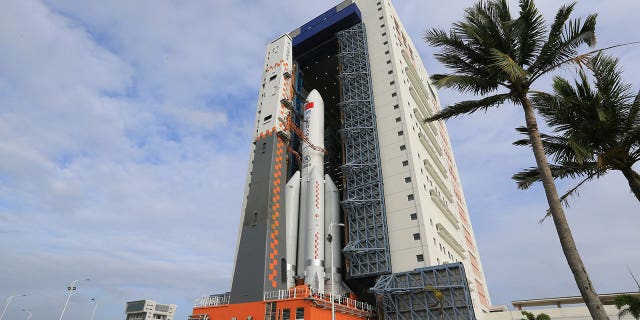
The laboratory module of China’s Mengtian space station and the Long March-5B Y4 rocket are transported to the launch area in south China’s Hainan Province on October 25, 2022.
(You Haichao/Xinhua via AP)
The space station was also emblematic of China’s growing influence and confidence in its space endeavors and a challenge to the United States in dominance, having been cut off from the NASA-run ISS and prohibited by US law from any collaboration, direct or indirect. with the US space agency.
The Shenzhou-15 mission, during which its crew will live and work on the space station for six months, also offered the nation a rare moment to celebrate, amid widespread discontent over China’s stifling zero-COVID-19 policies. as its economy hits the brakes amid uncertainties at home and abroad.
“Long live the homeland!” wrote many Chinese netizens on social media.
NASA’S SPACE CAPSULE ROUNDS THE MOON
Future ‘Taikonauts’
Leading the Shenzhou-15 mission was Fei Junlong, 57, who hailed from China’s first batch of astronaut trainees in the late 1990s. His previous visit to space was 17 years ago as commander of the second spaceflight. Chinese manned.
Fei was flanked by Deng Qingming, 56, who had trained for 24 years as an astronaut but had never been chosen for a mission until Shenzhou-15. They were joined by former air force pilot Zhang Lu, 46, also a space debutant.
During the operation of the space station for the next decade, China is expected to launch two crewed missions to the orbiting outpost every year.
The next batch of “taikonauts,” coined from the Chinese word for space, set to set foot on the station in 2023 will be chosen from the third generation of science-trained astronauts. The first and second groups of astronauts in the 1990s and 2000s were all former air force pilots.
CLICK TO GET THE FOX NEWS APP
China has started the selection process for the fourth batch, looking for candidates with doctoral degrees in disciplines ranging from biology, physics and chemistry to biomedical engineering and astronomy.
The selection process has also been opened to candidates from Hong Kong and Macao for the first time.
While still in its infancy compared to NASA technologies and expertise, China’s space program has come a long way since the mid-20th century, when the country’s late leader Mao Zedong lamented that China couldn’t even put a potato in orbit


