


The California government seeks to pay reparations to some 600 people alive today who were sterilized, sometimes against their will, as part of state programs.
The state is seeking to provide $15,000 to people in two groups: those sterilized by the government during the so-called eugenics movement that peaked during the 1930s and a smaller group that was victimized in state prisons a decade ago.
But after a year of searching, the state has only approved payments to 51 people out of 310 applicants due in part to problems verifying the information.
There is a year left before the $4.5 million program closes, and state officials have denied 103 people, closed three incomplete applications, and are processing another 153. Many records needed to verify applications have been lost or destroyed over the years. authorities said.
California in 2021 was the third state to pass a reparations program for forced sterilizations, after North Carolina and Virginia. But California was the first state to also include more recent victims of its state prison system.
INCOMING CALIFORNIA CONGRESSMAN TO TAKE AN OATH ON THE US CONSTITUTION, SUPERMAN COMIC

Moonlight Pulido poses for a portrait on Wednesday, Dec. 7, 2022, in Los Angeles. California is paying reparations to the victims, mostly women, who were forcibly or coercively sterilized by the government. Pulido was sterilized while incarcerated in 2005.
(AP Photo/Marcio José Sánchez)
The eugenics movement sought to prevent some people with mental illness or physical disabilities from having children, and California had the largest forced sterilization program in the country, sterilizing about 20,000 people as of 1909.
The state did not repeal its eugenics law until 1979.
A state audit found that 144 women were sterilized in California prisons between 2005 and 2013 with little or no evidence that they received counseling or offered alternative treatments. State lawmakers responded by passing a law in 2014 to ban prison sterilizations for birth control and allow other medically necessary procedures.
UNIVERSITY OF CALIFORNIA APOLOGIZES FOR ‘UNETHICAL’ EXPERIMENTS ON PRISONERS
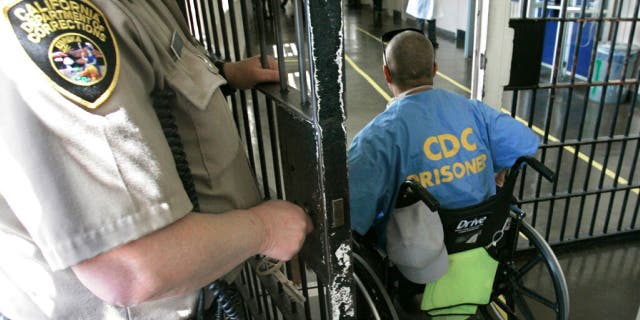
A wheelchair-bound inmate passes through a checkpoint at the California Medical Center in Vacaville, California, on April 9, 2008. A prominent California medical school has apologized for performing unethical experimental medical treatments on 2,600 incarcerated men. in the 1960s and 1970s.
((AP Photo/Rich Pedroncelli, File))
Of the 45 people approved for repairs so far, only three were sterilized during the eugenics era, and sterilization victims in prison have been much easier to find because the records are on file.
“We try to find as much information as we can, and sometimes we just have to hope that someone can find more detailed information on their own,” said Lynda Gledhill, an executive officer with the California Victim Compensation Board that oversees the program. “Sometimes we just can’t verify what happened.”
One of the victims, Moonlight Pulido, was serving a life sentence for attempted murder when a prison doctor told him in 2005 that he needed tumors removed that could be cancer. She signed a form and had surgery, but then noticed something didn’t feel right and a nurse told her she had a full hysterectomy where her uterus and cervix were removed.
CALIFORNIA MAN INTENTIONALLY DRIVEN TESLA OFF THE CLIFF WITH ANOTHER ADULT, 2 CHILDREN IN CAR: AUTHORITIES

Polished Moonlight along the shoreline of Harbor Lake on Wednesday, December 7, 2022, in Los Angeles. California is paying reparations to the victims, mostly women, who were forcibly or coercively sterilized by the government. Pulido was sterilized while incarcerated in 2005.
(AP Photo/Marcio José Sánchez)
Polished was surprised. She was 41 years old at the time, she already had children and she said that the doctor took away her right to start another family, something that affected her deeply.
“I am a Native American, and we as women are connected to Mother Earth. We are the only givers of life, we are the only ones who can give life, and he stole that blessing from me,” she said. . “I felt less than a woman.”
CLICK HERE TO GET THE FOX NEWS APP
Pulido was paroled in January 2022. Working with the advocacy group Coalition for Women Prisoners, she requested reparations and was approved for a $15,000 payment.
“I sat there and looked at it and cried. I cried because I’ve never had that much money in my life,” he said.
Associated Press contributed to this report


