


Africa’s public health agency says countries with deadly cholera outbreaks on the continent do not have “immediate access” to vaccines amid a global shortage of supplies.
The acting director of the African Centers for Disease Control and Prevention, Ahmed Ogwell, told reporters on Thursday that the agency is working with the World Health Organization and the GAVI vaccine alliance to obtain more doses.
The Africa CDC is also working with two local manufacturers to explore whether their facilities can be repurposed to make cholera vaccines, Ogwell said. He did not say which ones.
WORST OUTBREAK OF CHOLERA IN 2 DECADES BREAKS MALAWI, CLAIMS 750 LIVES
The WHO and partners recommended in October that countries temporarily switch to using a single dose of cholera vaccine instead of two due to tight supplies as outbreaks of the waterborne disease increase across the world. the world. They said one dose of the vaccine has been shown to be effective in stopping outbreaks “although evidence on the exact duration of protection is limited” and appears to be less in children.
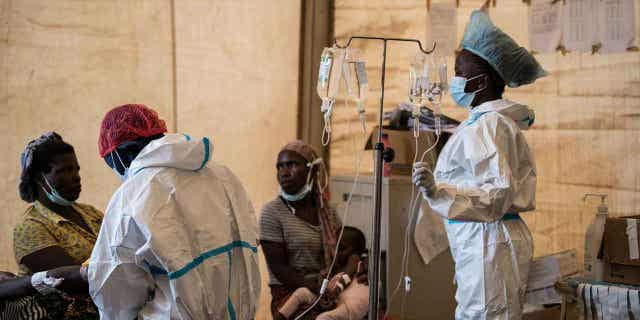
A woman carries her son, who has cholera, at Bwaila Hospital in Lilongwe, central Malawi, on January 11, 2023. Countries in Africa that have been affected by cholera outbreaks lack “immediate access” to the vaccines.
(AP Photo/Thoko Chikondi)
The WHO noted that Haiti and Syria are also trying to contain large outbreaks. WHO and partner agencies manage a stock of cholera vaccines that are distributed free of charge to countries that need them.
CHOLERA OUTBREAKS THREATEN CHILDREN’S SURVIVAL IN FLOOD-AFFECTED STATE OF NIGERIA
Malawi, in southern Africa, is especially battling a cholera outbreak. The country has registered 3,577 new cases, including 111 deaths in the past week, Ogwell said. They make up the majority of new cholera cases on the continent.
Since the beginning of 2023, there have been 27,300 new cholera cases, including 687 deaths in five African countries, Ogwell said.
CLICK HERE TO GET THE FOX NEWS APP
The WHO has said that climate change could make cholera epidemics more common, as the bacteria that cause the disease can reproduce more quickly in warmer waters.


