


Iranian women have taken to the streets to protest the country’s repressive laws against women, and women in neighboring Afghanistan are taking notice.
Widespread protests erupted in cities across Iran after the death of 22-year-old Mahsa Amini on September 16 while detained by morality police for violating Iran’s strict laws requiring women to cover their hair in public. What started as initial outrage over Amini’s tragic death quickly turned into anti-government protests and calls for the fall of the revolutionary regime of Ayatollah Ali Khamenei.
The crackdown on Iran’s security forces, particularly the Basij paramilitary force within the Iranian Revolutionary Guard, has been severe. Since the protests began in mid-September, the US-based Human Rights Activists news agency estimated that more than 400 protesters have been killed and at least 18,000 arrested.
Women in Afghanistan see a familiar pattern against Iranian women, albeit on a much smaller scale at the moment. Protests for women’s rights are nothing new to Iranian or Afghan society, and the movements in each country have influenced each other due to cultural, linguistic, and geographic proximity.

Afghan women shout slogans during a rally to protest what protesters say are the Taliban’s restrictions on women, in Kabul, Afghanistan, December 28, 2021.
(Reuters/Ali Khara)
ANGER AT IRAN PROTESTS IN THE STREETS AS OFFICIALS RENEW THREATS
Protesters in Iran have not lost sight of their neighbors in Afghanistan, who are also locked in a fight against an oppressive regime that restricts women’s rights. Women on the streets show unity through graffiti art and protest chants.
Whether the protests in Iran will have a cascading effect on Afghanistan and the wider region will depend on how well the movement can withstand the regime’s forceful response and whether it can survive the continued crackdown.
The mandatory hijab has long been a source of domestic discontent for Iranian women since it was first implemented after the 1979 Islamic Revolution. Thousands marched in the streets to oppose its rule in the early days of the new regime.
“The profound difference between protests today and those of the past is that they are led by women, not prominent women, but often schoolgirls. This may allow the current Iranian protest movement to endure despite government crackdown efforts.” said Fatemeh Aman, a non-resident. senior fellow at the Middle East Institute, told Fox News Digital.
Observers say that for Afghan women, the women’s rights agenda does not have the national reach or support that the current Iranian protests have garnered from broad swaths of society.

A protester displays a portrait of Mahsa Amini during a demonstration to support Iranian protesters opposing his leadership over the death of a young woman in police custody, Sunday, Oct. 2, 2022, in Paris.
(AP Photo/Aurelien Morissard)
LIFE UNDER TALIBAN GOVERNMENT A YEAR LATER: WOMEN AND GIRLS STRUGGLE UNDER OPPRESSIVE POLICIES
Belquis Ahmadi, senior program officer for Afghanistan at the US Institute of Peace, notes that while protests have sprung up in several provinces outside of Kabul, the internal political situations in Iran and Afghanistan are very different.
“Iranians have had nearly four decades to strategize and expand their networks between men and women. In Iran, men have come out to support women, while in Afghanistan we don’t see the level of public support from men that we would expect. Ahmadi told Fox News Digital.
Recently, a small group of women took to the streets of Kabul to express their solidarity with the women protesters in Iran. Women gathered in front of the Iranian embassy in Kabul chanting “woman, life, freedom”, a common slogan that can be heard on the streets of Iranian cities during recent protests. This comes on the heels of a deadly terrorist attack on September 30 at a tutoring center in the Dasht-e-Barchi area of western Kabul, a predominantly Hazara and Shia community.
The attack killed at least 53 people, including 46 girls and women. The protesters, mostly university students, took to the streets to demand answers and justice for their deaths. Taliban security forces quickly dispersed all these protesters with brute force.
Since returning to power in August 2021, the Taliban have reversed many of the rights that women had won over the 20 years since the Taliban were first ousted from power in 2001, shortly after the terror attacks. of September 11.
Women held government posts, participated in civic life, and enjoyed greater professional and educational opportunities. The Taliban quickly reverted to their old ways after initial assurances that they had modernized. Just as the anxious young women were about to return to school in March 2022, the Taliban reneged on their promise to allow girls older than sixth grade to return to school. Taliban fighters guarded school entrances and refused to let girls into class.

Afghan women sing and hold signs to protest during a demonstration in Kabul, Afghanistan, Saturday, March 26, 2022. Afghanistan’s Taliban rulers refused to allow dozens of women to board several flights, including some abroad, because they were traveling without a male guardian. two Afghan airline officials said on Saturday.
(AP Photo/Mohammed Shoaib Amin)
AFGHANISTAN A YEAR LATER: HOW DAILY LIFE IN THE WAR-TORNED COUNTRY HAS CHANGED SINCE THE TALIBAN TAKEOVER
The Taliban’s control over society extends beyond education and they exert near total control over all aspects of Afghan life.
Afghanistan’s Ministry for the Propagation of Virtue and Prevention of Vice, essentially the equivalent of Iran’s moral police but said to be even more archaic and brutal, is also tasked with monitoring the behavior of Afghan women in the public sphere. Among the many restrictions placed on Afghan women by the new Taliban government; women are now forced to cover their faces and entire bodies. Women cannot control the type and color of the clothes they wear, they cannot go to public parks, gyms, choose their own profession or leave the house without a male guardian.
“The Taliban have turned Afghanistan into a huge prison for women and girls,” Ahmadi said.
Despite the odds, Afghan women have still come out to challenge Taliban rule, even in the face of public beatings.
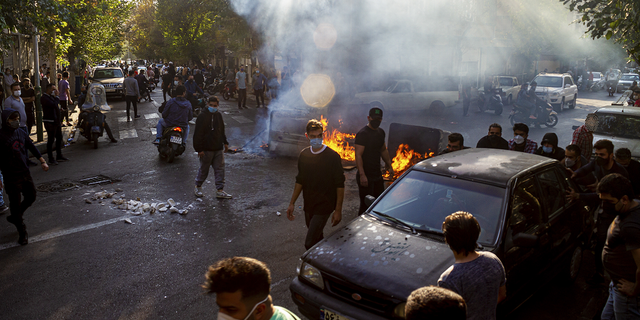
Iranians protest the death of 22-year-old Mahsa Amini after she was detained by the moral police last month, in Tehran, Thursday, October 27, 2022.
(AP Images/Middle East, File)
Pashtana Durani, founder of LEARN Afghanistan, a nonprofit organization that helps expand educational opportunities in Afghanistan, said the protests in Iran and Afghanistan are like a rising tide of women saying they’ve had enough.
CLICK HERE TO DOWNLOAD THE FOX NEWS APP
“Women are fed up with men using religion to control women. And that is why they want to not only free themselves from a regime that oppresses them, but also to show solidarity and believe in a better world for them and the next generations,” Durani told Fox Digital News.


