



Troubadour troupes, better known as the Klopse parade, celebrate the Tweede Nuwe Jaar in Cape Town.
- People flocked to the Tweede Nuwe Jaar celebration in Cape Town on Monday.
- The festival returned after the Covid-19 pandemic forced a two-year hiatus.
- The festival has its roots in colonial times, when slaves brought from other countries were allowed to relax on New Year’s Day.
Dressed in a green shirt with yellow and white polka dots, a blue pacifier in his mouth, two-year-old Thaakir Buzic led a colorful band through the streets of Cape Town, South Africa, from the safety of his home on Monday. his grandfather. arms.
Around 20,000 performers divided into dozens of groups marched through the city center as they played music and danced for the annual Cape Town Minstrel Carnival.
Returning after a covid-induced two-year hiatus, the celebration, also known as Tweede Nuwe Jaar, is a family affair for Buzic’s relatives.
The boy is the youngest of 13 family members, led by his 68-year-old great-aunt, who will participate in the parade as dancers for the 1,000-member company of Playaz Inc.
“We are very, very excited. Everything is good today,” said Buzic’s grandfather, Ridewaan Daniels, 47.
Tambourine in hand, Buzic hopped from one leg to the other as brass players rehearsed outdoors at a school in Mitchells Plain, near Cape Town, on New Year’s Eve.

Artists play music at a parade to commemorate the Tweede Nuwe Jaar in Cape Town.
“It is in the comparsas that my parents met. I was born into it, the same goes for my children and my grandchildren,” said her grandmother, Sadia Daniels, 40, who hasn’t missed a parade since she was born.
“Only the lockdown could keep us away… this year we’re back to normal.”
Tens of thousands of people turned out in droves to watch the march on Monday.
The minstrels stuck out their tongues and swayed their hips in the hot sun to the sound of trumpets and whistles.

Minstrel troupes or better known as the Klopse parade in the city center of Cape Town celebrate the Tweede Nuwe Jaar.
“We’ve been camping at this spot since December 28,” said Ruzia Fry, 39, as she sat under one of four canopies set up on the side of a road to accommodate about 50 family members.
“It’s a tradition for us to come here every year.”
The holiday has its roots in colonial times, when slaves, some of whom were forcibly brought to the southern tip of Africa from Southeast Asia, were allowed to relax the day after New Year’s Day.
They took advantage of the free time to dress up, dance and sing.

Performers at the Tweede Nuwe Jaar celebration in Cape Town on Monday.
It is now considered a celebration of the Cape’s cultural diversity and marks the beginning of a week-long competition in which minstrels battle it out for the title of best troupe.
Crime
In impoverished, crime-ridden communities with high unemployment rates, joining a gang offers a way out.
“The most important thing for us is to keep young people busy. It keeps them away from all the evils in our neighborhoods,” said Raeed Gallant, 35, co-head of Playaz Inc.
Siraaj Allen, 30, said music kept her from taking a more dangerous path when, as a teenager, she started hanging out with “the wrong guys.”
“I chose the music. And that saved me from being a bad person,” he said.
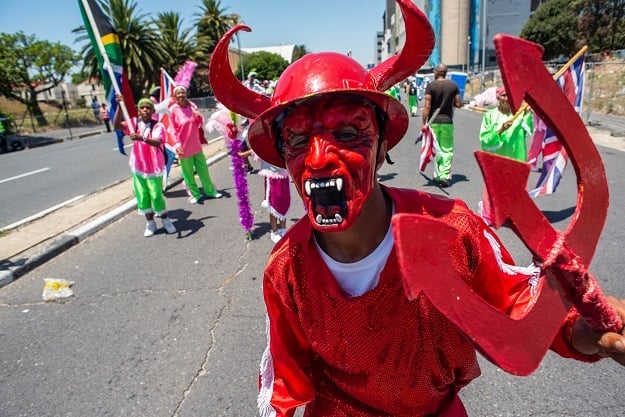
Performers at the Tweede Nuwe Jaar celebration in Cape Town.
Now a professional musician, he coaches the 150 trombone, sousaphone, trumpet and saxophone players in the band Playaz Inc.
“Music taught me discipline and now I leave it to the younger ones, to make sure they don’t follow the same path I almost took.”
With 27 groups confirmed, organizers said the parade would make a strong comeback after a two-year hiatus.
“There was something missing during covid-19, if you understand the cultural significance of this event,” said Deputy Mayor Eddie Andrews, dressed in a bright yellow and white suit.
“It’s very important to us, this event is part of Cape Town,” he added, outside City Hall as the parade was about to start.


