


Hundreds of years after the first person was executed in the American colonies for witchcraft, Connecticut lawmakers are considering exonerating the accused.
The executions of these accused witches in Connecticut occurred decades before the infamous Salem witch trials.
Alse Young was murdered by hanging in Connecticut on May 26, 1647. She was the first of nine women and two men executed by the Connecticut colony for witchcraft over 15 years. More than 40 people went to trial on charges that they had ties to Satan.
Amateur historians, researchers and descendants of the accused witches and their accusers are now lobbying Connecticut lawmakers to finally offer a posthumous exoneration.
CONNECTICUT MAN GETS 120 YEARS FOR 1987 DOUBLE MURDER OF FATHER AND SON
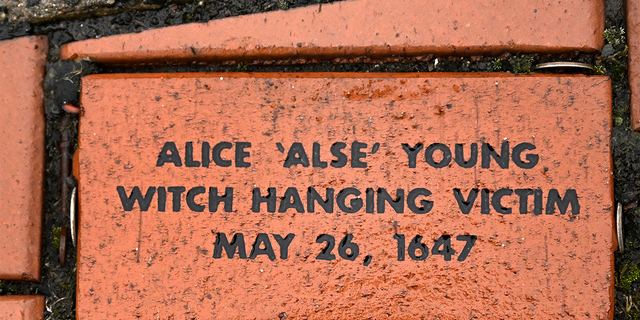
In this Tuesday, Jan. 24, 2023 photo, a brick reminiscent of Alice ‘Alse’ Young is laid at a Heritage Bricks facility in Windsor, Connecticut. Young was the first person on record to be executed in all 13 colonies for witchcraft.
And while demands for exoneration are nothing new, the calls have grown louder as many genealogy buffs discover their distant relatives were involved in the Connecticut witch trials.
“They’re talking about how this has followed their families down the generations and that they’d love for someone to say, ‘Hey, this was wrong,'” Connecticut State Representative Jane Garibay said.
Garibay proposed an exoneration resolution after receiving letters from eighth and ninth generation relatives of accused witches.
The Connecticut witch trials took place in the mid to late 17th century. At the time, witchcraft was considered a capital offense in each of the New England colonies.
Early laws in the Connecticut colony stated that “any man or woman (who) is a witch, that is, has or consults with a spirit familiar, shall be put to death.”
Many historians say that fear and anxiety among the religiously strict English colonists prompted the witch trials. They noted that life was very difficult during this period, given epidemics, floods, cold winters, and famine. Witchcraft accusations often began with an argument, the death of a child or a cow, or butter that could not be churned.
Many of the people accused of witches who were executed were poor single mothers, including Mary Johnson, a servant in Wethersfield, Connecticut, who faced accusations of “familiarity with the devil.”
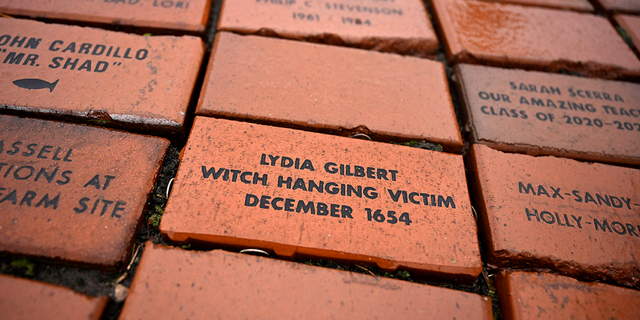
In this Tuesday, Jan. 24, 2023 photo, a Lydia Gilbert memorial brick is placed at a Heritage Bricks facility in Windsor, Connecticut. Gilbert.
Johnson was tortured for years by a local minister who flogged her until she finally admitted that she was a witch and had “filth with men”. She was allegedly hanged after giving birth to the son of a man she was not married to.
“It’s important to right the mistakes of the past, so that we learn from them and move on and not repeat those mistakes,” said podcast host Joshua Hutchinson, who traced his ancestry back to accused witches in Salem.
Hutchinson said that people have been killed in recent decades in various countries because they were believed to be witches or wizards.
Connecticut State Senator Saud Anwar has also proposed an exoneration bill and admits that some people may laugh at the idea of the Legislature taking the time to expunge the records of accused witches. But the descendants are feeling some “serious things,” he said, adding that a constituent called for the resolution.
“His wish was that if there was a way to give families some kind of closure, that would be a way for him to say that he has done his part, even though his ancestors did not do the right thing.” thing,” Anwar said.
ESTIMATE 100,000 CHICKENS KILLED IN CONNECTICUT FARM FIRE, OFFICIALS SAY
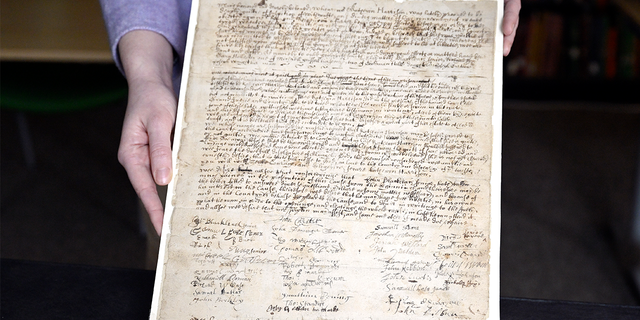
Connecticut Historical Society Collections Associate Julia Morrow displays an original letter of complaint dating to 1669 against Katherine Harrison, Tuesday, Jan. 31, 2023, in Hartford, Connecticut. Harrison, of Wethersfield, Connecticut, was tried several times for witchcraft.
Other states and countries have tried to atone for the persecution of people for witchcraft in the past, including Scotland’s first minister who issued a formal apology last year to the estimated 4,000 Scots who were accused of witchcraft until 1736. Around 2,500 of all 4,000 defendants were killed. A member of the Scottish Parliament asked that they be posthumously pardoned.
CLICK HERE TO GET THE FOX NEWS APP
Massachusetts lawmakers in 2022 formally exonerated Elizabeth Johnson Jr., who was convicted of witchcraft in 1693 and sentenced to death during the Salem witch trials. Johnson is believed to be the latest Salem witch to be charged with having her conviction overturned by lawmakers.
And in 2006, former Virginia Gov. Tim Kaine granted an informal pardon to Grace Sherwood, a widowed midwife who was accused by neighbors of ruining crops, killing livestock and creating storms before facing charges of being a witch. Sherwood was thrown into a river with her hands tied to find out if she was floating, which was seen as an indication of guilt. She was able to free herself and spent seven years in prison.
Associated Press contributed to this report.


