


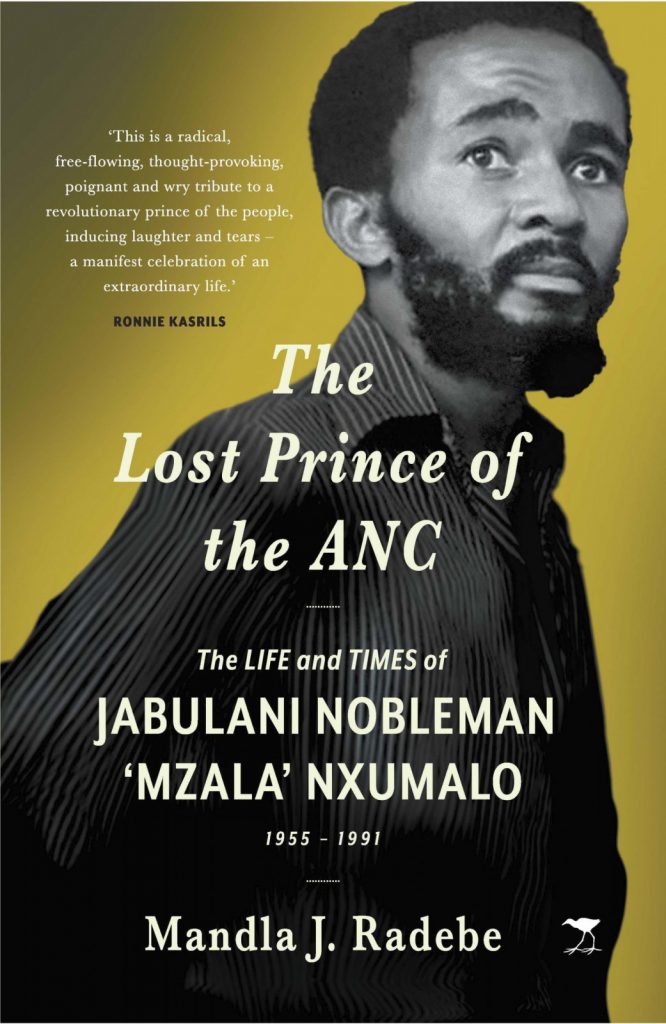
This excerpt from Mandla J Radebe’s The Lost Prince of the ANC: The Life and Times of Jabulani Nobleman ‘Mzala’ Nxumalo 1955 – 1991 is based on the July 1987 publication of Nxumalo’s article ‘Towards People’s War and Insurrection’ in the ANC publication. Sechaba, in which he argued that, under the prevailing conditions, ‘armed insurrection’ was possible. For him, anything less was a conservative approach that failed to read the situation correctly.
The West was using the ANC’s alliance with the South African Communist Party (SACP) as a justification for its lack of intervention, but it is precisely this reasoning that, Mzala said, demonstrated its bias. “This concern with the South African Communist Party is not genuine,” he wrote; “It is simply a contrived excuse created to avoid the responsibility of the United States, as one of South Africa’s main economic backers, for forcing it to abandon its inhumane policies and practices.”
He was consistent in his thesis that the interests of the United States were informed by its narrow capitalist interests. Capitalism was another reality that Mzala thought needed to be taken into account when addressing the South African revolution.
“South Africans not only suffer from the national oppression of the colonial system, but are also exploited by capitalism as a system of production.”
Mzala also urged the movement not to abandon the Freedom Charter, particularly clauses such as “Everyone will share the wealth of the country.” He stated: “I do not foresee any circumstances that could arise in South Africa that would lead the ANC to abandon this economic policy, what good will centuries of struggle and much sacrifice be if in the end the people cannot control the wealth of their own country.” ?
“A revolution without a radically democratic economic policy, detailing concrete measures to transform the country’s economic ills and end mass exploitation and hunger, such a revolution is not worth a single letter of the word ‘revolution’.”
These interventions by Mzala were, to a certain extent, a way of pushing for a leftist perspective within the movement. It was through such perspectives that the interests of imperialism in South Africa were exposed. There were conflicting opinions in the ANC, expressed in the same newspaper.
Eventually, in his absence, Mzala’s views were defeated. Nearly three decades after democracy, the distribution of wealth in South Africa still reflects apartheid ownership patterns. Therefore, Mzala’s question of what use is struggle and sacrifice if the people cannot control the country’s wealth remains pertinent.
Mzala was not finished yet. In the August 1987 issue of Sechabá continued his scrutiny of the US with the article “People Power or Shared Power? United States policy in South Africa”. In this article, he argued: “The belief within the US State Department is that the interests of the South African Communist Party are served by an inflexible attitude on the part of the Pretoria regime towards negotiating with the ANC, and by the ANC’s focus on increasing military pressure on South Africa”.
For Mzala, this was a complete misunderstanding of the ANC and what it was that united its members. Thus, he asserted that the SACP could not reject negotiations in principle.
To illustrate this point, he returned to the 1962 program of the SACP: “The party does not rule out all prospects for nonviolent transition to democratic revolution.” However, he was quick to emphasize the conditions on which the party based this principle: “[This] perspective will be enhanced by [the] development of revolutionary and militant popular forces. The illusion that the white minority can rule forever over an unarmed majority will crumble in the face of the reality of an armed and determined people. The possibility of a peaceful and negotiated transfer of power to the representative of the oppressed majority of the people would be opened”.
Thus it was that, with these articles, Mzala entered the fray of the negotiated settlement. Of course, by 1987, the genie was out of the bottle and it was apparent that a “peaceful and negotiated transfer of power” as envisioned by the SACP was increasingly becoming a likely scenario.
One month before this article was published, in July 1987, a delegation of South Africans from a broad political spectrum met with the ANC in Dakar, Senegal. It was at this meeting that the “ANC for the first time publicly committed to a negotiated settlement to end the political conflict in South Africa.”
Still, Mzala was unable to understand this process outside the prism of the people’s war, insisting that the ANC’s position was well known and aligned with that of the SACP. He argued: “To suggest that the ANC, in the current circumstances, would place unarmed people on the altar of negotiations with a fascist regime is to insult the ANC and question its sincerity and sense of responsibility towards the South African leadership. oppressed people”.
Mzala was not stupid. He wasn’t just debating for himself; rather, he was addressing a perspective that he felt was in danger within the ANC.
In the article, he returned to points raised earlier about the process of transferring power to the people. He asserted that a People’s Assembly “that can begin to draft a new Constitution for South Africa (after the draft has been thoroughly discussed by the masses in all walks of life) can only be one that has been invested with authority and power.” supreme. For this, it is invested with the sovereignty of the people”.
While he respected the negotiation process, he insisted that it should be nothing more than the transfer of power from the racist minority to the democratic majority.
Mzala did not trust the imperialists’ commitments to the transfer of power and therefore attached a lot of meaning to narrow concepts such as “power sharing”. He perceived this to be an attempt by the US to craft a deal suited to its interests.
For him, “power sharing” was the wrong approach to the country’s problem. “It’s a concept that may seem ‘logical’ and ‘fair’ only to those unfamiliar with the history of our country and the source of our national oppression.” To his understanding, the South African struggle was following a path similar to that of other formerly colonized nations on the continent.
Because the apartheid regime with its imperialist handlers would do everything possible to derail the revolution, Mzala did not rule out the possibility that the regime would create “a third force.” Part of the trick, Mzala argued, was for the US to “get the apartheid regime to declare its intention to hold negotiations, even long before it can be prepared to negotiate the transfer of power, and if the ANC refuses to participate , get together the puppet forces of the [Bishop Abel] Muzorewa type, and go ahead and arrange a neocolonial solution for South Africa.”
In this regard, he warned the liberation forces to be vigilant about the imposition of a neocolonial solution: “Such a neocolonial solution, however, is bound to collapse even before it gets off the ground, because the current uprising and liberation war in South Africa is not run by those puppet forces; furthermore, the people of South Africa are politically aware enough to know who their real leaders are, and they know what they want as well.”
In fact, some attempts were made in this direction, resulting in, among other things, a low-intensity civil war in what are now KwaZulu-Natal and Gauteng. Mzala’s foresight extended to the issue of minority rights, which would be a major issue during the negotiations. To do this, he invoked the clause of the Freedom Charter that “all national groups shall enjoy the same rights.”
Therefore, he envisioned a South Africa aligned with the principles of the Freedom Charter where “all people shall enjoy the same rights, regardless of colour, race or creed”. He saw no reason for the white part of the population to fear anything in a free South Africa based on the Freedom Charter, which stipulates that “South Africa belongs to all who live in it, black and white.”
Mandla J Radebe is Associate Professor of Strategic Communication and Director of the Center for Digital Communications and Data at the University of Johannesburg.


