


At the time, China held a week-long military exercise around the island, in which Beijing tried to “demonstrate its ability to impose a blockade around Taiwan,” according to some experts.
The drills were part of China’s attempt to create a new normal in the Taiwan Strait, as the People’s Liberation Army (PLA) has since repeatedly been sending warships and military aircraft across the median line of the Taiwan Strait. Taiwan, an unofficial demarcation between China and China. Taiwan that the former does not recognize.
“The real change is the maintenance of China’s military presence around the midline of the Taiwan Strait,” said Amanda Hsiao, a senior China analyst at think tank International Crisis Group (ICG).
Da-Jung Li, professor of international relations and strategic studies at Tamkang University in Taiwan, said that pelosi’s journey further increased security pressure on Taipei.
“The pressure from Chinese military planes and warships is much stronger than before,” he said, noting that Taiwan’s room for maneuver has narrowed in the face of mounting military pressure from Beijing.
“In addition, China has not stopped sending military aircraft to Taiwan’s Air Defense Identification Zone (ADIZ). While those exercises have not been held with the same frequency, they are sometimes held on a larger scale, which creates great pressure on Taiwan,” he added.
Increased risk of conflict
With the increased military presence around the Taiwan Strait, Hsiao said, the likelihood that the Chinese and Taiwanese militaries will meet has also increased.
“When the Chinese cross the median line, the Taiwanese respond and maybe push them back across the median line,” he noted.
“These interactions simply increase the risks of an unintended collision, and in today’s political environment, any type of small incident has a higher risk of becoming something bigger. Taiwan and China do not have the means of communication to resolve a conflict in a major incident or crisis.”
Despite a number of challenges China is currently facing, including the ongoing Covid health crisis and economic slowdown, Taiwan will continue to be high on Beijing’s agenda. “China will wait for an external event to increase the pressure on Taiwan, since that is how they normally operate,” Hsiao said. D.W..
On Monday, Taiwan said the PLA sent 71 military aircraft to Taiwan’s ADIZ over a 24-hour period, with 43 of the aircraft reportedly crossing the median line.
According to the PLA’s Eastern Theater Command, the “mock strike” was part of their reaction to “provocations and collusion” between the US and China.
The largest incursion to date took place after US President Joe Biden signed into law the National Defense Authorization Act on December 23, which authorized $10 billion (9.4 billion euros) in aid. military to Taiwan.
The Chinese government expressed strong opposition to the move, describing the provisions related to military support for Taiwan as a serious violation of Beijing’s “one China” principle.
In response to the Chinese incursions, the White House said Monday that the United States is concerned about China’s military activities near Taiwan.
Washington vowed to continue “assisting Taiwan to maintain a sufficient self-defense capability in line with our long-standing commitments and consistent with our one-China policy.”
Competition between the United States and China aggravates tensions
Li from Tamkang University said Strategic competition between the United States and China adds to tensions in the Taiwan Strait.
“The United States views many of Beijing’s actions as more aggressive and seemingly destructive to the status quo. But from China’s point of view, the United States has been trying to hollow out the substance of its One China Policy in recent years,” she noted.
Biden and Chinese President Xi Jinping sent constructive signals after their meeting on the sidelines of the G20 summit in Bali, saying they want to maintain a stable relationship between the two powers.
Hsiao said it means neither side wants the competition to turn into a conflict. “Competition is a given in the future, and Taiwan continues to be one of the key players in that competition,” he noted. “That will not change”.
The potential speaker visits a possible risk factor
One possible event that could escalate tensions in 2023 is a possible visit to Taiwan by prospective Speaker of the United States House of Representatives Kevin McCarthy, who had promised to visit the democratic island if he became the new Speaker of the House of Representatives. the United States.
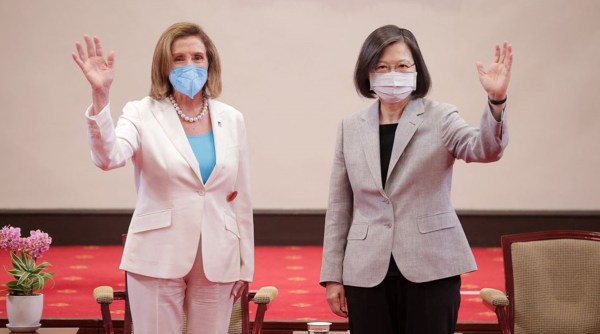 US House Speaker Nancy Pelosi attends a meeting with Taiwan President Tsai Ing-wen at the presidential office in Taipei, Taiwan on August 3, 2022. (Presidential Office Taiwan/Handout via Reuters)
“At the very least, China would have to respond to the same level that it did after Pelosi’s visit,” Hsiao said. “They may also feel they have to respond more forcefully,” he noted, adding that it would depend on the timing of that visit.
“If the visit occurs very close to the end of 2023, the 2024 Taiwan presidential election would be just around the corner and that will potentially be a source of restraint on how China chooses to respond,” he said.
“If they overreact, that will only feed the internal narrative in Taiwan in a direction that is not helpful to China. There are a number of considerations and the timing has a lot to do with the strength of China’s response,” she added.
Li noted that there are a number of “unpredictable variables” that will affect the situation in the Taiwan Strait next year.
They include “China’s behavior across the Taiwan Strait, how Taiwan-related issues will be framed in US domestic politics, and Taiwan’s presidential elections in early 2024, which typically focus on cross-sea relations.” Strait and Taiwan’s relationship with the United States.


