


South Africa is in the midst of an electricity crisis.
This year alone, the hours of power outages across the country equal four full months.
According to the app that monitors power outages, EskomSePush, that’s 200% worse than any other year.
The state power company, Eskom, blames an outdated fleet of coal stations they constantly break.
These stations generate just over half of their capacity, as demand for power constantly exceeds supply.
The shortage is expected to worsen as major units such as the Koeberg nuclear power plant go offline for maintenance.
Eskom has warned south africans expect extended periods of power outages for the foreseeable future and is currently implementing its highest levels of “load shedding,” leaving residents without power for at least five hours a day.

A general view of Eskom’s Medupi coal-fired power station is seen near Lephalale
Highest crime rates in the city center
In a country with one of the highest urban crime rates in the world, overnight power outages have been detrimental to public safety.
“It is dark and we have more robberies that are happening, more robberies that are happening.
“We have more complaints that are just coming in. There’s so much unemployment right now that it’s just chaotic.”
“Anyone would do anything for anything. It makes it really, really hard to keep him safe.”

Cars drive through an intersection controlled by traffic lights during a power outage in Johannesburg. Photo: AP
“So now load shedding comes in and suddenly it’s 50% harder,” says Happy Raphela, a community patrol in Alexandra, one of Johannesburg’s most dangerous townships.
Here, the community has come together to patrol, to keep crime levels down.
Armed only with flashlights and walkie-talkies, they go street by street responding to the complaints of their neighbors.
“Our government only cares about our votes, but when it comes to power outages, they don’t care because they only live in their suburbs.
“I know some of them experience these power outages, but their houses are well protected, they have security guards.
“We don’t have security guards here, we only have ourselves,” says Lefa Buthelezi, another patrolman.
Read more:
Renewable energy offset the global increase in the use of fossil fuels
‘The beginning of the end of fossil fuels’
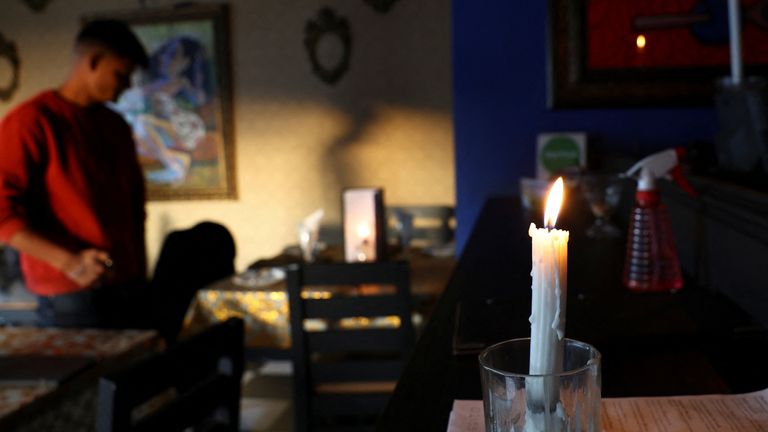
A restaurant uses candles due to regular power cuts from Eskom, the South African electric power company.
Not even the streetlights stay on
Battery-backed generators and alarm systems have kept those living in wealthier areas safe.
But in Alexandra, muggings and robberies frequently occur in the dark hours of power outages. Even streetlights don’t stay on when there’s no light.
Zothile Ncala has lived in Alexandra all her life. The 34-year-old mother of three was attacked on her way home one night during power outages.
His phone was stolen and he was kicked in the pregnant stomach.
Click to subscribe to Sky News ClimateCast wherever you get your podcasts
“That guy, he was coming from the back, the other one was walking in front of me.
“I felt like I had lost my baby. But I had to be strong to save my son, so that’s when I survived.”
“We are praying for everything that is happening in this country,” says Zothile.
But hope is fading as cuts worsen and communities experience the brunt of economic inequality.


