


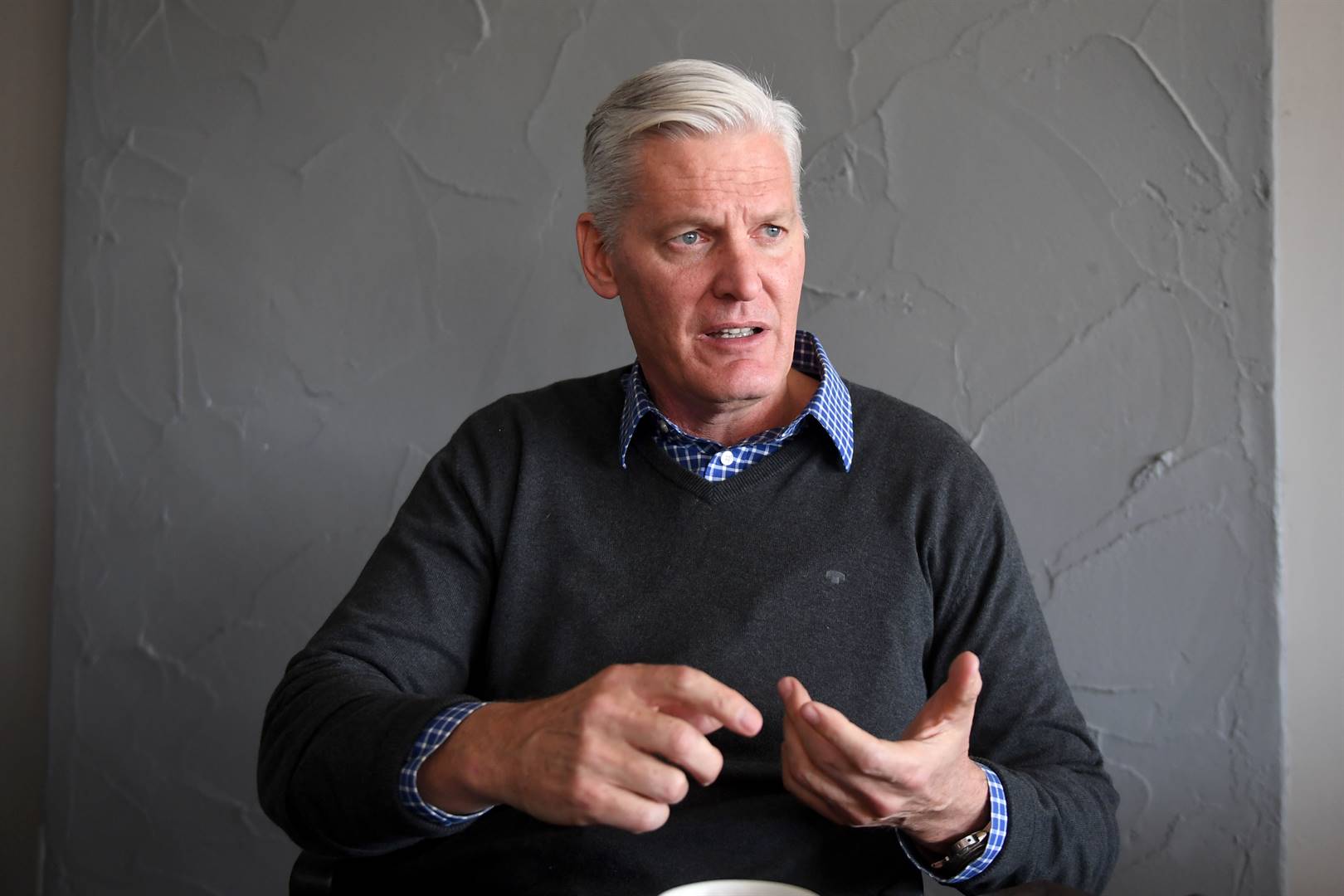
The chief executive of the Eskom group, André de Ruyter, resigned this week. His last day in office will be March 31, 2023. (Deaan Vivier)
- André de Ruyter has been cornered by politicians, one who accused him and Eskom of treason, while the others remained silent.
- The lack of an objective and honest assessment of the state of Eskom and the ANCThe role of De Ruyter, who has no political affiliation, has made his stay untenable.
- News24 has learned from Eskom sources of the new board, apparently carrying out a mandate to a member of the executiveundermined and frustrated De Ruyter.
Eskom boss André de Ruyter, who resigned as Eskom’s group chief executive, was apparently gradually sabotaged by the company’s board after his appointment in October, with the chairman neglecting to sign crucial documents to help ease the load reduction.
News24 has established that shortly after Mpho Makwana was installed as chairman of the board, De Ruyter sent him a document for his signature to approve the acquisition of 585 MW of electricity from existing providers.
The document was never signed and the acquisition of the additional capacity has not yet taken place. South Africa currently remains in the grip of load shedding between stages 4 and 6.
Last week De Ruyter was excluded from crucial meetings and it emerged that the board and Public Enterprises Minister Pravin Gordhan apparently dealt directly with Eskom’s senior staff, bypassing the company’s chief executive.
This information is based on a variety of sources within Eskom and knowledge of recent events.
EXCLUSIVE | De Ruyter: ‘This work is impossible given the current state, shape of Eskom’
De Ruyter stepped down as chief executive of the group on Wednesday. He was not available for comment. Eskom issued a statement in which both Makwana and Gordhan thanked him for his service.
It follows a series of public attacks on De Ruyter by the Minister for Energy and Mineral Resources, Gwede Mantashe. He said last week that Eskom was “actively agitating for the overthrow of the state.” Neither Gordhan nor President Cyril Ramaphosa defended De Ruyter or Eskom.
The ANC goes to its national conference this week amid a clamor in the party for the government to end the shedding of charges. Several ANC leaders, as well as the EFF, welcomed De Ruyter’s decision last night.
The board’s interference in operational matters began almost immediately after his appointment in October, News24 has established.
Gordhan also called Eskom officials directly to confirm what management told him, based on information from Eskom managers with direct knowledge of the incidents. He denied improper interference, but confirmed that he has been in contact with senior Eskom officials in the recent past. “I talk to who I need to for information if other officials are not available, yes, including people like Rhulani Mathebula (former director of Generation, recently resigned),” Gordhan told News24.
Within two months of being in office, members of the new board began requesting details of the bids, including specifications, and revision of existing performance targets, such as achieving an EAF of 70 % for April next year.
Gordhan himself has set a target of 75% EAF, which was “equally unrealistic”, according to several Eskom officials who spoke on condition of anonymity.
Eskom sources at the top levels of the company reacted with dismay to the news of De Ruyter’s imminent departure. Others said they expected this after public comments from ministers and a lack of support from other quarters.
political mandate
Participation in operational matters is outside the official powers of the board, but News24 understands that both the board and the cabinet minister appear to have overstepped the bounds of late.
The board has also apparently undermined De Ruyter and its ability to run Eskom.
Examples of this include:
- Makwana’s delay in pushing through the nomination of candidates for the board of directors of the newly formed National Transmission Company. Eskom provided a list of people with international experience to the Public Companies department in February 2022, but no appointments have yet been made. News24 understands that Makwana is sitting down with a list of candidates, but it’s unclear if any of the truly independent candidates have made the cut.
- Makwana sitting on the documents that need to be signed to allow Eskom to buy 585 MW of electricity from private producers, electricity that is already being produced by various Eskom customers. The documents were provided to Makwana in October.
- During the recent crisis meetings between Eskom and the Presidency, when it was decided to delay the closure of Koeberg Unit 1 for a few days to avoid the loss of cargo from stages 7 or 8, De Ruyter was not informed about the meetings and he was not asked to sit down. in.
- Mantashe’s extraordinary and factually flawed attacks, accusing Eskom of “agitating for the overthrow of the state” by “failing to resolve” cargo shedding, for which De Ruyter was not publicly defended.
- The board also dressed De Ruyter in a meeting soon after, in November, COO Jan Oberholzer told the country the utility had no more funding for diesel as it had spent more than R12 billion. from 1 April 2022. De Ruyter are said to have been reprimanded by the junta and apparently told an “interpreter” was needed to communicate with South Africans.
Makwana read but did not respond to questions sent to him on Wednesday. He also did not respond to phone calls.
De Ruyter and his executive have faced sustained campaigns of sabotage at power plants, with little or no progress by the police or the State Security Agency to investigate and prevent cases of sabotage.
He has also faced unsubstantiated allegations and investigations after being accused of racism and corruption. Although he was acquitted after numerous official investigations, the time he took to prepare the responses for the numerous trials was detrimental.
His ouster calls into question important anti-corruption reforms and investigations he helped oversee.
financing at risk
De Ruyter and former Eskom executive Mandy Rambharos were also instrumental in securing $8.5bn (R130bn) in funding from wealthy nations for South Africa’s Just Energy Transition, a strategy that will see sources Renewable energy power plants are built in a way that would fairly include workers supporting their families who work in the coal industry, including coal-fired power plants.
With De Ruyter’s departure, this funding may now be at risk. News24 understands that representatives of these nations had confidence in De Ruyter and his ability to limit opportunities for corruption in the projects they eventually financed with his money.
De Ruyter’s warnings that Eskom urgently needs to pivot to building greener power sources, at least 5,000 to 6,000 MW, have been met with skepticism by Mantashe and his allies. Realistically, it is the only option South Africa has, as the major financing institutions will not be willing to finance any additional coal projects, including major repairs to existing stations.
More than half of South Africa’s annual exports will also in future be subject to Border Carbon Adjustment Mechanisms, effectively a carbon tax, due to high levels of emissions in the country, of which coal-fired power plants They are the main contributor.
In the Eskom statement, Makwana confirmed that De Ruyter’s last working day would be March 31, 2023.


