


‘AIDS is a scourge that will devastate Africa. I will immigrate to the United States next month’
When writing an account of your own life, you better hope that your story is compelling. Your story should be interesting enough to keep your readers entertained. Jan Glazewski, the author of blood and silver, you don’t have to worry about this. His life is vividly colorful.
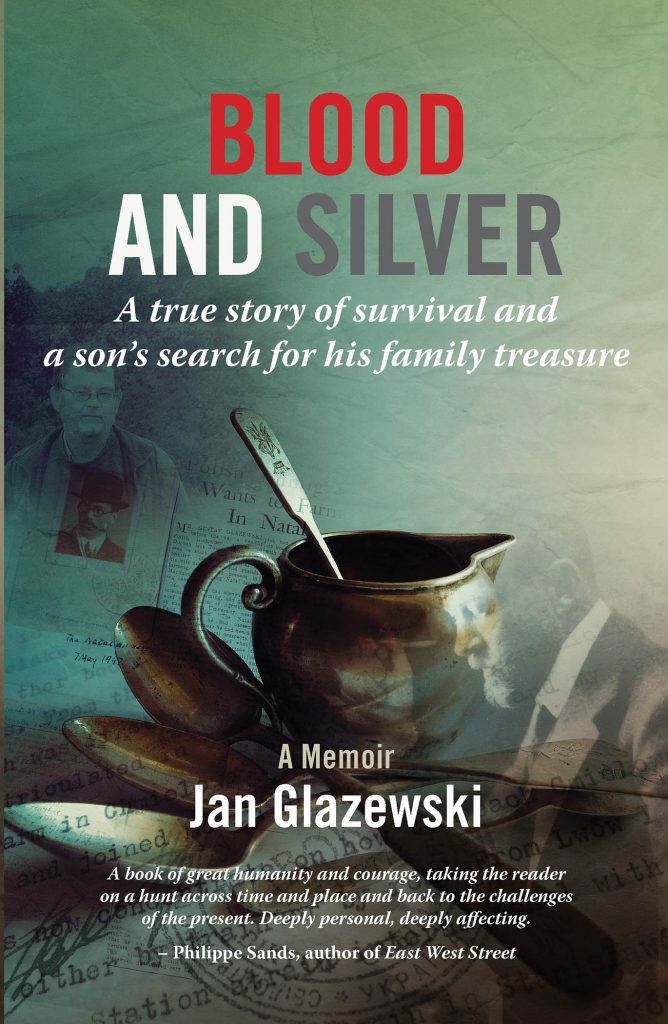
Blood and Silver: A Memory It is, as the book cover makes clear, “a true story of survival and a son’s search for the family treasure”. An environmental lawyer and academic, Glazewski weaves a complex and fascinating story. It’s a story about his family fleeing Europe and making a living in the southern tip of Africa, and it’s about his own struggles with hemophilia and HIV. Then there’s his involvement in drafting the South African Constitution and his quest to locate a buried treasure trove of silver in the Ukraine.
The narrative begins with his ancestors, as they flee war-torn Europe and, specifically, the arrival of the Russians in eastern Poland (now Ukraine) in 1939. They escape to Palestine, eventually heading to Africa. As a wealthy landowner in Poland, and because he had a master’s degree in agriculture, the arrival of Glazewski’s father in Natal in 1947 was newsworthy enough to make the birth witness.
However, after the family’s arrival in the Cape, Glazewski’s father became a farm manager and the family settled on a dusty farmhouse near Durbanville, a clear step down from their luxurious Polish lives.
I struggled, initially, to get into this part of the book. Perhaps it was the introduction of a plethora of characters, in a short period of time, from the Polish immigrant community. But I stood my ground and was soon immersed in this small group that strives to make a new life, far from home.
You meet a cast of interesting personalities, including Glazewski’s godmother, Ciocia (aunt) Tychna. As a PhD graduate, she joined the Polish underground during World War II and ended up in Auschwitz after being betrayed by a colleague. Even on the hottest days in the Cape, she wore long sleeves to cover the concentration camp identification digits tattooed on her wrist. Her survival there was terrifying and unbelievable, as she met and eventually worked for Josef Mengele, the infamous Nazi doctor responsible for the torture and death of countless people. A fact that she understandably never spoke of.
And this is what it does blood and silver so interesting. The author not only tells his own story, but also seems to have a knack for meeting people with their own intriguing tales along the way. Many of them had front seats at some of the most significant events in history.
But it’s Glazewki’s insightful and heartbreaking account of his severe hemophilia that will fascinate. The disorder, carried by his mother and passed down the male line, was responsible for the death of his little brother Adam.
Always fearful of uncontrollable bleeding, hemophilia is a cloud that hung over Glazewski’s childhood, preventing him from playing sports. The treatment had limitations and side effects, resulting in numerous health problems, which the writer still suffers from decades later.
The diagnosis
In January 1985, Glazewski’s life changed when, after learning about a new disease called AIDS, he decided to have a blood test. At this early stage, he insensitively and, of course, incorrectly promoted himself as only affecting the three H’s: “homosexuals, Haitians, and hemophiliacs,” with the fourth category of “heroin addicts” added later. In the case of hemophiliacs, AIDS transmission occurred by receiving life-saving infected blood products.
Glazewski’s results came back positive, and with little knowledge about the virus, the doctor’s handling of the diagnosis is scary. He cruelly announces: “AIDS is a scourge that will devastate Africa. I am going to immigrate to the United States next month.”
A short time later, another doctor refused to operate on him due to fear surrounding the diagnosis. Four years old to live and frightened by the stigma, Glazewki kept the diagnosis a secret until later. However, he witnessed key struggles in the fight against HIV and AIDS, especially in South Africa.
He talks about watching 11-year-old Nkosi Johnson address a large crowd and openly share his positive status. He writes about Judge Edwin Cameron’s passionate account at a conference, declaring that he was only alive because he could afford antiretroviral drugs. The fact that Cameron revealed his condition had a profound impact on Glazewski: he became something of a hero to the author.
Glazewski would play his own role in this epidemic when he joined the ethics committee at Groote Schuur Hospital. The group, guided in part by his legal knowledge, presented the hospital’s first protocol for needlestick injuries and HIV transmission, as well as the use of gloves.
His own fight and acceptance of HIV, as well as the early fight against the virus in the 1980s and 1990s in South Africa, is fascinating. Not only from a health and stigma perspective, but also in terms of policy and practice.
While dealing with these personal issues, the author went on to build a career as a lawyer, first with the revenue administrator in Pretoria. Of course, he didn’t mesh very well with someone with liberal leanings during the height of apartheid.
Glazewski later returns to academia, studying for a master’s degree at the University of Cape Town’s School of Environmental Studies. This knowledge and passion was key during the birth of environmental law in South Africa, after 1994.
The treasure
Who would not feel compelled by his sick father saying: “at the edge of the forest, among the trees, you must look for our silver and my hunting weapons”?
That’s exactly what Glazewski sets out to do, post-retirement, with little information and a vague hand-drawn map.
He arrives in what is essentially a foreign land, despite being his ancestral home. The closest city to his family’s estate is Lviv, now in the Ukraine. He was formally Polish and has a fascinating and tumultuous history.
And what a fascinating part of history this hunt makes; full of shady characters, excitement, and a dash of extortion. All, I imagine, are an integral part of any good treasure hunt. Find the treasure? Well, you’ll just have to read the book to find out.
Of course, any mention of the Ukraine is incredibly topical, but what this book does so well is illustrate how contested the space has always been: suffering atrocities “under successive waves of invaders and the holocaust.” Glazewski ends what he calls an unfinished memoir with his thoughts on Ukraine and specifically on Lviv, a recent target of Russian missiles.
Cameron and the writer Philippe Sands write the publicity notes that appear on the cover of blood and silver. Cameron calls it “a richly layered exploration of what it means to be human” as well as “absorbing and current.” Sands, author of the award-winning best-seller east west streetset in Lviv, he describes Glazewski’s memoir as “deeply personal” and “deeply moving”.
This praise of such heavyweights is certainly well founded. Jan Glazewski’s life is exciting, full of challenges, tragedy, rich characters, and plenty of adventure. His has been a life well lived, meant to be written about and shared. How many of us can say that we have traversed continents to find a long-lost family treasure?
- Blood and Silver for Jan Glazewski is published by Tafelberg Publishers, R320


