


On Tuesday, Indonesia’s parliament approved a new penal code that prohibits sexual relations outside of marriage, which carries a penalty of up to a year in jail.
The new code, approved with the support of all political parties, also prohibits cohabitation between unmarried couples.
The code will apply to Indonesians and foreigners and is applied despite concerns that the laws could keep tourists out and harm investment.
It will not come into force for another three years to allow for the drafting of regulations.
VOLCANO IN INDONESIA ERUPTS, RELEASING RIVER OF LAVA
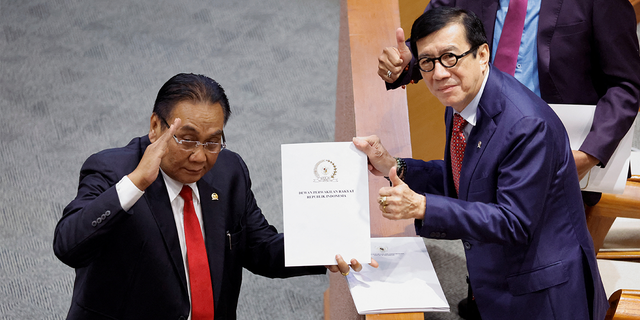
Yasonna Laoly, Indonesia’s Minister of Law and Human Rights, receives the report of the new penal code from Bambang Wuryanto, head of the parliamentary committee overseeing the review, during a parliamentary plenary meeting in Jakarta, Indonesia.
(Reuters photos)
The country already bans adultery but had not done the same for premarital sex.
Maulana Yusran, deputy head of Indonesia’s tourism industry board, said the new code was “totally counterproductive” at a time when the country’s economy and tourism were beginning to recover from the coronavirus pandemic.
“We deeply regret that the government has turned a blind eye. We have already expressed our concern to the tourism ministry about how detrimental this law is,” he said.
US Ambassador to Indonesia Sung Kim told an investment summit that the new code could lead to less foreign investment, tourism and travel to the country.
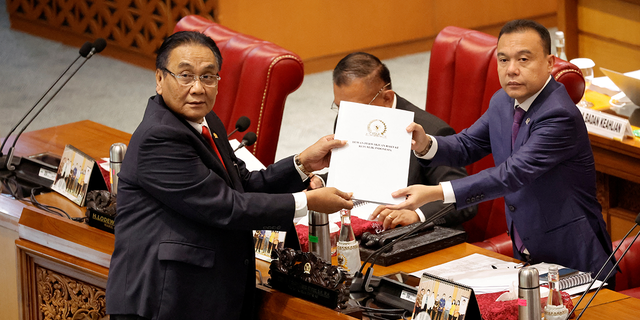
Bambang Wuryanto, head of the parliamentary committee supervising the review, passes the report of the new penal code to Sufmi Dasco Ahmad, vice speaker of the House of Representatives, during a parliamentary plenary meeting in Jakarta, Indonesia.
(Reuters photos)
NORTH KOREA EXECUTES TEENAGERS FOR DISTRIBUTING SOUTH KOREA TV, FILMS: REPORT
“Criminalizing the personal decisions of individuals would play a big role in the decision matrix of many companies determining whether to invest in Indonesia,” Kim said.
The code is part of several new laws that critics say impose civil liberties, along with a ban on black magic, insulting the president or state institutions, spreading views contrary to state ideology and organizing protests without notification.
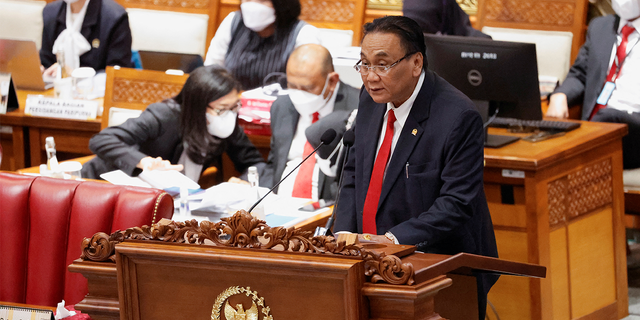
Bambang Wuryanto, head of the parliamentary commission overseeing the review of Indonesia’s penal code, speaks during a parliamentary plenary meeting in Jakarta, Indonesia.
(Reuters photos)
CLICK TO GET THE FOX NEWS APP
Indonesian Minister for Law and Human Rights Yasonna Laoly responded to criticism of the new law by telling parliament: “It is not easy for a multicultural and multi-ethnic country to make a penal code that can be adapted to all interests.”
Reuters contributed to this report.


