


Russian soldiers face a new enemy during the country’s ongoing invasion of Ukraine, and reports are emerging that inadequate equipment and clothing have led some troops to die of hypothermia.
“This is what happens when you have a fashion designer, like Valentin Yudashkin, developing a Russian military uniform,” said Rebekah Koffler, a former DIA intelligence officer and author of “Putin’s Playbook: Russia’s Secret Plan to Defeat America.” he told Fox News Digital. .
Koffler’s comments come after reports emerged Sunday that Russian forces have struggled to combat the freezing temperatures with equipment and clothing inadequate for winter combat.
“For Russian troops, there is now quite significant evidence of under-equipped, particularly recruits who are… even in training camps, dying of hypothermia,” security expert Robert Fox said during an interview over the weekend. according to The UK’s Daily Express Journal. “That’s really a big thing. Inadequate sleeping bags, inadequate clothing and suffering from the cold. They find it difficult to fight in the cold, but the fight continues.”
PUTIN OPEN TO UKRAINE TALKS AFTER BIDEN SIGNALS WILLING IF RUSSIA IS SERIOUS ABOUT ENDING WAR
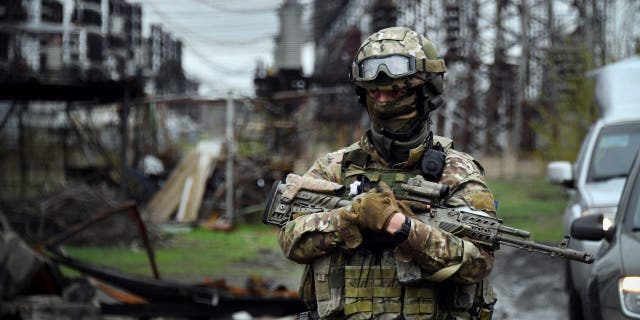
A Russian soldier stands guard at the Luhansk power plant in the city of Shchastya.
(Photo by ALEXANDER NEMENOV/AFP via Getty Images)
The fight against cold temperatures could not have come at a worse time for Russian troops, who have faced fierce resistance and multiple counter-offensives from Ukrainian forces that have stalled the country’s progress.
According to Koffler, the problem Russia now faces dates back to the Soviet-era military transition, noting that Yudashkin actually used to be a designer for former Soviet leader Mikhail Gorbachev’s wife, Raisa Gorbacheva.
“Russian soldiers dying of hyperthermia in winter is nothing new,” Koffler said. “Unlike Soviet Army uniforms that were designed for harsh Russian winters, the modern Russian military uniform is not optimized for subzero temperatures.”
Instead, the 1994 rebranding of the Russian Army caused “consternation” among the troops, with designs that “prioritized style and low cost over pragmatism and functionality.”
BIDEN ‘HAS NO IMMEDIATE PLANS TO CONTACT’ PUTIN, WILL ONLY SPEAK IF HE IS ‘LOOKING FOR A WAY TO END THE WAR’

The Russian army.
(Photo by Stringer/Anadolu Agency via Getty Images)
“Instead of using natural textiles like cotton, linen, and heavy, coarse wool, synthetic materials were used that kept soldiers cold in winter and warm in summer,” Koffler said. “The bulky, baggy style was replaced by fitted styles. The post-Soviet military leadership banned the traditional Russian footwear made of felt, valenki, which was worn by the military and civilians for hundreds of years.”
Winter conditions could also be hampering Russia’s ability to use drones the country’s military recently bought from Iran, and The Express reported Monday that Russia stopped deploying the Iranian-built Shahed-136 drone to Ukraine because parts are inadequate. to work in the winter. temperatures
“I think it’s declining, because any aircraft, which are drones, are made of plastic and materials that are sensitive to frost and weather conditions,” said Yevgeny Silkin, the chairman of the Armies Joint Forces Command for Strategic Communications. Ukrainian forces, he told the outlet.
Silkin said the drones, which have been used near population centers and caused many casualties in recent months, have gone undetected in nearly a month.

Firefighters work after a drone attack on buildings in kyiv, Ukraine, on October 17, 2022.
(AP Photo/Roman Hrytsyna, File)
CLICK HERE TO GET THE FOX NEWS APP
However, Koffler was skeptical that the drones would not work in winter, arguing that they are made “almost exclusively” from Western parts and should be designed to work regardless of weather conditions.
“Even if these drones are not optimized for subzero temperatures, they could still cause injuries and deaths when heading into populated areas, which is what the Russians are doing,” Koffler said. “Russian war strategy emphasizes psychological pressure on civilians to put pressure on Ukrainian leaders to stop the suffering inflicted on them by Russian forces.”


