


Iran’s attorney general has announced that the country will abolish its morality police, a potential concession after months of anti-regime protests.
The morality police “were abolished by the very authorities that installed them,” Attorney General Mohammad Javad Montazeri said Saturday, according to a report by The New York Times.
The decision would be a major victory for protesters in the country, who have demonstrated across the country for months in response to the death of 22-year-old Mahsa Amini, who died in police custody after being arrested for not covering her head. in public.
The unrest that followed the death became one of the biggest challenges to the Iranian regime in decades, spreading across the country and showing little sign of slowing down despite attempts by police to suppress the demonstrations.
IRAN CLIMBER REKABI PLACED UNDER HOUSE ARREST AFTER COMPETING WITHOUT HIJAB: REPORT
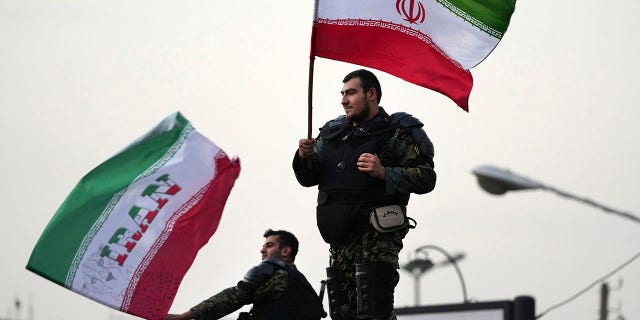
Two riot police officers wave Iranian flags during a street celebration after Iran defeated Wales in the World Cup in Qatar, at Sadeghieh Sq. in Tehran, Iran, Friday, November 25, 2022.
(AP Photo/Vahid Salemi)
The crackdown has resulted in some 400 deaths, according to international human rights groups, including 50 minors. Another 30 members of Iran’s security forces have been killed during the demonstrations. Meanwhile, the government is issuing threats of harsh punishment and execution for public dissent against the regime.

Iranian police arrive to disperse a protest marking the 40 days since the death in custody of 22-year-old Mahsa Amini, whose tragedy sparked Iran’s biggest anti-government movement in more than a decade, in Tehran, Iran, Wednesday, 26 October 2022.
(AP)
The morality police in Iran have been primarily responsible for enforcing the country’s strict Islamic dress code, which requires women to cover their bodies in long, loose clothing and their heads in a veil, or hijab.
The abolition of the moral police would not change the rules that the police were tasked with enforcing, and Montazeri made it clear that the courts would still have the ability to restrict “social behaviour”.

People blocking an intersection in Iran as protesters marked a symbolic 40 days since 22-year-old Mahsa Amini died in custody, igniting the biggest anti-government movement in more than a decade.
(AP Photo)
Iran has also announced that it is reviewing the country’s regulations on the headscarf, vowing to reach a decision on the matter within 15 days.
CLICK HERE TO GET THE FOX NEWS APP
That push has been led by women’s rights activists in the country, who have openly defied the law in public and on social media as a form of protest.


