


Soccer World Cup matches in Qatar find Arab diaspora in Latin America divided by divided loyalties
SAO PAULO: The World Cup is a huge event in Latin America, with cities in Brazil, Argentina, Mexico and elsewhere stopping whenever their respective national teams are on the field. But for a particular segment of society, the 2022 tournament hosted by Qatar is particularly significant.
Arab Latin Americans are believed to number around 23 million people. There are large communities in Brazil and Argentina, and significant populations in Mexico, Chile, Venezuela and Colombia, made up of descendants of Arab emigrants who arrived from the Middle East and North Africa, voluntarily or as refugees. And, like everyone in these countries, Arabs love soccer.
The fact that the 2022 World Cup is being held in an Arab country for the first time provides even greater incentive for the Arab diaspora in Latin America to tune in from distant time zones. The only question is whether to support the Arab team that reflects their ethnic origins or the teams from their adopted countries.
The fact that Qatar is hosting the competition “certainly generates sympathy among the Arab communities; people have been waiting for that World Cup for a long time,” Agustín Dib, director of the Arab Culture Club in Buenos Aires, told Arab News.
However, according to him, most Arab Latin Americans tend to cheer on the team that represents their adopted home.
“The first Lebanese and Syrian immigrants began to arrive in Argentina at the end of the 19th century,” Dib said. “The same thing happened in Brazil. So, we are completely Argentine, Brazilian, etc., and we love our national teams.
At the same time, however, Arab Latin Americans proudly watch the national teams of the Arab world and enthusiastically follow the fortunes of countries such as Morocco, Saudi Arabia, Tunisia and Qatar. The Saudi team’s historic 2-1 victory against Argentina in their first game in Qatar certainly captured the imagination of many.
There are large Arab communities in the border areas between Brazil, Argentina, Uruguay and Paraguay. In these areas, a World Cup campaign can temporarily divide Arab groups.
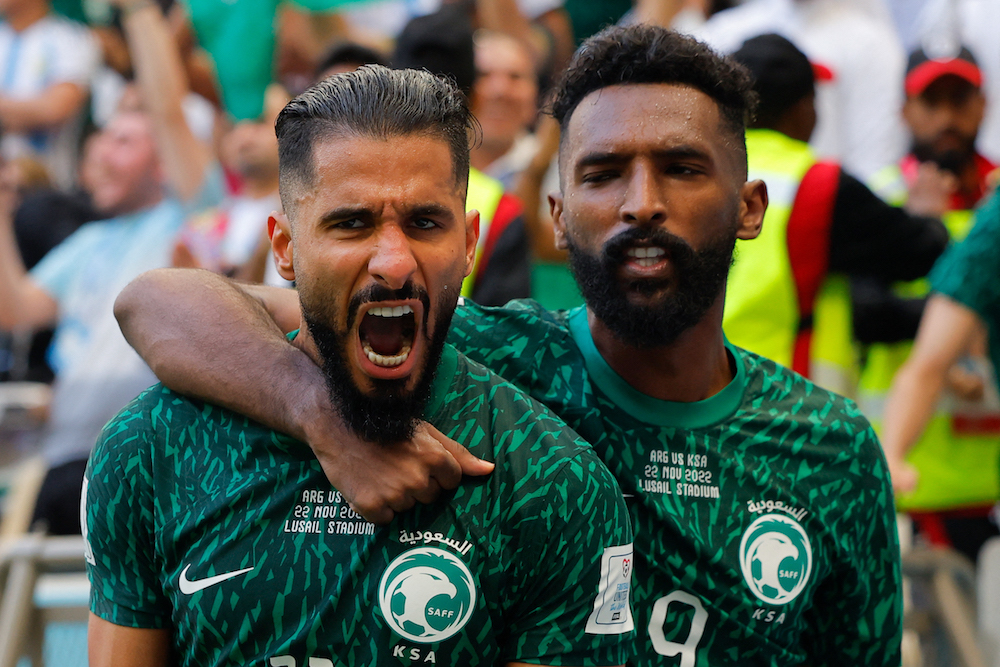
Saleh Al-Shehri celebrates with Saudi Arabia forward #09 Firas Al-Buraikan after scoring his team’s first goal during the Qatar 2022 World Cup Group C football match between Argentina and Saudi Arabia at Lusail Stadium . (AFP)
This is certainly the case in the bisected Brazilian city of Chui and its Uruguayan counterpart, Chuy, where several thousand Palestinians have settled. Most of the time, this community pays little attention to the geographic border that separates them. But a World Cup can change this.
“In general, we support both Uruguay and Brazil,” Jaber Nassar, a 43-year-old shopkeeper who lives on the Brazilian side of the city, told Arab News. “But if there is a match between the two teams, each side will root for their national team.”
However, the rest of the time, there has traditionally been a historical link between both communities when it comes to football. In 1987 they founded the Central Palestino Futbol Club. Active for just over a decade before withdrawing due to lack of funds, Central Palestino was part of the Uruguayan league and caused a sensation in the 1990s when it reached the final of a national championship.
“I used to watch a lot of matches with my mom when I was a kid. Central Palestino was a local champion and we traveled all over Uruguay to see them play,” said Nassar, whose brother-in-law was part of the squad for several years.
The Palestinian community routinely shows up to watch as many matches as possible during a World Cup, Nassar said. Some of his friends even traveled to Qatar for the tournament.
“Of course, we will focus on the Arab teams,” he added.
Nassar said the Palestinians’ love of South American soccer is not just a byproduct of immigration. Even in Palestine, he said, many people cheer for Brazil during international tournaments.
QUICKFACTS
* The Arab diaspora in Central and South America is believed to number about 23 million people.
* The largest Arab communities are found in Brazil and Argentina, followed by Mexico, Chile, Venezuela and Colombia.
According to Dib, this is common in many Arab nations and reflects a recognition and appreciation for the skill of the best South American players.
“In countries like Syria and Lebanon, people love Argentine and Brazilian soccer,” he said. “I lived in Tunisia for a few months and people always asked me about Maradona and Messi.”
Zuka Khouri, who left Syria as a refugee and settled in the Brazilian city of Curitiba nine years ago, said his family cheers on the Brazilian team during every World Cup.
“We also liked watching Italy play,” he told Arab News. “This year, Italy is not in the competition, so we support Brazil.”
Anas Obaid, a 34-year-old Syrian refugee, was captured and held hostage by an armed group in Syria until his family paid a ransom. After his release, he fled to Lebanon where he worked in a refugee camp in Zahle. He has lived in Brazil since 2015 and is now a journalist and human rights activist. He loves soccer and said that he used to cheer for Argentina when he was a child.
“I was there during the 2014 World Cup, which took place in Brazil,” Obaid told Arab News. “I supported Germany, because the country hosted many Syrian refugees. But some in the camp supported Brazil.”
Since he arrived in Sao Paulo, he said, he has become a fervent supporter of the Brazilian team. “Brazilians have a passion for soccer and it is an honor to cheer on their team,” he said.
Although soccer is unequivocally a national obsession in Brazil, and the World Cup a major event for the people there, the number of Brazilian fans who bought tickets for matches in Qatar, 39,546, is significantly lower than the number of Argentines (61,083). ) and Mexicans. (91,173).
Mexico regularly sends a large contingent of fans to the World Cups. Most Mexican Arabs are of Lebanese origin, according to Héctor Chamlati, a member of the advisory board of Centro Libanes, a community association in Mexico City. The number of Mexican Lebanese is estimated at about 500,000, most of whom are Christians.
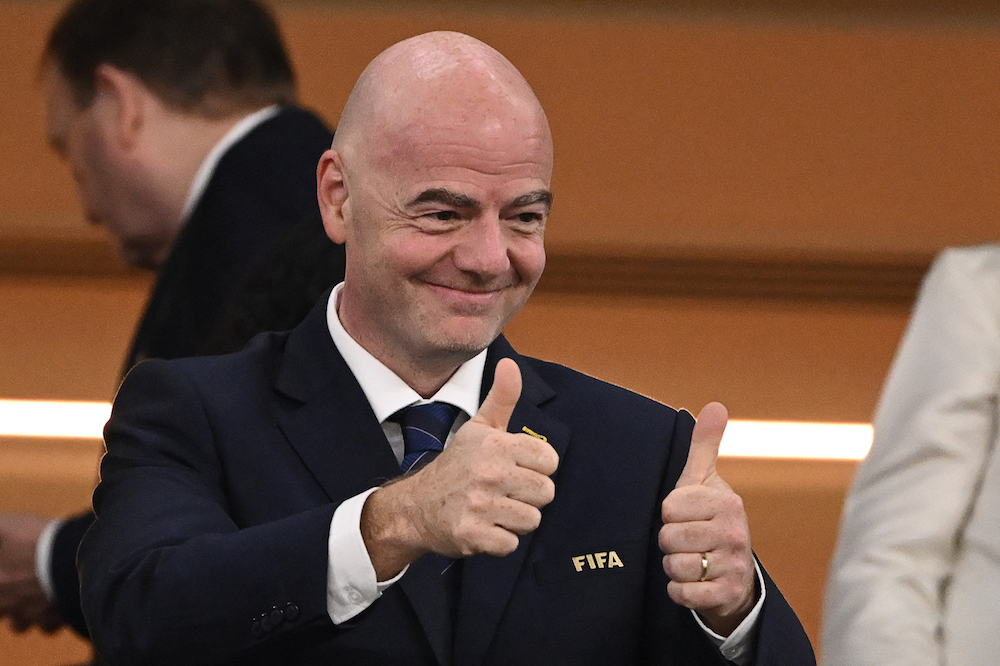
FIFA President Gianni Infantino gives the all-clear during the Qatar 2022 World Cup Group G soccer match between Brazil and Switzerland at Stadium 974 in Doha. (AFP)
“We have a very strong connection with the Mexican national team,” Chamlati told Arab News. “But many of us are pleased to see Arab teams play. I was happy to see that Tunisia managed to draw with Denmark (on November 22).”
The grandson of Lebanese immigrants, he said the Mexican community feels a strong connection to Lebanon and if the country’s national team were competing in Qatar, many of them would no doubt support them.
“But I think it’s special to see the potential success of any Arab team,” he added.
José Alejandro Serio Haddad, a 25-year-old Lebanese Mexican, traveled to Qatar with his friends to watch Mexico play. It was his first visit to an Arab country and it turned out to be something of a culture shock.
“I think Qatari and Lebanese culture are very different,” he told Arab News. “Also, the number of Arabs here is not very high. Most of the time we meet with South Asians. We feel like foreigners all the time.”
Serio Haddad was not confident in the chances of the Arab teams going from the group stage to the final stages of the tournament, “but we certainly feel more empathy with them than with the Latin American teams, like Argentina, for example.”
As for the World Cup being hosted by a Muslim country for the first time, Obaid said this was certainly noteworthy, but he was not happy with the amount of criticism that has been leveled at Qatar.
“I am concerned about the reaction of the international community,” he said. “It can be a way to combat prejudices about Muslims and Arabs. But at the same time, people are paying much more attention to the social contradictions in Qatar than when the (competition) happened in non-Muslim countries.”
Dib said he has been organizing talks to discuss common distortions in the way Western countries perceive the World Cup in Qatar.
“Since the first World Cup, in Uruguay in 1930, there have been corruption scandals, for example,” he said. “But the media now focuses almost exclusively on Qatar’s problems. It’s a matter of prejudice.”
In any other context, Dib said, the world press would have talked about the construction marvels achieved by the host country “but since it is an Arab nation, it only talks about the deaths that occurred during construction.”
He added: “I’m not saying those issues aren’t important, but the exclusive focus on them is a problem. It has to do with Orientalism as defined by Edward Said.”
In his 1978 book, “Orientalism,” Said established the term as a critical concept to describe the often dismissive Western representation of the Orient.
Dib said that many Arab Latin Americans are not comfortable with what many perceive as biased coverage of Qatar, which has also been echoed in the Latin American media, because they feel that “there is an ongoing attack on Arab culture as a whole.”


