


Newly released state inmate population statistics contradict the popular argument by criminal justice reform advocates that prisons are largely filled with nonviolent drug-related offenders, some experts said.
Data from the Bureau of Justice Statistics (BJS) shows that only 12.6% of state prisoners are behind bars for drug-related offenses and only 3.2% are incarcerated for possession charges, while five times as many people are in state prison for violent crimes as are drug charges.
“If you listen to people on the left, you would think that everyone with a joint in their pocket is going to go to prison for 20 years, which is not the case,” said Zack Smith, a legal fellow at the Heritage Foundation. Meese Center for Legal and Judicial Studies, told Fox News Digital.
Leading Democrats and some Republicans across the country have pushed to decriminalize drugs, arguing, in part, that harsh drug laws have led to a boom in the prison population.
DEMOCRATS STAND FOR ‘FAIRNESS’, BUT SHRUME AS RADICAL CRIMINAL JUSTICE REFORMS HIT MINORITIES HARDEST
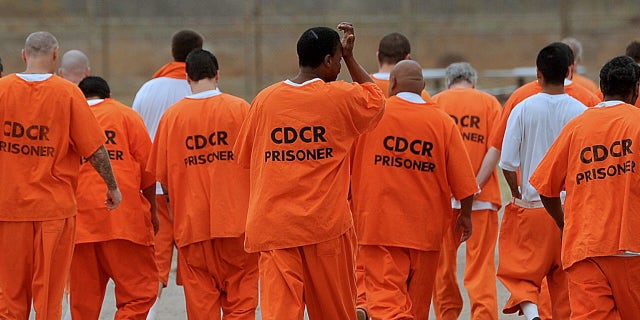
Prisoners in the California Department of Corrections system (Getty Images/File)
In a 2019 tweet, Democratic Rep. Alexandria Ocasio-Cortez suggested on Twitter that the “reality” of the US prison system is “nonviolent” people “arrested with a bag of dimes.”
President Joe Biden has issued thousands of pardons for marijuana-related crimes and insists that “no one should be in federal prison solely for possession of marijuana; no one should be in a local jail or state prison for that reason either.”
Massachusetts Sen. Elizabeth Warren, a Democrat, said in 2018 that “more people [are] locked up for minor marijuana offenses than for all violent crimes in this country.
Smith and Keith Humphreys, an American psychologist and Esther Ting Memorial Professor at Stanford University, told Fox News Digital that those positions are simply not supported by the data.
“It’s been a topic of conversation for a long time, particularly around the legalization of cannabis, to say that our prisons are full of marijuana smokers and non-violent drug-related offenders,” Humphreys told Fox News Digital. “It’s something that’s never been true, certainly for cannabis. You can still spend a night in jail for cannabis, but going to prison is almost impossible now, not that it’s ever been possible.”
Humphreys said that even at the height of the crack cocaine explosion in the 1980s, only one in five state prisoners were incarcerated on some kind of drug-related charge.
‘PUBLIC SAFETY’ BIDEN DOJ PUSHES $57M SHELLS FOR ‘RACIAL EQUITY,’ CRIMINAL ‘JUSTICE SYSTEM REFORMS’
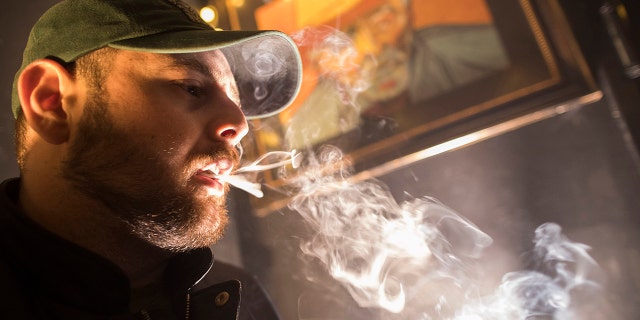
A man smokes marijuana in New York. New Yorkers can possess and use up to 3 ounces of cannabis under a legalization bill. (AP Photo/Mary Altaffer/File)
Humphreys explained that “violent crime is driving” prison populations in the United States, as evidenced by data showing that 62.4% of state prisoners are serving time for violent crimes. The other 40% include people who have previously committed violent crimes or who have pleaded guilty to a violent crime to a misdemeanor, she said.
Smith agreed, saying that people charged with simple possession, especially first-time offenders, “probably went up” on those charges for a more serious charge.
“For example, many times if someone is potentially facing possession with intent to distribute charges, which carry much higher penalties … the prosecutor could plead guilty to simple possession charges in that case,” Smith said. “So more often than not, I would suspect that’s what’s going on.”
Smith also echoed the finding that prison populations are driven by violent crime and not “low-level drug offenders,” not just in recent years but historically.
“Between 1960 and 1990, the violent crime rate in the United States increased by more than 35%,” Smith told Fox News Digital. “It is the largest increase in the history of our country, and that increase in violent crime was the increase in incarceration and the increase in incarceration rates. Not misdemeanor drug offenses or really drug offenses, period.”
Smith said there were 43 million drug arrests in the United States between 1980 and 2012, which “sounds like a lot” until you consider there were 445 million total arrests during that same time period, which he said , shows that “drug arrests accounted for less than 10% of all arrests during that roughly 32-year period” and goes against the reform narrative.
TUCKER CARLSON: NORMAL PEOPLE DON’T WANT CRIMINAL JUSTICE REFORM, THEY WANT CRIMINAL JUSTICE IMPLEMENTATION

Barbed wire and a guard tower are seen at San Quentin State Prison on April 12, 2022, in San Quentin, California. (AP Photo/Eric Risberg)
“Even if you go back to 1997, the heart of the crackdown on crime era, so to speak, only 1% of all inmates were in prison for a first or second time nonviolent drug offense, and only Four percent of state prisoners in 1997 were considered drug lords,” said Smith, who is the author of a forthcoming book called “Rogue Prosecutors” about progressive prosecutors across the country implementing what they call criminal justice reform.
Liberal megadonor George Soros, who has spent billions pushing for criminal justice reform and backing the progressive prosecutors Smith’s book discusses, has often advocated an end to “mass incarceration.” through its Open Society Foundations, which argues that “petty crimes” have “filled America’s jails and prisons to overflowing.”
Fox News Digital has reached out to the Open Society Foundations for comment on the latest BJS statistics; a spokesperson for the group responded only with a disparaging comment about Fox News.
Humphreys also questioned the argument of many activists who say that violence stems from the fact that drugs are illegal and that violent crime would decrease if it were legalized.
“The problem with that reasoning is that the number one drug involved in violence in the United States by a wide margin is alcohol, which is, of course, legal,” Humphreys said. “So it doesn’t follow at all, from this data, that this just proves your point all along. No, it doesn’t actually.”
Hannah E. Meyers, a fellow and director of police and public safety at the Manhattan Institute, responded to the latest BJS statistics by pointing out the connection between drugs and violence that the political left often ignores.
“Those who denounce how the US justice system treats drug offenders are also ignoring the disturbingly close relationship between drug offenses and other, often violent crimes,” Meyers told Fox News Digital. “A previous BJS survey found that 22.4% of drug offenders in state prison they were violent repeat offenders and 26.4% had three to five previous sentences. More than 13% of sentenced drug offenders had between six and ten prior sentences.”
WE CAN SOLVE A BAIL BAIL REFORM BY PUTTING PUBLIC SAFETY FIRST

President Joe Biden (Joe Raedle/Getty Images/File)
Meyers also noted a bjs survey which found that 38.4% of state drug possession offenders were re-arrested within a year of release; by year 5, that percentage grew to a 73% arrest rate.
Of all state drug offenders, 28% of those released in 2012 were re-arrested for a violent crime within five years; released drug offenders were more likely to be re-arrested within five years for a violent crime than those released for homicide or rape.
“Thus, the new BJS data only adds to a long-standing picture: it is not possible to simply separate offenders arrested for drug possession, or even for all drug offences, and safely reduce the population. US Prison Showing Them Leniency”, Meyers. saying. “Not only do they make up a small and declining proportion of a dwindling number of total state inmates, drug crime and violent crime are deeply intertwined among the prison population.”
Proponents of the idea that inmates with drug convictions are filling jails often point to the fact that 46.7% of inmates in federal prisons are serving drug sentences. Humphreys told Fox News Digital that the argument is “dishonest” considering that the federal prison population is much smaller than the state population and that federal drug convictions are not for low-level drug offenses, but for criminal charges. serious traffic or crimes with unusual jurisdictional qualities.
“It’s a very unusual set of things that land people in federal prison,” Humphreys said. “Also, violence is not charged at the federal level, almost never. Murder is charged almost entirely by the states. Even if you average that out with the state data, still, because it’s so small, you end up with the conclusion that there aren’t really that many people in prison for drugs.”
WASHINGTON STATE PRISONS TO IMPLEMENT ‘EQUITY’ AND ‘ANTI-RACISM’ POLICIES TO HELP ‘MARGINALIZED’ INMATES
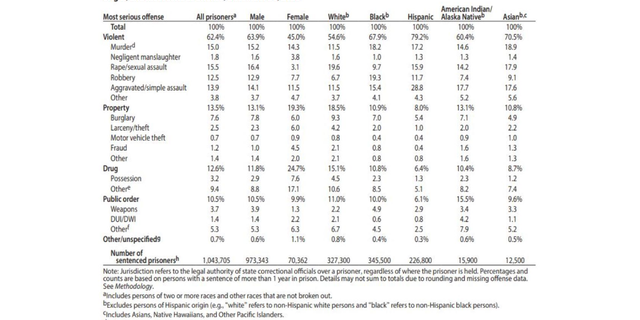
Prisoners in 2021: statistical tables report published in December 2022. (Office of Justice Statistics)
Federal inmates make up about 11% of inmates in the United States, some 142,000, while 89% of inmates, some 1.04 million, are in state prisons, according to BJS data.
Smith told Fox News Digital that more than half of all inmates in state prisons are there for violent crimes like rape and robbery.
“You hear some of these advocates say they want to cut the prison population in half or more; you’re going to have to let [out] people who have committed very serious and heinous crimes,” Smith said.
CLICK HERE TO GET THE FOX NEWS APP
The new BJS numbers are also a sign, according to Humphreys, that the narrative of many progressives that drug convictions are driving the incarceration of blacks is also inaccurate given that data shows that “people in state prison for drug crimes drugs are disproportionately whiter.
“So what that means is if you released every drug prisoner in the United States tomorrow, racial disparities in incarceration would increase, not decrease,” Humphreys said.
Smith told Fox News Digital that “especially with the push for more lenient bail policies” across the country and the push to decriminalize possession, “you would be surprised if a lot of people who really have simple possession issues, especially first time”. delinquents, they spend some time in jail.


