


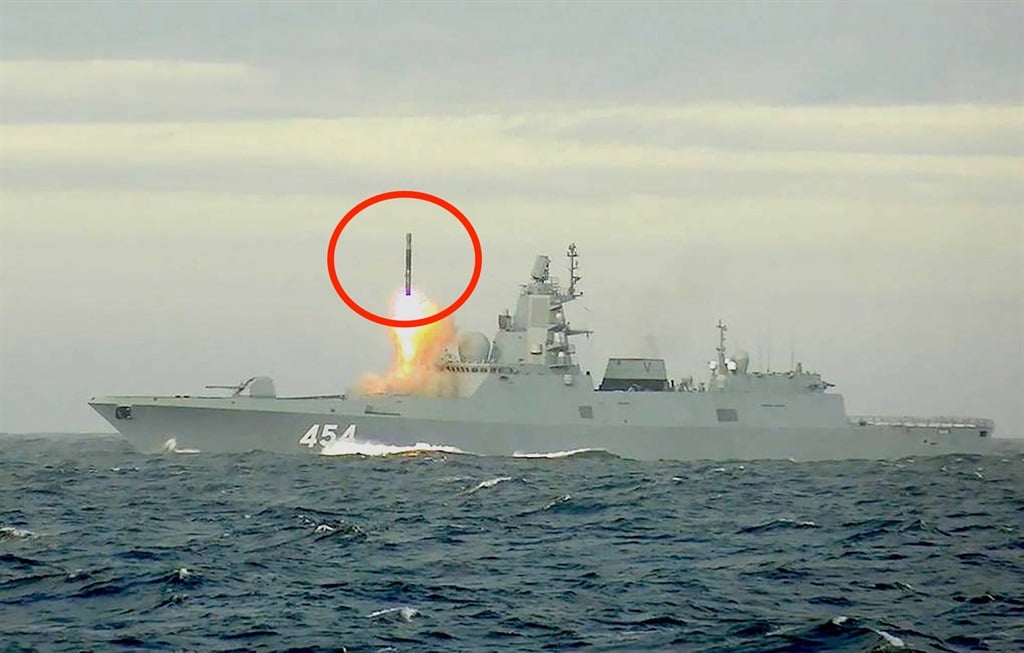
Admiral Gorshkov rests firing a missile. (Russian Defense Ministry)
news analysis
- Russian state media is raising the possibility of Russia testing the launch of a Zircon hypersonic missile during Exercise Mosi II.
- That is the joint exercise with China and Russia that SA is scheduled to host this month, off KwaZulu-Natal.
- Zircon could indeed be unstoppable, and Vladimir Putin has used it as an example of Russian might.
- It has never been closely observed in action by other nations, so China and South Africa will act as guarantors that it works as advertised.
- For more stories, visit www.BusinessInsider.co.za.
For 10 days starting February 17, the navies of China, Russia and South Africa will conduct what is formally known as Exercise Mosi II off the coast of KwaZulu-Natal.
That is, in itself, controversial, “tantamount to a declaration that South Africa will join the war against Ukraine on Russia’s side,” according to the Desmond and Leah Tutu Foundation.
But now it looks like the exercise will become an event of some historical significance, with a very specific role for South Africa in what is preparing to be a propaganda coup for Russia: the discovery of a weapon that drastically changes the balance of power. in maritime transport. battles and atomic wars.
During Mosi II, the Russian frigate Admiral Gorshkov will launch a Zircon missile, the state news agency Tass reported, citing an anonymous military source that it “could not” officially corroborate.
The launch, during a joint operation, would be the first of its kind, said that source.
See also | If SA is taking sides in an economic war, it has chosen R16 billion over R1.131 trillion in trade
The Zircon, sometimes translated as Tsirkon, is a hypersonic missile, a class that China, France, and the United States, among others, are furiously developing. With speeds that Russia claims can reach Mach 9, the weapon could be effectively unstoppable if deployed correctly, making any ship (for example, a very expensive and strategically important aircraft carrier) an easy prey. And if the Ziron’s claimed range is accurate, such a capital ship could be destroyed by an enemy as far as Durban is from Cape Town.
Like all of its major features, it’s unclear how far and fast a Zircon can fly, just as it’s not entirely certain that Russia was the first nation to use a hypersonic missile in anger last year, in its war of Ukraine, because it has never been independently observed in action. Until now, the only evidence of its use has been a low-quality video released by the Russian Defense Ministry.
Now China and South Africa can get a chance to see it up close, in full view of the South African tracking apparatus and data collection machine. After which, if history is any guide, the three countries will issue a joint statement capturing the highlights of the exercise. At that point, SA will become a kind of guarantor that, yes, Russia has really deployed hypersonic missiles and, yes, they really do work as advertised.
Propaganda Device Meets Gun
When Admiral Gorshkov set sail in January, Russian President Vladimir Putin spoke of how the Tsirkon “will reliably protect Russia from possible external threats and help ensure the national interests of our country.”
In 2018, Putin pointedly described hypersonic missiles as “invincible.” He has been highly visible at every step of Zircon’s development, culminating in its operational deployment this year, in what has been described as a source of national pride for several nations, akin to the race to the Moon.
The weapon has been described as “terrifying” in the popular press in NATO countries, and in some ways purports to be exactly that; Putin has expressly described hypersonic missiles as a way to defeat anti-missile systems that had the potential to neutralize Russia’s nuclear deterrent. Give it a nuclear payload and place it on a submarine or ship in international waters, and only a small slice in the middle of America will be safe from nuclear annihilation.
In Europe, there will be nowhere to hide.
The perception of the Zircon’s capabilities could drive foreign and military policy in Western countries, analysts suggested.
And South Africa may be on the verge of becoming a major source of information on those capabilities.


