


The Cooper Gallery exhibit, its first since the pandemic struck in 2020, features 52 works by artists from the 19th century to the present. The curatorial team, which included Bárbaro Martínez-Ruiz, holder of the Tanner-Opperman Chair in honor of Roy Sieber at Indiana University, and Cary A. García Yero, Alexander von Humboldt Foundation Postdoctoral Fellow at Freie Universität and Leibniz Universität, was inspired by the work of Afro-Brazilian artist and curator Emanoel Araújo, who curated the groundbreaking exhibition “A Mão Afro-Brasileira” in 1988.
“As I read more and more about the exhibit, I felt like this is something that should be replicated throughout Latin America,” de la Fuente said. “However, nothing like that has really happened since then, including Cuba, which after Brazil would be the only country in Latin America closest to African cultures.”
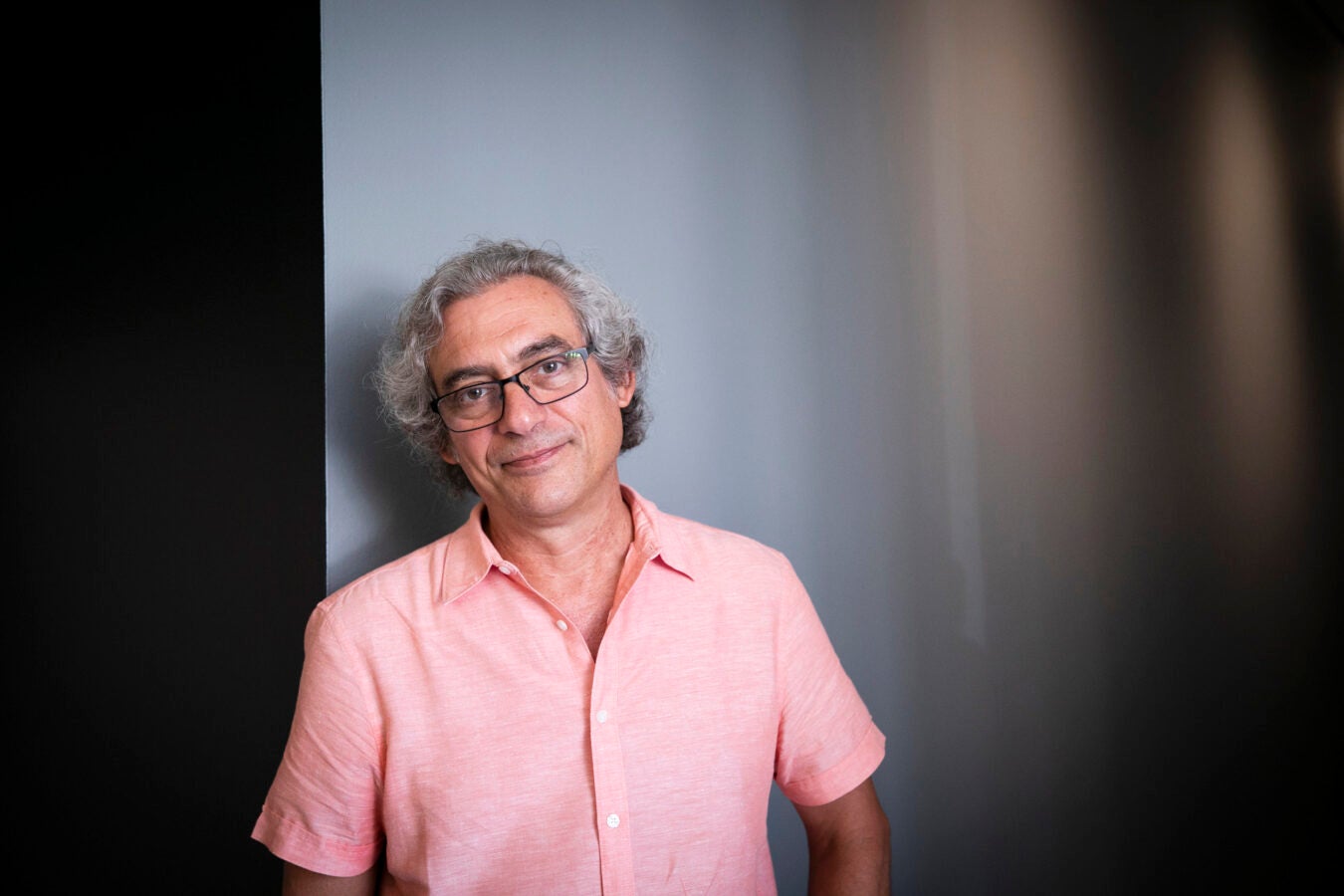
The exhibition’s curator, Alejandro de la Fuente, is director of the Afro-Latin American Research Institute.
Stephanie Mitchell/Harvard Staff Photographer
Latin America has not accepted the influence of people of African descent in the life and culture of the region, he said, but noted that it is beginning to recognize important contributions in fields ranging from art to music and religion.
“It is a continental movement. it’s a wave. We’ve been at the center of that because Harvard created the Afro-Latin American Research Institute in 2013 and that has played a huge role in bringing these groups together and moving the field forward,” he said, noting that the University has developed collaborations with research groups in Argentina, Chile, Uruguay, Brazil, Colombia and Mexico. “This exhibition is part of those efforts.”
“El Pasado Mio / My Own Past” highlights the work of Vicente Escobar y Flores, the first known Afro-descendant artist in Cuba (1762-1834). Escobar y Flores was registered as Afro-Cuban by birth but classified as white after obtaining a royal exemption that allowed him to participate in occupations and enjoy privileges exclusive to whites in Spain.
“This is not the first Cuban artist of African descent by any means,” de la Fuente said. “The fact that he is the first we meet speaks of our ignorance and of how colonial societies manufactured silences [and] exclusions that feed our ignorance.”
Alberto Peña and Teodoro Ramos Blanco were two artists who worked during the 1930s creating racially conscious works that spoke to blackness, he said. In 1936, Peña and Ramos Blanco exhibited their work in Havana at the prestigious Afro-Cuban society Club Atenas. Two of those works appear in “El Pasado Mío / My Own Past”.


