


Cybersecurity Expert: Who Protects American Cyberspace?
Jamil Jaffer, founder and CEO of the George Mason University Law School Institute for Homeland Security, spoke to Fox News Digital about the strengths and weaknesses of America’s cybersecurity apparatus.
US cybersecurity is more fractured than it seems, with state and federal authorities handling their own responsibilities while private companies also have to work on their own infrastructure.
“We know that other nation states, China, Russia, Iran and North Korea, are after us in the cyber domain,” Jamil Jaffer, founder and CEO of the George University Law School Institute for National Security, told Fox News. Mason. Digital.
“Generally, we expect the government to defend itself against those types of attacks. If a Russian bomber crosses the horizon, nobody says, ‘Hey, you know, Walmart or Target, why don’t you have surface-to-air missiles in the field? “. roof of your building, fend off that Russian bear?
“Of course, we don’t expect [in cybersecurity]”He continued. “We expect Walmart, Target, JPMorgan, a small family business in the middle of the country to defend themselves against any cyberattack, whether it’s someone in their basement or the Chinese or Russian nation-state. National state.”
FROM PHISHING SCAMS TO PROPAGANDA: HOW RUSSIA AND THE RUBY NATIONS USE CYBER CAPABILITIES AGAINST THE UNITED STATES
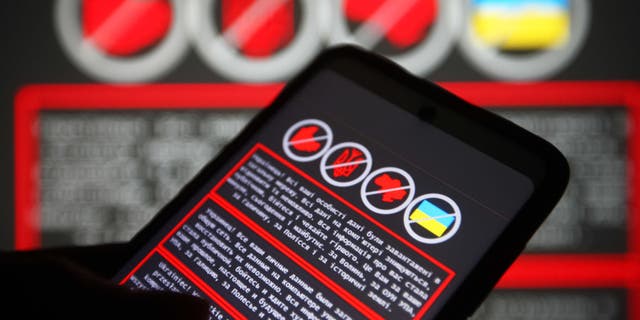
In this photo illustration a warning message in Ukrainian, Russian and Polish is displayed on a smartphone screen and in the background in Ukraine on January 14, 2022.
(Photo Illustration by Pavlo Gonchar/SOPA Images/LightRocket via Getty Images)
That inverse relationship exists partially due in large part to the fact that the private sector owns and operates Internet access in the United States, even though it has become a major factor in the war. In the months leading up to the Russian invasion of Ukraine, military experts told Fox News Digital that cyberattacks would serve as a leading indicator that an invasion was about to take place.
In describing what a Chinese invasion of Taiwan would look like, experts have routinely cited a cyberattack as a leading indicator that Beijing would make its move.
SINGER BILLIE EILISH DOXXED BY CRIME APP: HOW TO AVOID SAME FATE
However, the US has its cybersecurity divided into three parts: the federal government, which operates through the Cybersecurity and Infrastructure Security Agency (CISA) as part of the Department of Homeland Security; governments at the state level; and private companies.
“In general, cybersecurity policy has been quite progressive and has been quite bipartisan,” Jaffer told Fox News Digital. “It varies from member to member of Congress, but at the end of the day…we trust them to get the incentives right.
A hand is seen on a keyboard with a binary code displayed on a laptop screen in this illustrative photo taken in Krakow, Poland on August 17, 2021.
(Jakub Porzycki/NurPhoto via Getty Images)
“We have to give them better incentives and not penalize the industry with excessive regulation or excessive lawsuits and liability,” Jaffer argued. “I think it’s likely to make us less cybersecure.”
In a recent study, Proxyrack, a proxy provider website, surveyed each state to determine which states were most at risk of cyberattacks, based on the number of cybercrime victims per 100,000 people. Nevada, Iowa, Alaska, Delaware, Florida, Maryland, Colorado, Washington, Arizona and California rank in the top 10 most vulnerable, according to the survey, showing little consistency across region, political leaning or other factors outside of mere investment in cyber security.
ARE YOUR OWN DEVICES INADVERTENTLY SPYING ON YOU?
Phishing (email scams), vishing (phone scams), smishing (text scams) and pharming, which aims to direct Internet traffic to fraudulent websites, ranked as the most common crimes, responsible for just under 324,000 victims in 2021. Another 82,500 people were victims of non-payment scams, and approximately 52,000 others experienced personal data breaches.
According to reports, California alone lost $1.23 billion to cybercrime and scams, and Texas, New York, and Florida each lost more than half a trillion dollars to these same crimes in the same year.
A Homeland Security vehicle at the end of the day in Lower Manhattan on October 5, 2016.
(iStock)
“Although there is a federal Department of Energy and a Federal Energy Regulatory Commission, we generally think of power, water and the like as the responsibility of the state,” Jaffer said. “I think you’ll see states doing a lot more in that space and working with their people and also in emergency response. If something goes wrong, just like you would in a hurricane or another earthquake or another natural disaster.
“The states go in first, the federal government goes in later. And the states are likely to play a role in the cyber domain,” he said.
THE BEST PASSWORD MANAGER REVIEWED BY EXPERTS OF 2023
Jaffer stressed that private and state operators operate with only part of the picture, as the federal government tightly controls threat information from foreign actors such as Russia, China, Iran and North Korea. Nations like Iran and North Korea have significantly improved their own cyber literacy over the past decade.
North Korea, in particular, has improved its capabilities and has focused on scams and other cyber operations that would allow it to obtain as much wealth as possible to circumvent sanctions.
The federal government has embraced its role as facilitator and supporter rather than leader in these spaces. CISA regularly reviews the requirements and weaknesses of various industries and states to help them strengthen and improve their infrastructures.
“The primary role of the federal government, including through CISA, within the Department of Homeland Security, within that homeland security function, is to provide state and local governments and private businesses with services, guidance, and information to help them protect their networks, help them understand threats, help them prioritize risks,” Eric Goldstein, CISA’s deputy executive director of cybersecurity, told Fox News Digital.
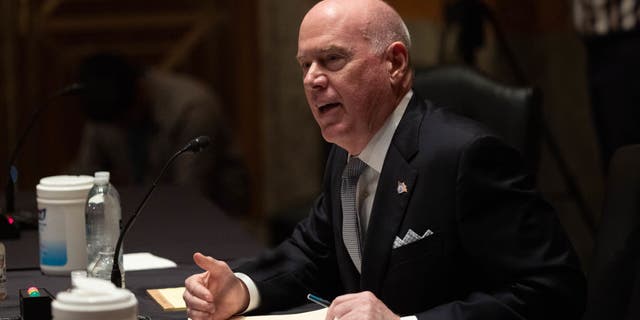
Joseph A. Blount Jr., President and CEO of Colonial Pipeline, testifies during a Senate Homeland Security and Government Affairs Committee hearing on the Colonial Pipeline cyberattack on Capitol Hill, June 8, 2021, in Washington, DC
(Graeme Jennings/Pool/Getty Images)
“We provide newsletters, we share information, so our role is really to support the operators of these critical systems, whether they are state government or the private sector,” he added.
Goldstein acknowledged that this burden of responsibility on state governments can lead to “wide diversity in local governments, particularly depending on their level of resources or their cybersecurity maturity.” But there are resources that can enable state and local governments to achieve a “common baseline, including CISA’s recently released cybersecurity performance targets.”
CISA aims to “help fill those gaps and raise the bar so that we achieve a higher baseline and more uniformity of practice across the country,” he said.
CLICK HERE TO GET THE FOX NEWS APP
Whether the various pieces working in the US cybersecurity apparatus can achieve that efficiency and literacy remains to be seen, but CISA is trying to help “all sectors continuously work together around cyberthreats.”
“I think there is widespread recognition at this point that all networks are at risk and no organization can defend their networks on their own. So we have to collaborate across all levels of government and with the private sector if we’re going to succeed”. Goldstein said.


